







Question: standard deviations. (ii) First we find the m that goes with 80%: .80 = 1 - m = 2.236. m- Thus, Chebyshev tells us that
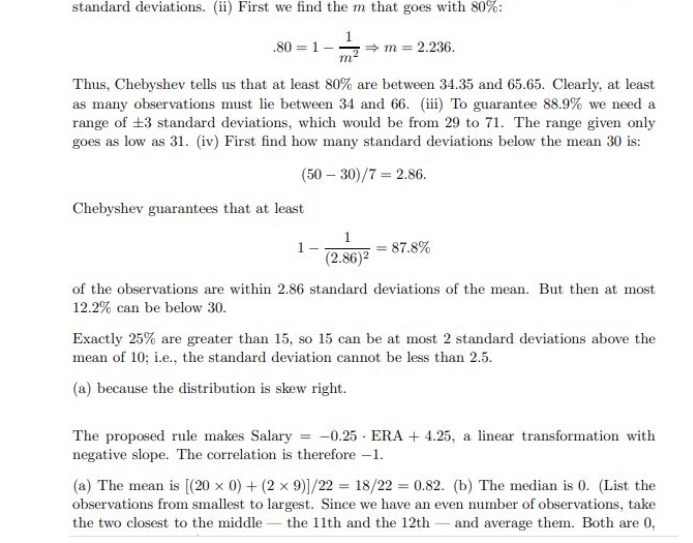
standard deviations. (ii) First we find the m that goes with 80%: .80 = 1 - m = 2.236. m- Thus, Chebyshev tells us that at least 80% are between 34.35 and 65.65. Clearly, at least as many observations must lie between 34 and 66. (iii) To guarantee 88.9% we need a range of 13 standard deviations, which would be from 29 to 71. The range given only goes as low as 31. (iv) First find how many standard deviations below the mean 30 is: (50 - 30)/7 = 2.86. Chebyshev guarantees that at least 1 - = 87.8% (2.86)2 of the observations are within 2.86 standard deviations of the mean. But then at most 12.2% can be below 30. Exactly 25% are greater than 15, so 15 can be at most 2 standard deviations above the mean of 10; i.e., the standard deviation cannot be less than 2.5. (a) because the distribution is skew right. The proposed rule makes Salary = -0.25 . ERA + 4.25, a linear transformation with negative slope. The correlation is therefore -1. (a) The mean is [(20 x 0) + (2 x 9)]/22 = 18/22 = 0.82. (b) The median is 0. (List the observations from smallest to largest. Since we have an even number of observations, take the two closest to the middle - the 11th and the 12th - and average them. Both are 0
Step by Step Solution
There are 3 Steps involved in it

Get step-by-step solutions from verified subject matter experts
 Study Help