



Question: STANDARD-STATES: TRUE OR FALSE? (1 +1 +1 +1 + 2 + 2 + 2 = 10 pts) 1. Consider the expression seen in class for
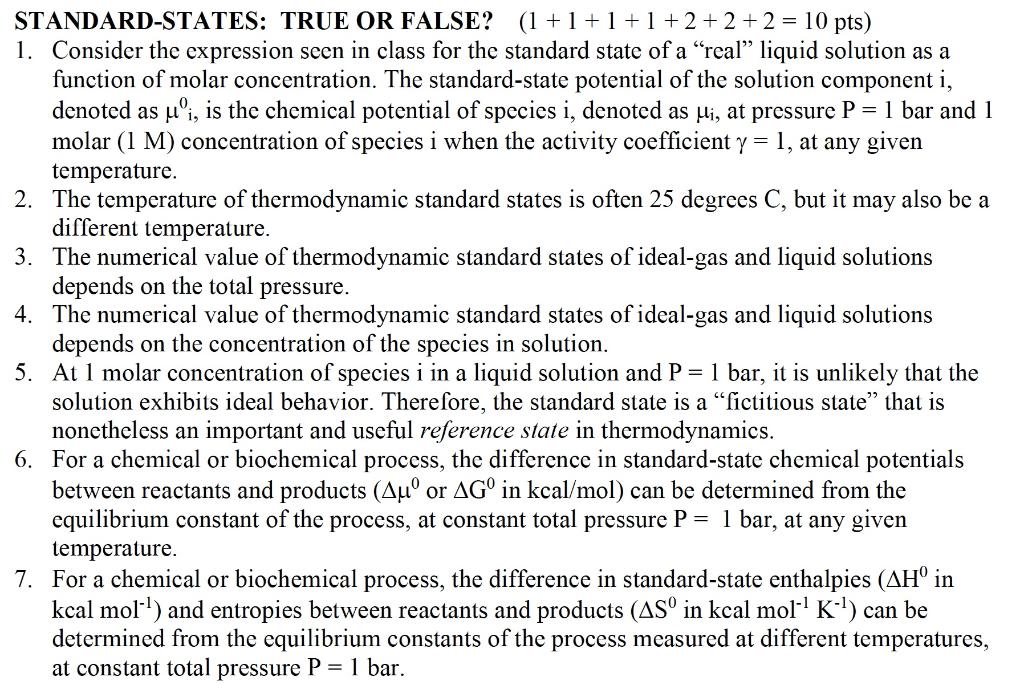
STANDARD-STATES: TRUE OR FALSE? (1 +1 +1 +1 + 2 + 2 + 2 = 10 pts) 1. Consider the expression seen in class for the standard state of a real liquid solution as a function of molar concentration. The standard-state potential of the solution component i, denoted as pi, is the chemical potential of species i, denoted as Hi, at pressure P = 1 bar and 1 molar (1 M) concentration of species i when the activity coefficient y = 1, at any given temperature. 2. The temperature of thermodynamic standard states is often 25 degrees C, but it may also be a different temperature. 3. The numerical value of thermodynamic standard states of ideal-gas and liquid solutions depends on the total pressure. 4. The numerical value of thermodynamic standard states of ideal-gas and liquid solutions depends on the concentration of the species in solution. 5. At 1 molar concentration of species i in a liquid solution and P = 1 bar, it is unlikely that the solution exhibits ideal behavior. Therefore, the standard state is a fictitious state that is nonetheless an important and useful reference state in thermodynamics. 6. For a chemical or biochemical process, the difference in standard-state chemical potentials between reactants and products (Au or AG in kcal/mol) can be determined from the equilibrium constant of the process, at constant total pressure P= 1 bar, at any given temperature. 7. For a chemical or biochemical process, the difference in standard-state enthalpies (AH in kcal moll) and entropies between reactants and products (AS in kcal mol' K!) can be determined from the equilibrium constants of the process measured at different temperatures, at constant total pressure P = 1 bar
Step by Step Solution
There are 3 Steps involved in it

Get step-by-step solutions from verified subject matter experts