



Question: start time: Model I. (20min) Composition of Functions. (1, 2, 3, 4, 5), B-(a, b, c, d, e), and C- (1, 2, 3, 4,5, 6,7.
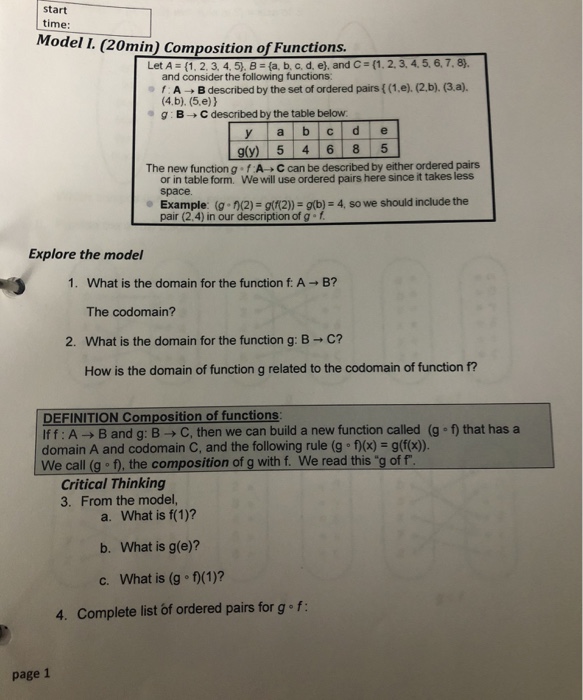
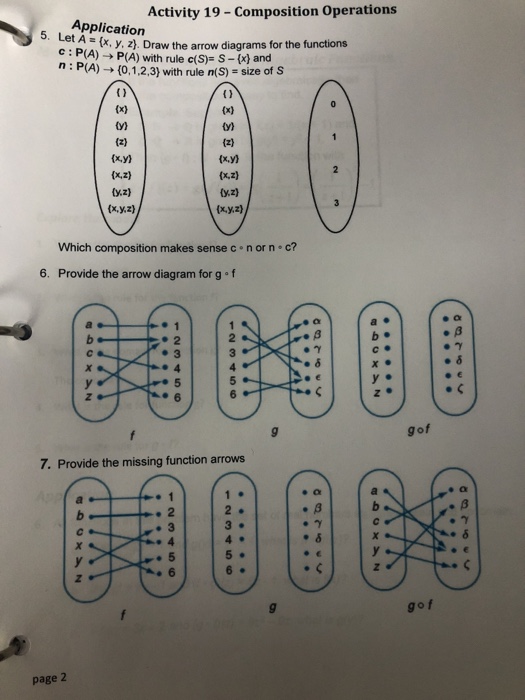
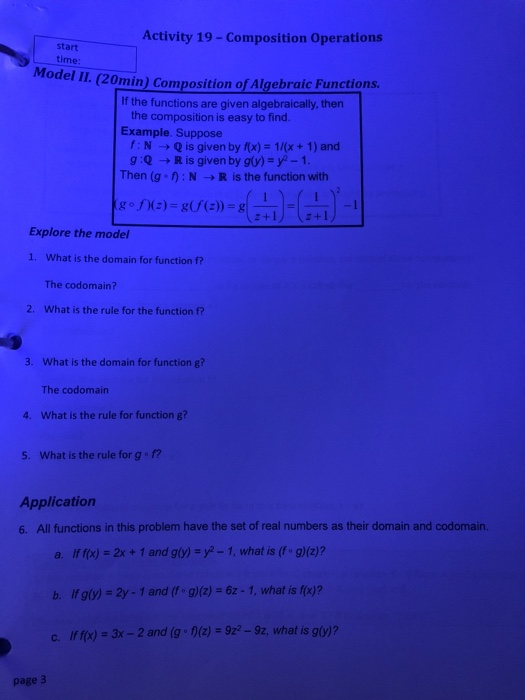
start time: Model I. (20min) Composition of Functions. (1, 2, 3, 4, 5), B-(a, b, c, d, e), and C- (1, 2, 3, 4,5, 6,7. 8. and consider the following functions: f A-+ B described by the set of ordered pairs { (1,e)R,b). (3a). (4.b). (5.e)h Let A gB- C described by the table below g 5 4 6 8 5 The new function g-A-, C can be described by either ordered pairs or in table form. space We will use ordered pairs here since it takes less Example (g.n(2)= g( 2-g(b)24, so we should include the pair (2.4) in our description of gf Explore the model 1. B? What is the domain for the function f: A The codomain? What is the domain for the function g: B ? C? How is the domain of function g related to the codomain of function f? 2. DEFINITION Composition of functions Iff: A B and g: B C, then we can build a new function called (g f that has a domain A and codomain C, and the following rule (g f)(x) - g(f(x)) We call (g f, the composition of g with f. We read this 'g of f Critical Thinking 3. From the model, a. What is f(1)? b. What is g(e)? c. What is (g (1)? 4. Complete list of ordered pairs for g f: page 1
Step by Step Solution
There are 3 Steps involved in it

Get step-by-step solutions from verified subject matter experts