







Question: Start with the man's initial position x_(i)=-3.0m . Based on the simulation data, in the table below, please list the distances traveled for each of
Start with the man's initial position
x_(i)=-3.0m. Based on the simulation data, in the table below, please list the distances traveled for each of the paths followed by the man:\ \\\\table[[Path followed by the man,\\\\table[[Distance],[traveled
(m) 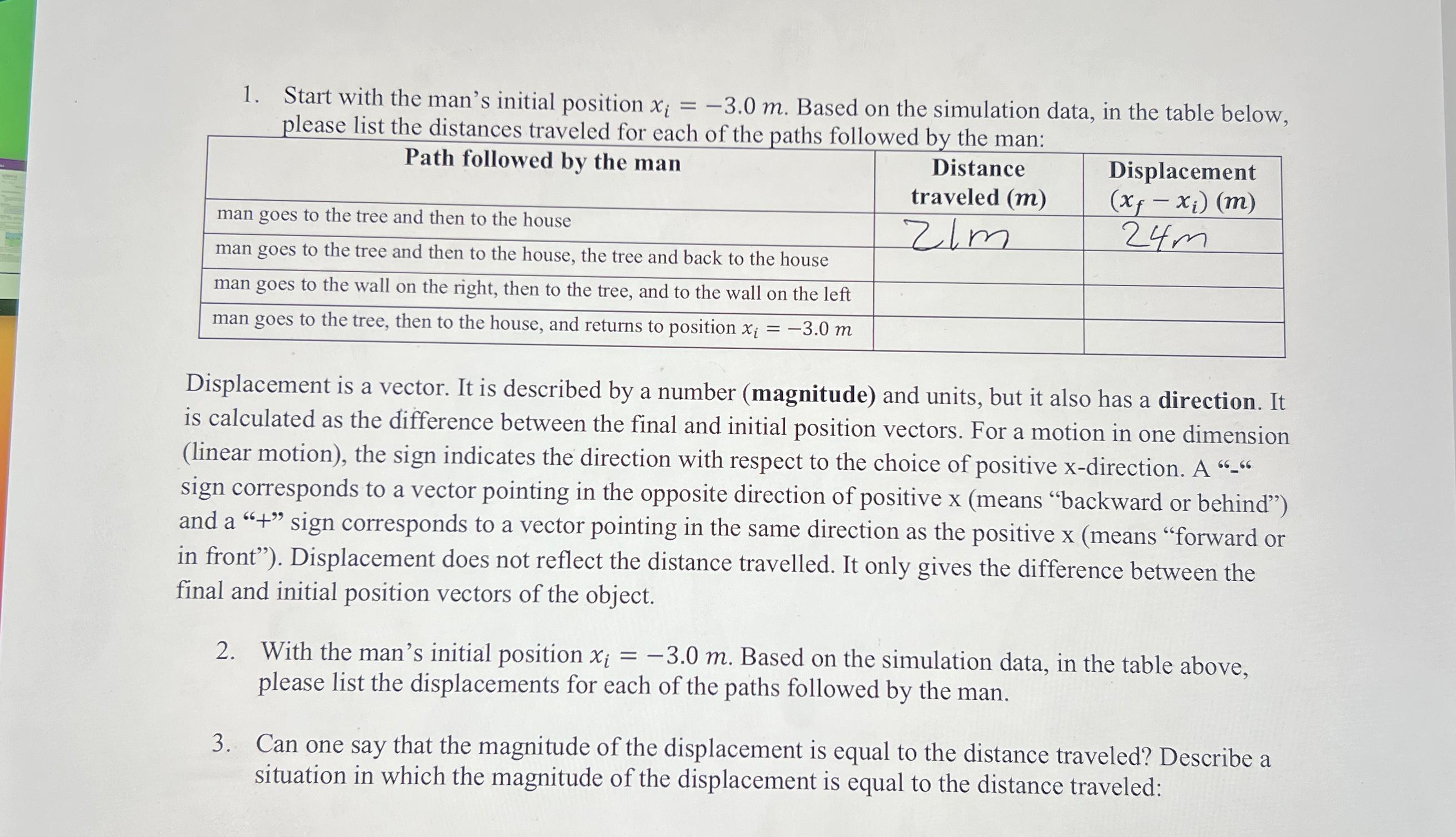
1. Start with the man's initial position xi=3.0m. Based on the simulation data, in the table below, please list the distances traveled for each of the paths followed bv the man. Displacement is a vector. It is described by a number (magnitude) and units, but it also has a direction. It is calculated as the difference between the final and initial position vectors. For a motion in one dimension (linear motion), the sign indicates the direction with respect to the choice of positive x-direction. A "" sign corresponds to a vector pointing in the opposite direction of positive x (means "backward or behind") and a "+" sign corresponds to a vector pointing in the same direction as the positive x (means "forward or in front"). Displacement does not reflect the distance travelled. It only gives the difference between the final and initial position vectors of the object. 2. With the man's initial position xi=3.0m. Based on the simulation data, in the table above, please list the displacements for each of the paths followed by the man. 3. Can one say that the magnitude of the displacement is equal to the distance traveled? Describe a situation in which the magnitude of the displacement is equal to the distance traveled
Step by Step Solution
There are 3 Steps involved in it

Get step-by-step solutions from verified subject matter experts
 Study Help