Question: STARTER CODE #pragma rtGlobals=3 // Use modern global access method and strict wave access. Function Schrodinger_wells(U0, mass, width, spacer, Nrepeats, dx,plotfigs,scalefactor, name) // solves 1D
STARTER CODE
#pragma rtGlobals=3 // Use modern global access method and strict wave access.
Function Schrodinger_wells(U0, mass, width, spacer, Nrepeats, dx,plotfigs,scalefactor, name) // solves 1D schrodinger equation for quantum wells Variable U0 // height of well in eV Variable width, spacer // well width and spacer (barrier) width in Angstrom Variable mass // effective mass in units of electron mass m0 Variable Nrepeats // number of repeats Variable dx // mesh step in Angstrom Variable plotfigs // 1 to plot figures, 0 no figures Variable scalefactor // for plotting psi_sq string name
// make potential Variable cellpoints = round((spacer+width)/dx) make /o = (cellpoints*Nrepeats+round(spacer/dx),1) potential setscale /P x, 0, dx, potential
Variable i for (i=0; i //width=10; offset=0.5; testfun=erf(x*width+offset*width)/2+1/2
// assemble H Variable m0 = 9.10938e-31/(1e20*1.6e-19); // eV s^2 / Angstrom^2 Variable hbar = 6.582e-16; // eV*s Variable t0 = hbar^2/(2*mass*m0*dx^2)
make /o =(dimsize(potential,0),dimsize(potential,0)) H Variable j for (i=0; i // diagonalize H // Wave /z m_eigenvectors, w_eigenvalues Make /o =(dimsize(potential,0),1) w_eigenvalues Make /o =(dimsize(potential,0),dimsize(potential,0)) m_eigenvectors MatrixEigenV /sym /evec H setscale /P x, 0, dx, m_eigenvectors
make /o =(dimsize(m_eigenvectors,0),dimsize(m_eigenvectors,0)) psi_sq setscale /P x, 0, dx, psi_sq for (i=0; i // plot the bound states if (plotfigs==1) display potential ModifyGraph offset(potential)={0,-U0} ModifyGraph rgb(potential)=(0,0,0) ModifyGraph mirror=2 Label left "potential" SetAxis left -U0*1.1, U0*0.1 Label bottom "x"
for (i=0; i //print "energies of bound states [eV]:" //print i, energies[i]-U0 else AppendToGraph psi_sq[][i] ModifyGraph muloffset($("psi_sq#"+num2str(i)))={0,scalefactor/WaveMax(psi_sq)} ModifyGraph offset($("psi_sq#"+num2str(i)))={0,energies[i]-U0} //print i, energies[i]-U0 endif endif endfor endif
Killwaves M_eigenVectors, W_eigenvalues, H rename potential $("potential_" + name) rename psi_sq $("psi_sq_" + name) rename energies $("energies_" + name)
End
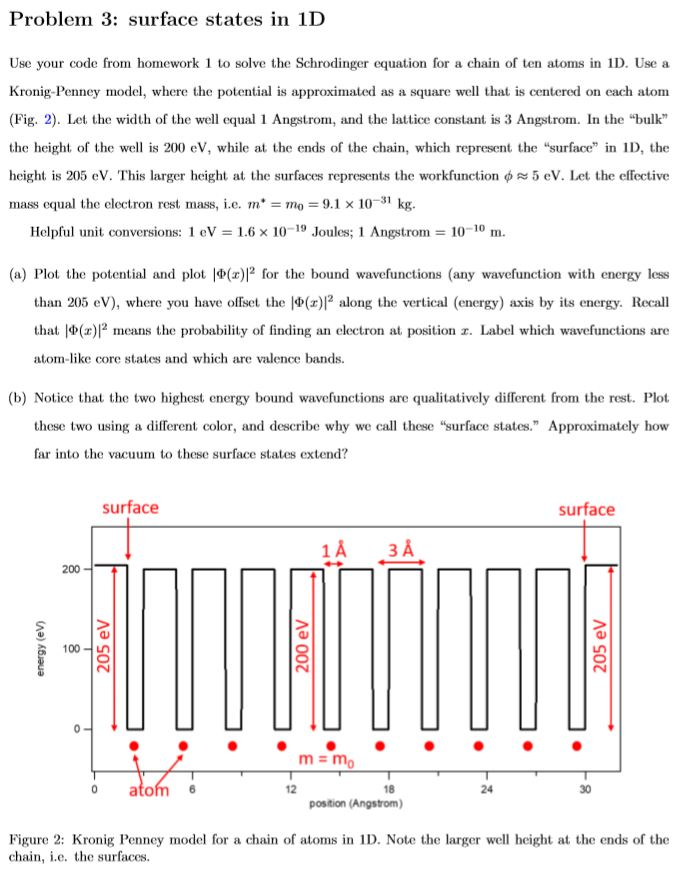
Problem 3: surface states in 1D dinger equation for a chain of ten atoms in D. Use a Use your code from homework 1 to solve the Schro Kronig-Penney model, where the potential is approximated as a square el that is centered on each atom (Fig. 2). Let the width of the wel equal 1 Angstrom, and the lattice constant is 3 Angstrom. In the "bulk the height of the we is 200 eV, while at the ends of the chain, which represent the "surface" in 1D, the height is 205 eV. This larger height at the surfaces represents the workfunction ~ 5 eV. Let the effective mass equal the electron rest mlass, i.e. m.-mo = 9.1 10-31 kg Helpful unit conversions: 1 eV = 1.6 10-19 Joules; 1 Angstrom = 10-10 m. (a) Plot the potential and plot (z) 2 for the bound wavefunctions (any wavefunction with energy less than 205 eV), where you have offset the $(2) 2 along the vertical (energy) axis by its energy. Recall that (z 2 means the probability of finding an electron at position z. Label which wavefunctions are atom-like core states and which are valence bands. (b) Notice that the two highest energy bound wavefunctions are qualitatively different from the rest. Plot Approximately how these two using a different color, and describe why we call these "surface states. far into the vacuum to these surface states extend? surface surface 200 100 o ato 12 18 30 position (Angstrom) Figure 2: Kronig Penney model for a chain of atoms in 1D. Note the larger well height at the ends of the chain, .e. the surfaces. Problem 3: surface states in 1D dinger equation for a chain of ten atoms in D. Use a Use your code from homework 1 to solve the Schro Kronig-Penney model, where the potential is approximated as a square el that is centered on each atom (Fig. 2). Let the width of the wel equal 1 Angstrom, and the lattice constant is 3 Angstrom. In the "bulk the height of the we is 200 eV, while at the ends of the chain, which represent the "surface" in 1D, the height is 205 eV. This larger height at the surfaces represents the workfunction ~ 5 eV. Let the effective mass equal the electron rest mlass, i.e. m.-mo = 9.1 10-31 kg Helpful unit conversions: 1 eV = 1.6 10-19 Joules; 1 Angstrom = 10-10 m. (a) Plot the potential and plot (z) 2 for the bound wavefunctions (any wavefunction with energy less than 205 eV), where you have offset the $(2) 2 along the vertical (energy) axis by its energy. Recall that (z 2 means the probability of finding an electron at position z. Label which wavefunctions are atom-like core states and which are valence bands. (b) Notice that the two highest energy bound wavefunctions are qualitatively different from the rest. Plot Approximately how these two using a different color, and describe why we call these "surface states. far into the vacuum to these surface states extend? surface surface 200 100 o ato 12 18 30 position (Angstrom) Figure 2: Kronig Penney model for a chain of atoms in 1D. Note the larger well height at the ends of the chain, .e. the surfaces









 Study Help