







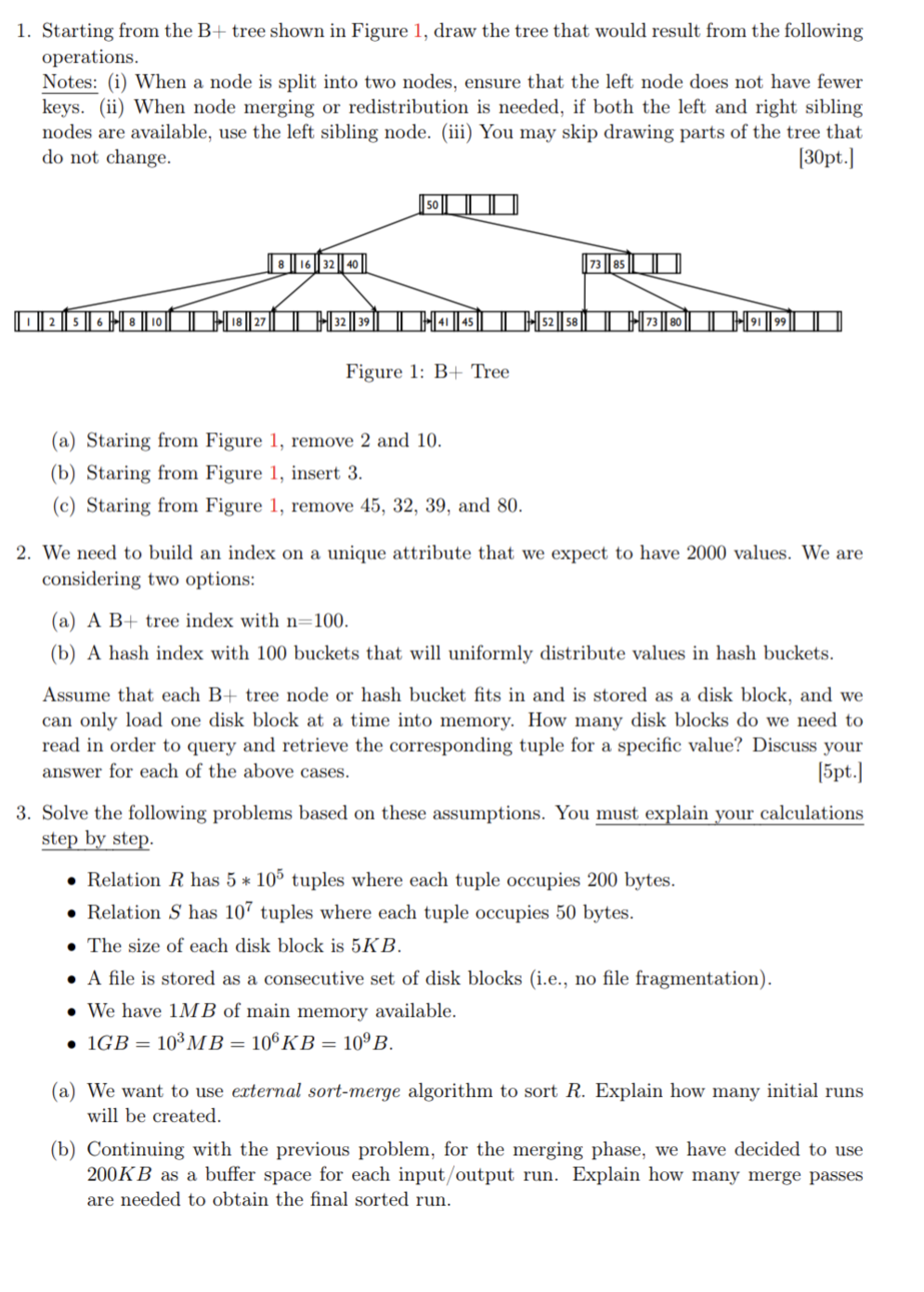
Question: Starting from the B + tree shown in Figure 1 , draw the tree that would result from the following operations. Notes: ( i )
Starting from the B tree shown in Figure draw the tree that would result from the following operations.
Notes: i When a node is split into two nodes, ensure that the left node does not have fewer keys. ii When node merging or redistribution is needed, if both the left and right sibling nodes are available, use the left sibling node. iii You may skip drawing parts of the tree that do not change.
pt
a Staring from Figure remove and
b Staring from Figure insert
c Staring from Figure remove and
We need to build an index on a unique attribute that we expect to have values. We are considering two options:
a A tree index with
b A hash index with buckets that will uniformly distribute values in hash buckets.
Assume that each B tree node or hash bucket fits in and is stored as a disk block, and we can only load one disk block at a time into memory. How many disk blocks do we need to read in order to query and retrieve the corresponding tuple for a specific value? Discuss your answer for each of the above cases.
pt
Solve the following problems based on these assumptions. You must explain your calculations step by step.
Relation has tuples where each tuple occupies bytes.
Relation has tuples where each tuple occupies bytes.
The size of each disk block is
A file is stored as a consecutive set of disk blocks ie no file fragmentation
We have of main memory available.
a We want to use external sortmerge algorithm to sort Explain how many initial runs will be created.
b Continuing with the previous problem, for the merging phase, we have decided to use as a buffer space for each inputoutput run. Explain how many merge passes are needed to obtain the final sorted run.
Step by Step Solution
There are 3 Steps involved in it
1 Expert Approved Answer
Step: 1 Unlock

Question Has Been Solved by an Expert!
Get step-by-step solutions from verified subject matter experts
Step: 2 Unlock
Step: 3 Unlock
 Study Help