







Question: Starting from the momentum equation d e l u i d e l t + d e l d e l x j ( u
Starting from the momentum equation
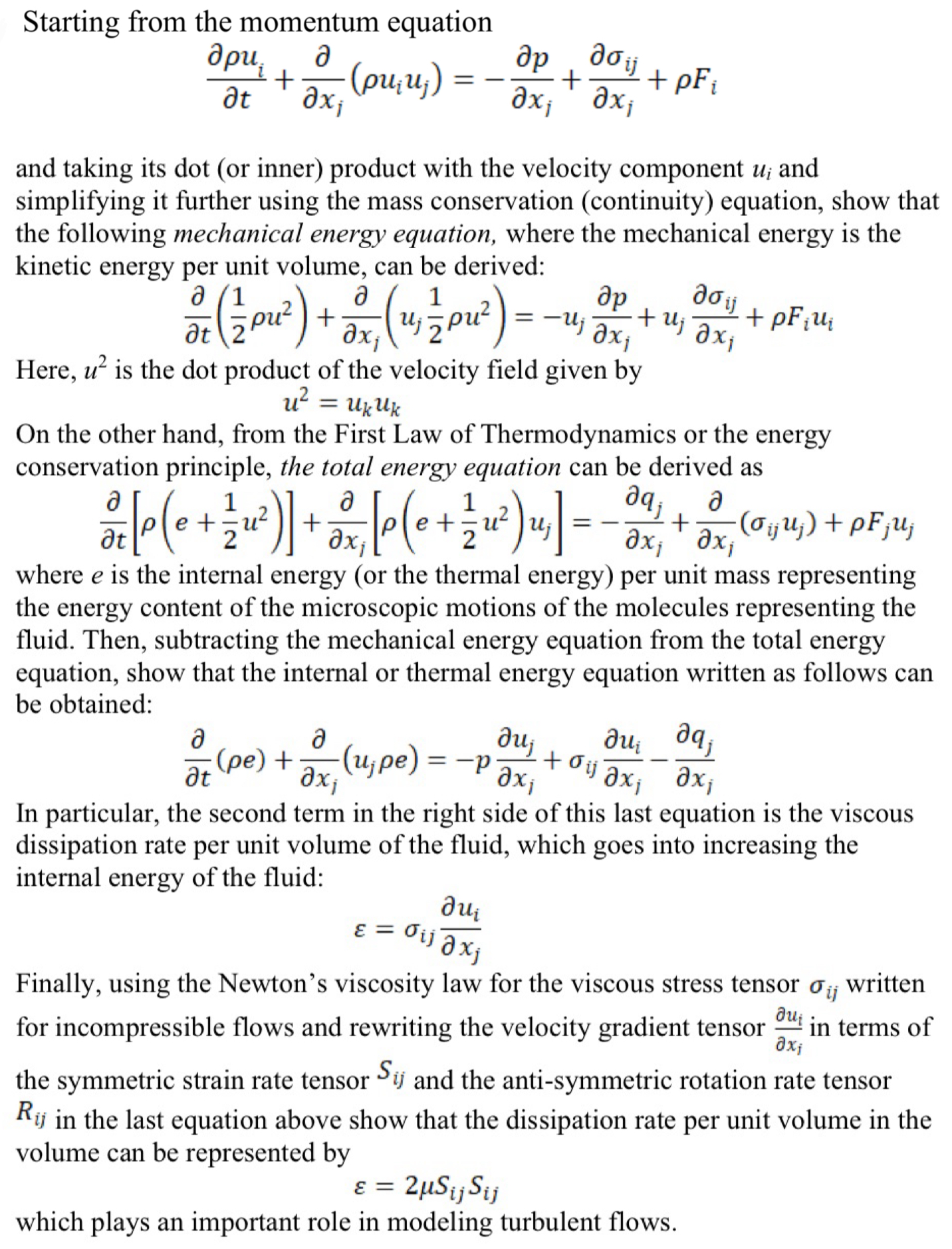
and taking its dot or inner product with the velocity component and simplifying it further using the mass conservation continuity equation, show that the following mechanical energy equation, where the mechanical energy is the kinetic energy per unit volume, can be derived:
Here, is the dot product of the velocity field given by
On the other hand, from the First Law of Thermodynamics or the energy conservation principle, the total energy equation can be derived as
where is the internal energy or the thermal energy per unit mass representing the energy content of the microscopic motions of the molecules representing the fluid. Then, subtracting the mechanical energy equation from the total energy equation, show that the internal or thermal energy equation written as follows can be obtained:
In particular, the second term in the right side of this last equation is the viscous dissipation rate per unit volume of the fluid, which goes into increasing the internal energy of the fluid:
Finally, using the Newton's viscosity law for the viscous stress tensor written for incompressible flows and rewriting the velocity gradient tensor in terms of the symmetric strain rate tensor and the antisymmetric rotation rate tensor in the last equation above show that the dissipation rate per unit volume in the volume can be represented by
which plays an important role in modeling turbulent flows.
Step by Step Solution
There are 3 Steps involved in it
1 Expert Approved Answer
Step: 1 Unlock

Question Has Been Solved by an Expert!
Get step-by-step solutions from verified subject matter experts
Step: 2 Unlock
Step: 3 Unlock
 Study Help