



Question: stat question: a1b1c1 Exercise 11.2: Bayes Recap (6 points) Assume Alice has three coins, two unbiased (fair) coins and one biased (unfair) coin. You know
stat question: a1b1c1
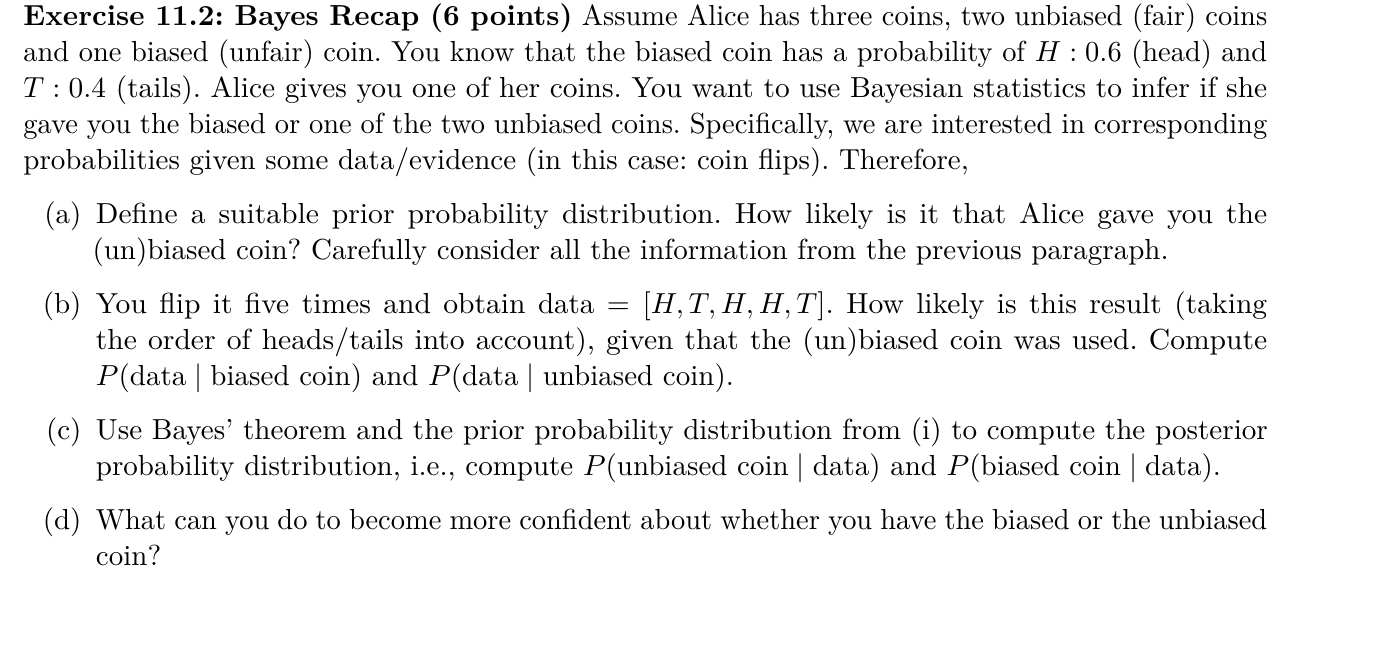
Exercise 11.2: Bayes Recap (6 points) Assume Alice has three coins, two unbiased (fair) coins and one biased (unfair) coin. You know that the biased coin has a probability of H : 0.6 (head) and T : 0.4 (tails). Alice gives you one of her coins. You want to use Bayesian statistics to infer if she gave you the biased or one of the two unbiased coins. Specifically, we are interested in corresponding probabilities given some data/evidence (in this case: coin flips). Therefore, (a) Define a suitable prior probability distribution. How likely is it that Alice gave you the (un) biased coin? Carefully consider all the information from the previous paragraph. (b) You flip it five times and obtain data = [H, T, H, H, T]. How likely is this result (taking the order of heads/ tails into account), given that the (un) biased coin was used. Compute P(data | biased coin) and P(data | unbiased coin). (c) Use Bayes' theorem and the prior probability distribution from (i) to compute the posterior probability distribution, i.e., compute P(unbiased coin | data) and P(biased coin | data). (d) What can you do to become more confident about whether you have the biased or the unbiased coin
Step by Step Solution
There are 3 Steps involved in it

Get step-by-step solutions from verified subject matter experts