







Question: STATCRUNCH SKILL: CONFIDENCE INTERVALS FOR PROPORTIONS WITH DATA This question uses the following data set StatCrunchSurveyData [StatCrunch 2?] [Google @] Conducting hypothesis tests is the
![the following data set StatCrunchSurveyData [StatCrunch 2?] [Google @] Conducting hypothesis tests](https://dsd5zvtm8ll6.cloudfront.net/si.experts.images/questions/2024/09/66ef52988e9ad_28066ef5298766b8.jpg)
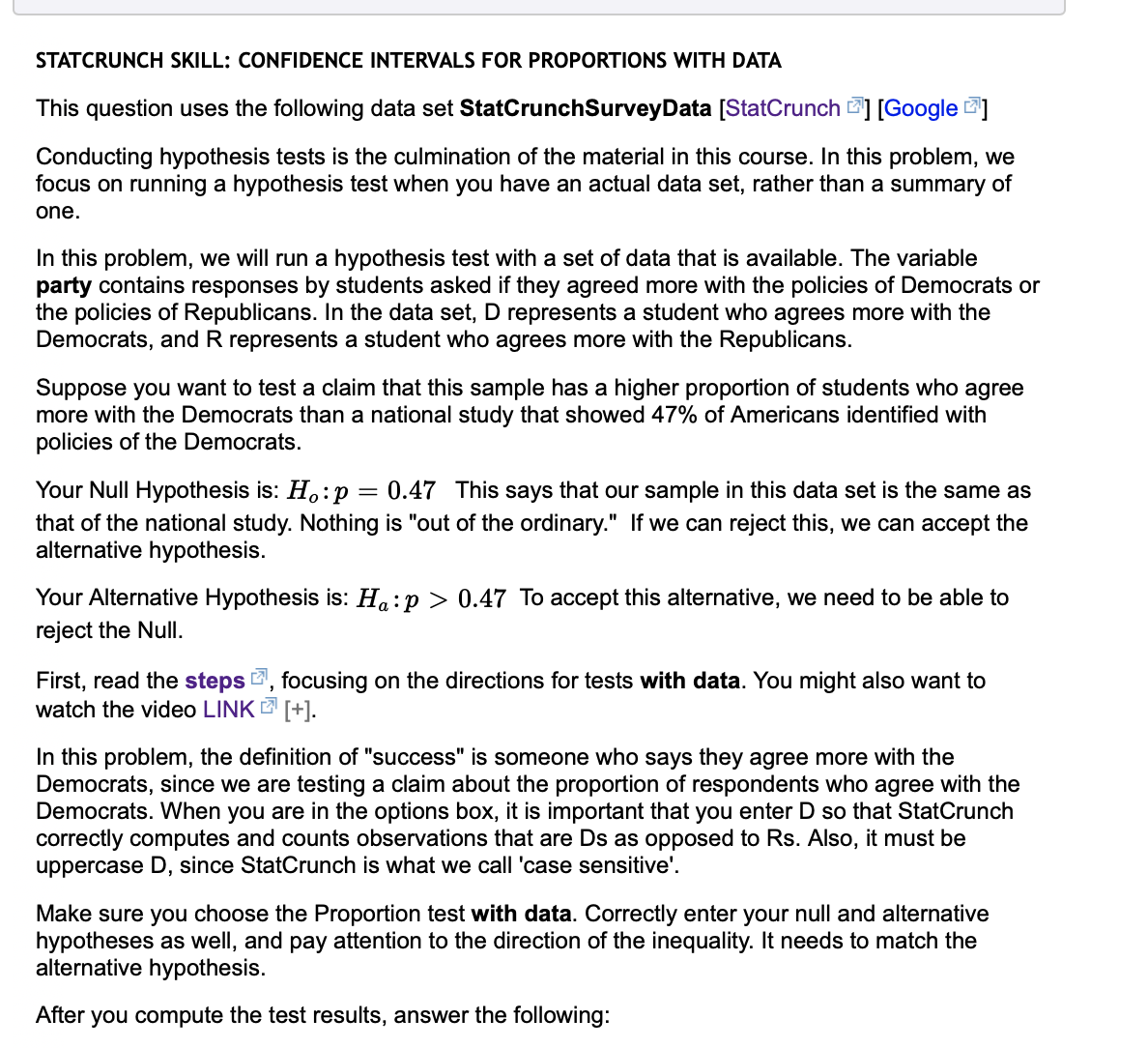
STATCRUNCH SKILL: CONFIDENCE INTERVALS FOR PROPORTIONS WITH DATA This question uses the following data set StatCrunchSurveyData [StatCrunch 2?] [Google @] Conducting hypothesis tests is the culmination of the material in this course. In this problem, we focus on running a hypothesis test when you have an actual data set, rather than a summary of one. In this problem, we will run a hypothesis test with a set of data that is available. The variable party contains responses by students asked if they agreed more with the policies of Democrats or the policies of Republicans. In the data set, D represents a student who agrees more with the Democrats, and R represents a student who agrees more with the Republicans. Suppose you want to test a claim that this sample has a higher proportion of students who agree more with the Democrats than a national study that showed 47% of Americans identied with policies of the Democrats. Your Null Hypothesis is: H0 : p = 0.47 This says that our sample in this data set is the same as that of the national study. Nothing is "out of the ordinary." If we can reject this, we can accept the alternative hypothesis. Your Alternative Hypothesis is: Ha : p > 0.47 To accept this alternative. we need to be able to reject the Null. First, read the steps E7, focusing on the directions for tests with data. You might also want to watch the video LINK E' [+]. In this problem, the denition of "success" is someone who says they agree more with the Democrats, since we are testing a claim about the proportion of respondents who agree with the Democrats. When you are in the options box, it is important that you enter D so that StatCrunch correctly computes and counts observations that are Ds as opposed to Rs. Also, it must be uppercase D, since StatCrunch is what we call 'case sensitive'. Make sure you choose the Proportion test with data. Correctly enter your null and alternative hypotheses as well, and pay attention to the direction of the inequality. It needs to match the alternative hypothesis. After you compute the test results. answer the following: After you compute the test results, answer the following: A) What is the sample proportion? This is labeled as "Sample Prop." in the output. Answer: Sample proportion = C]. (Round to FOUR decimal places) You'll see that 30 of the students identied more with Democrats. The corresponding proportion is above the 47% level that's in our hypotheses. BUT, is this simply due to random variability? Let's see how many standard deviations this sample is away from the mean... B) What is the test statistic? This is labeled as Z-Stat. Remember, this test is based on the assumption that the distribution is normal. We can make this assumption because 11 . p0 = 47 - (0.6383) > 10 and n(1 p0) = 47(0,3617) > 10. Recall that the test statistic tells us how many standard deviations from the mean this particular sample is. Answer: Test-statistic, z = C]. (Round to FOUR decimal places) To determine how likely this result is. we look at the probability of getting a sample such as this one... C) What is the P-value for this test? This is the probability of getting a sample like the one you for which you have a summary. Answer: P-value = [:l (Round to FOUR decimal places) From your results above. you see that the probability of getting a sample like the one you have is about around 1%. That's pretty low. If we took many samples of this size, only about 1 in 100 would have this sample proportion. If we set our 0: level at 0.05. then we are well below that. This means we can REJECT the null hypothesis, which says our sample is the same as the one in the national study. Because we can reject it. we are then able to ACCEPT the alternative hypothesis (Ha : p0 > 0.47) , which means we have evidence that this sample DOES have a higher proportion of students who are more likely to identify more with Democratic policies than those in the national study
Step by Step Solution
There are 3 Steps involved in it

Get step-by-step solutions from verified subject matter experts
 Study Help