



Question: State the following algorithm in plain english and provide the psuedo code of the following problem. Figure 1: An input instance for a problem in
State the following algorithm in plain english and provide the psuedo code of the following problem. 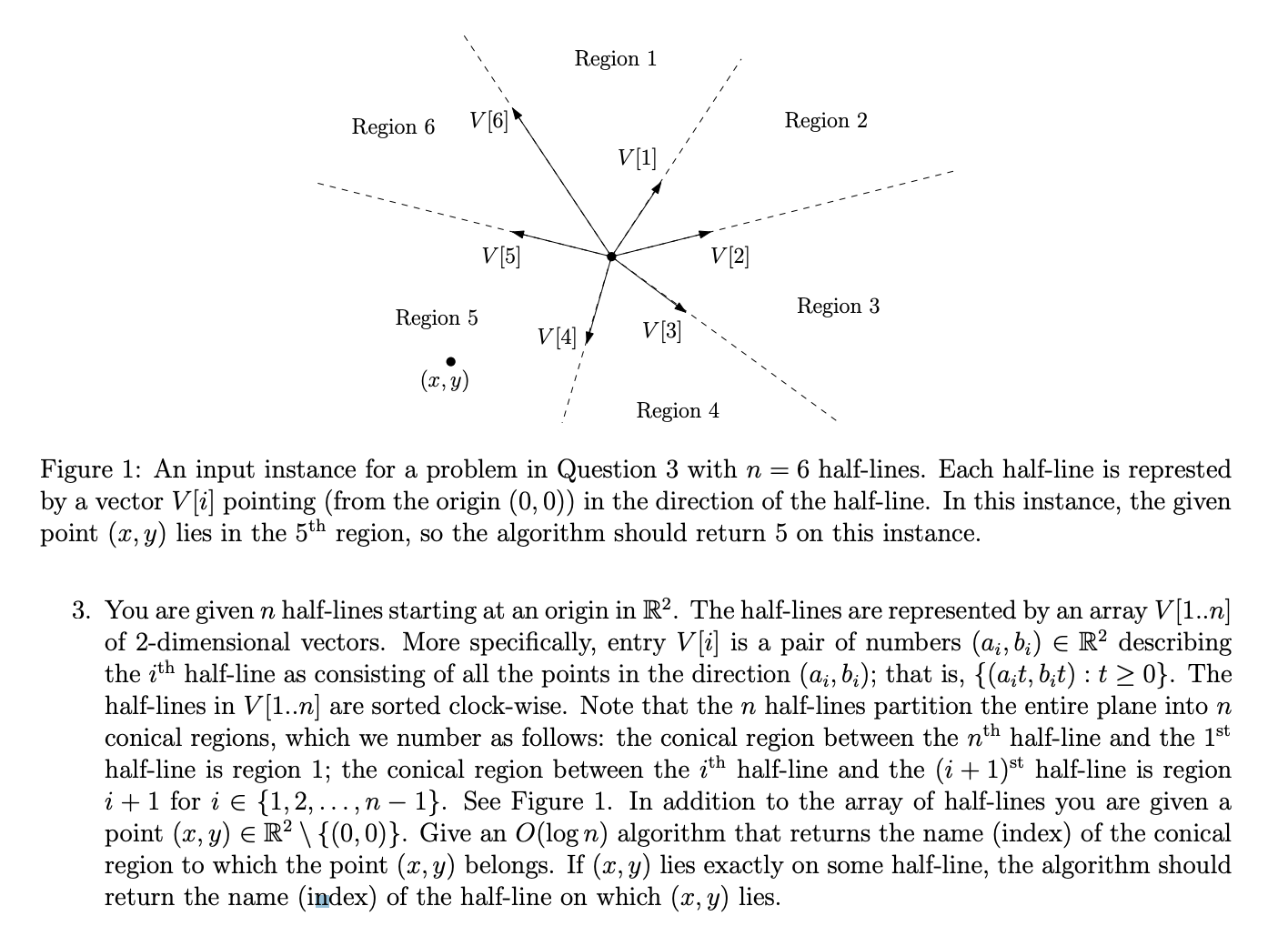
Figure 1: An input instance for a problem in Question 3 with n=6 half-lines. Each half-line is represted by a vector V[i] pointing (from the origin (0,0) ) in the direction of the half-line. In this instance, the given point (x,y) lies in the 5th region, so the algorithm should return 5 on this instance. 3. You are given n half-lines starting at an origin in R2. The half-lines are represented by an array V[1..n] of 2-dimensional vectors. More specifically, entry V[i] is a pair of numbers (ai,bi)R2 describing the ith half-line as consisting of all the points in the direction (ai,bi); that is, {(ait,bit):t0}. The half-lines in V[1..n] are sorted clock-wise. Note that the n half-lines partition the entire plane into n conical regions, which we number as follows: the conical region between the nth half-line and the 1st half-line is region 1 ; the conical region between the ith half-line and the (i+1)st half-line is region i+1 for i{1,2,,n1}. See Figure 1. In addition to the array of half-lines you are given a point (x,y)R2\{(0,0)}. Give an O(logn) algorithm that returns the name (index) of the conical region to which the point (x,y) belongs. If (x,y) lies exactly on some half-line, the algorithm should return the name (index) of the half-line on which (x,y) lies. Figure 1: An input instance for a problem in Question 3 with n=6 half-lines. Each half-line is represted by a vector V[i] pointing (from the origin (0,0) ) in the direction of the half-line. In this instance, the given point (x,y) lies in the 5th region, so the algorithm should return 5 on this instance. 3. You are given n half-lines starting at an origin in R2. The half-lines are represented by an array V[1..n] of 2-dimensional vectors. More specifically, entry V[i] is a pair of numbers (ai,bi)R2 describing the ith half-line as consisting of all the points in the direction (ai,bi); that is, {(ait,bit):t0}. The half-lines in V[1..n] are sorted clock-wise. Note that the n half-lines partition the entire plane into n conical regions, which we number as follows: the conical region between the nth half-line and the 1st half-line is region 1 ; the conical region between the ith half-line and the (i+1)st half-line is region i+1 for i{1,2,,n1}. See Figure 1. In addition to the array of half-lines you are given a point (x,y)R2\{(0,0)}. Give an O(logn) algorithm that returns the name (index) of the conical region to which the point (x,y) belongs. If (x,y) lies exactly on some half-line, the algorithm should return the name (index) of the half-line on which (x,y) lies
Step by Step Solution
There are 3 Steps involved in it

Get step-by-step solutions from verified subject matter experts