



Question: Statement of cash flows indirect method The comparative balance sheet of Olson - Jones Industries Inc. for December 3 1 , 2 0 Y 2
Statement of cash flowsindirect method
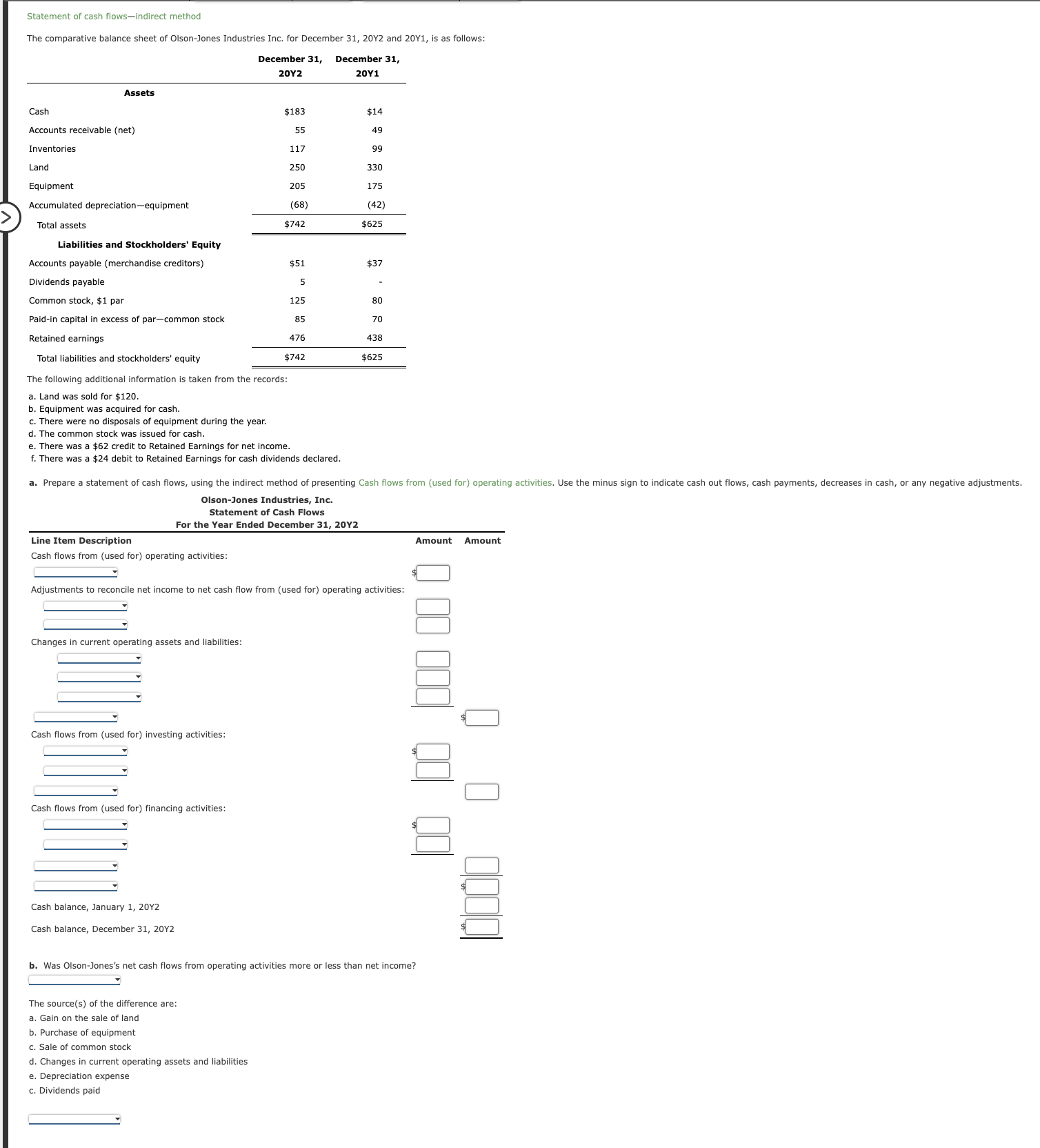
The comparative balance sheet of OlsonJones Industries Inc. for December Y and Y is as follows:
Line Item DescriptionDecember
YDecember
YAssetsCash$$Accounts receivable netInventoriesLandEquipmentAccumulated depreciationequipmentTotal assets$$Liabilities and Stockholders' EquityAccounts payable merchandise creditors$$Dividends payableCommon stock, $ parPaidin capital in excess of parcommon stockRetained earningsTotal liabilities and stockholders' equity$$
The following additional information is taken from the records:
Land was sold for $
Equipment was acquired for cash.
There were no disposals of equipment during the year.
The common stock was issued for cash.
There was a $ credit to Retained Earnings for net income.
There was a $ debit to Retained Earnings for cash dividends declared.
Question Content Area
aPrepare a statement of cash flows, using the indirect method of presenting Cash flows from used for operating activities. Use the minus sign to indicate cash out flows, cash payments, decreases in cash, or any negative adjustments.
OlsonJones Industries, Inc.
Statement of Cash Flows
For the Year Ended December YLine Item DescriptionAmountAmountCash flows from used for operating activities:
Cash received from sale of common stockDecrease in accounts receivableIncrease in inventoriesNet incomeNet lossNet income
$Net incomeAdjustments to reconcile net income to net cash flow from used for operating activities:
Decrease in accounts receivableDepreciationIncrease in accounts receivableLoss on sale of landNet income
Select
Decrease in inventoriesGain on sale of landIncrease in accounts payableLoss on sale of landNet income
Select Changes in current operating assets and liabilities:
Decrease in accounts receivableDecrease in inventoriesDepreciationIncrease in accounts receivableNet income
Select
Decrease in accounts payableDecrease in accounts receivableDecrease in inventoriesIncrease in inventoriesNet income
Select
Cash paid for dividendsDecrease in accounts payableDepreciationIncrease in accounts payableNet income
Select
Net cash flows from operating activitiesNet cash flows from investing activitiesNet cash flows from financing activitiesNet cash flows used for operating activitiesNet cash flows used for financing activities
$ Select Cash flows from used for investing activities:
Cash paid for dividendsCash received from sale of landDepreciationGain on sale of landNet income
$ Select
Cash paid for purchase of equipmentCash received from sale of common stockDepreciationIncrease in inventoriesNet income
Select
Net cash flows from operating activitiesNet cash flows from investing activitiesNet cash flows from financing activitiesNet cash flows used for operating activitiesNet cash flows used for investing activities
Select Cash flows from used for financing activities:
Cash received from sale of common stockCash received from sale of landDecrease in accounts payableDepreciationNet income
$ Select
Cash paid for dividendsCash received from sale of landDecrease in inventoriesIncrease in accounts receivableNet income
Select
Net cash flows from operating activitiesNet cash flows from investing activitiesNet cash flows from financing activitiesNet cash flows used for operating activitiesNet cash flows used for financing activities
Select
Decrease in accounts payableDepreciationIncrease in accounts payableNet increase in cashNet income
$ Select Cash balance, January YCash balance, January YCash balance, December Y$Cash balance, December Y
Feedback Area
Feedback
Question Content Area
bWas OlsonJoness net cash flows from operating activities more or less than net income?
LessMore
The sources of the difference are:
a Gain on the sale of land
b Purchase of equipment
c Sale of common stock
d Changes in current operating assets and liabilities
e Depreciation expense
c Dividends paid
Step by Step Solution
There are 3 Steps involved in it
1 Expert Approved Answer
Step: 1 Unlock

Question Has Been Solved by an Expert!
Get step-by-step solutions from verified subject matter experts
Step: 2 Unlock
Step: 3 Unlock