







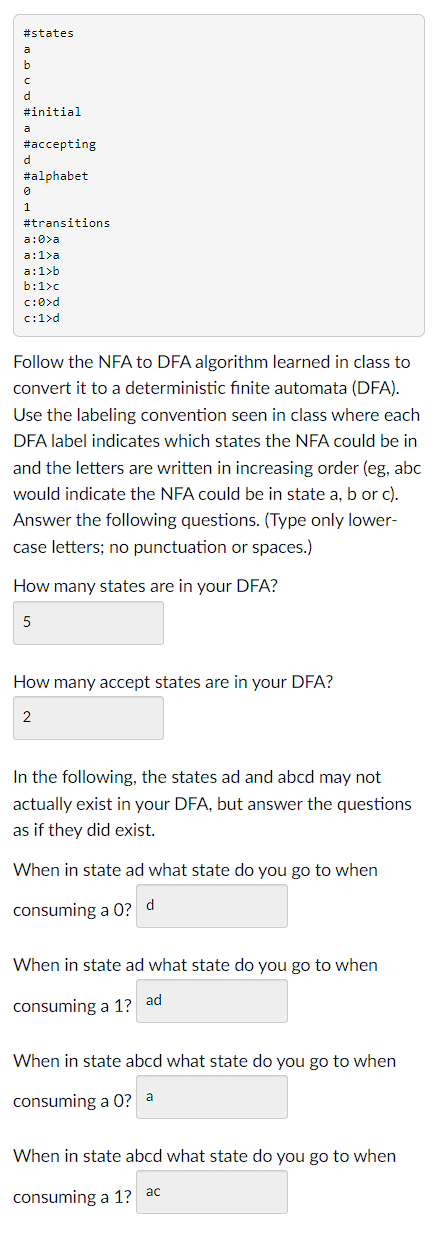
Question: ` ` ` #states a b c d #initial a #accepting d #alphabet 0 1 #transitions a: 0 > a a: 1 > a a:
#states
a
b
c
d
#initial
a
#accepting
d
#alphabet
#transitions
a:a
a:a
a:b
b:c
c:d
c:d
Follow the NFA to DFA algorithm learned in class to convert it to a deterministic finite automata DFA Use the labeling convention seen in class where each DFA label indicates which states the NFA could be in and the letters are written in increasing order eg abc would indicate the NFA could be in state mathrmamathrmb or c Answer the following questions. Type only lowercase letters; no punctuation or spaces.
How many states are in your DFA?
How many accept states are in your DFA?
In the following, the states ad and abcd may not actually exist in your DFA, but answer the questions as if they did exist.
When in state ad what state do you go to when consuming a
When in state ad what state do you go to when consuming a
When in state abcd what state do you go to when consuming a
When in state abcd what state do you go to when consuming a
Step by Step Solution
There are 3 Steps involved in it
1 Expert Approved Answer
Step: 1 Unlock

Question Has Been Solved by an Expert!
Get step-by-step solutions from verified subject matter experts
Step: 2 Unlock
Step: 3 Unlock
 Study Help