







Question: Place a + beside each true statement. Place an 'O' beside each false statement. 1 point each. A. In an experiment, randomly assigning subjects
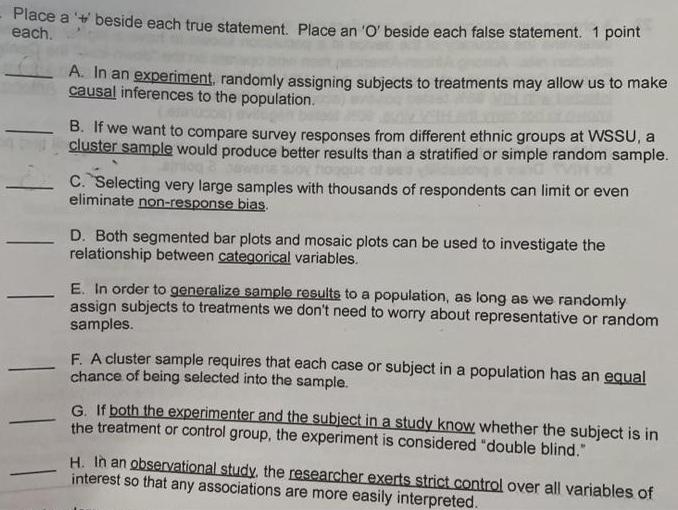
Place a + beside each true statement. Place an 'O' beside each false statement. 1 point each. A. In an experiment, randomly assigning subjects to treatments may allow us to make causal inferences to the population. B. If we want to compare survey responses from different ethnic groups at WSSU, a cluster sample would produce better results than a stratified or simple random sample. C. Selecting very large samples with thousands of respondents can limit or even eliminate non-response bias. D. Both segmented bar plots and mosaic plots can be used to investigate the relationship between categorical variables. E. In order to generalize sample results to a population, as long as we randomly assign subjects to treatments we don't need to worry about representative or random samples. F. A cluster sample requires that each case or subject in a population has an equal chance of being selected into the sample. G. If both the experimenter and the subject in a study know whether the subject is in the treatment or control group, the experiment is considered "double blind." H. In an observational study, the researcher exerts strict control over all variables of interest so that any associations are more easily interpreted.
Step by Step Solution
3.45 Rating (161 Votes )
There are 3 Steps involved in it
A yes it allows us to make casual inferences to the population B yes becaus... View full answer

Get step-by-step solutions from verified subject matter experts
 Study Help