



Question: Statistics and probability Random variables X, Y, Z are said to form a Markov chain in that order (denoted by X - Y - Z)
Statistics and probability
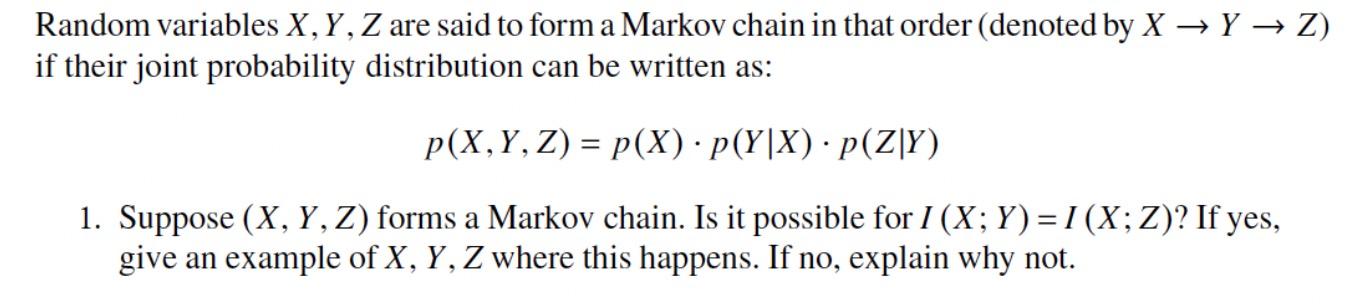
Random variables X, Y, Z are said to form a Markov chain in that order (denoted by X - Y - Z) if their joint probability distribution can be written as: p(X, Y, Z) = P(X) . p(Y|X) . P(Z|Y) 1. Suppose (X, Y, Z) forms a Markov chain. Is it possible for 1 (X; Y) = 1 (X; Z)? If yes, give an example of X, Y, Z where this happens. If no, explain why not
Step by Step Solution
There are 3 Steps involved in it
1 Expert Approved Answer
Step: 1 Unlock

Question Has Been Solved by an Expert!
Get step-by-step solutions from verified subject matter experts
Step: 2 Unlock
Step: 3 Unlock