







Question: Statistics b) Consider a two-dimension plane in which we mark the lines y = n for neZ. We now randomly drop a needle (i.e. draw
Statistics
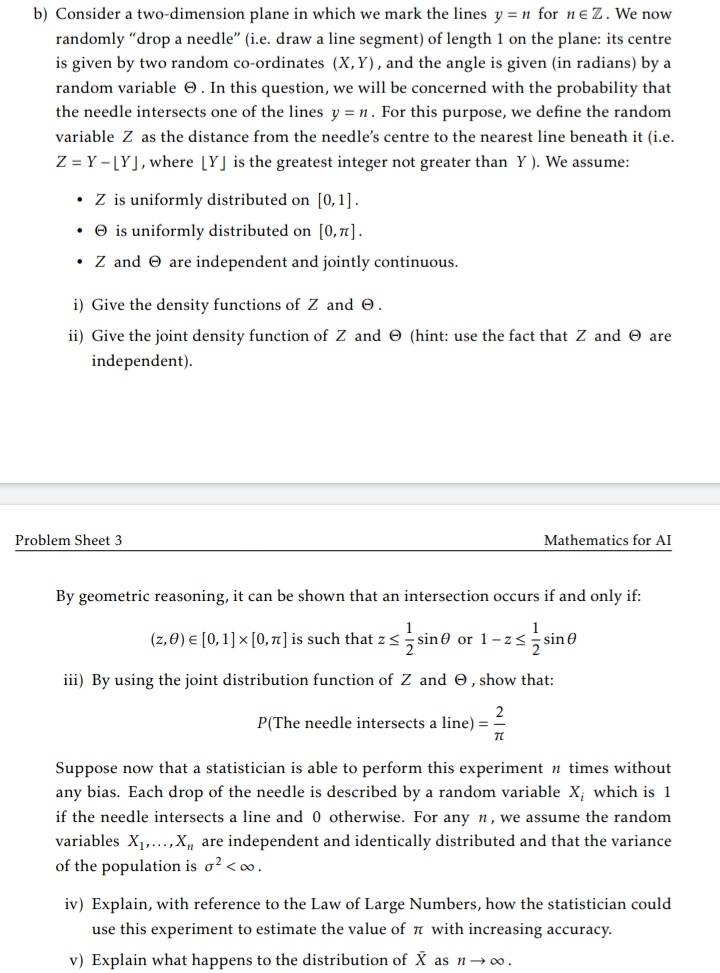
b) Consider a two-dimension plane in which we mark the lines y = n for neZ. We now randomly "drop a needle" (i.e. draw a line segment) of length 1 on the plane: its centre is given by two random co-ordinates (X, Y), and the angle is given (in radians) by a random variable O . In this question, we will be concerned with the probability that the needle intersects one of the lines y = n . For this purpose, we define the random variable Z as the distance from the needle's centre to the nearest line beneath it (i.e. Z = Y-LY], where [Y] is the greatest integer not greater than Y ). We assume: . Z is uniformly distributed on [0, 1]. . O is uniformly distributed on [0, x]. . Z and O are independent and jointly continuous. i) Give the density functions of Z and 0. ii) Give the joint density function of Z and O (hint: use the fact that Z and O are independent). Problem Sheet 3 Mathematics for AI By geometric reasoning, it can be shown that an intersection occurs if and only if: (z,0) E [0, 1] x [0, x] is such that z S - sin0 or 1 -zS - sine iii) By using the joint distribution function of Z and O , show that: P(The needle intersects a line) = = Suppose now that a statistician is able to perform this experiment n times without any bias. Each drop of the needle is described by a random variable X; which is 1 if the needle intersects a line and 0 otherwise. For any n, we assume the random variables X1....,X,, are independent and identically distributed and that the variance of the population is oz
Step by Step Solution
There are 3 Steps involved in it

Get step-by-step solutions from verified subject matter experts
 Study Help