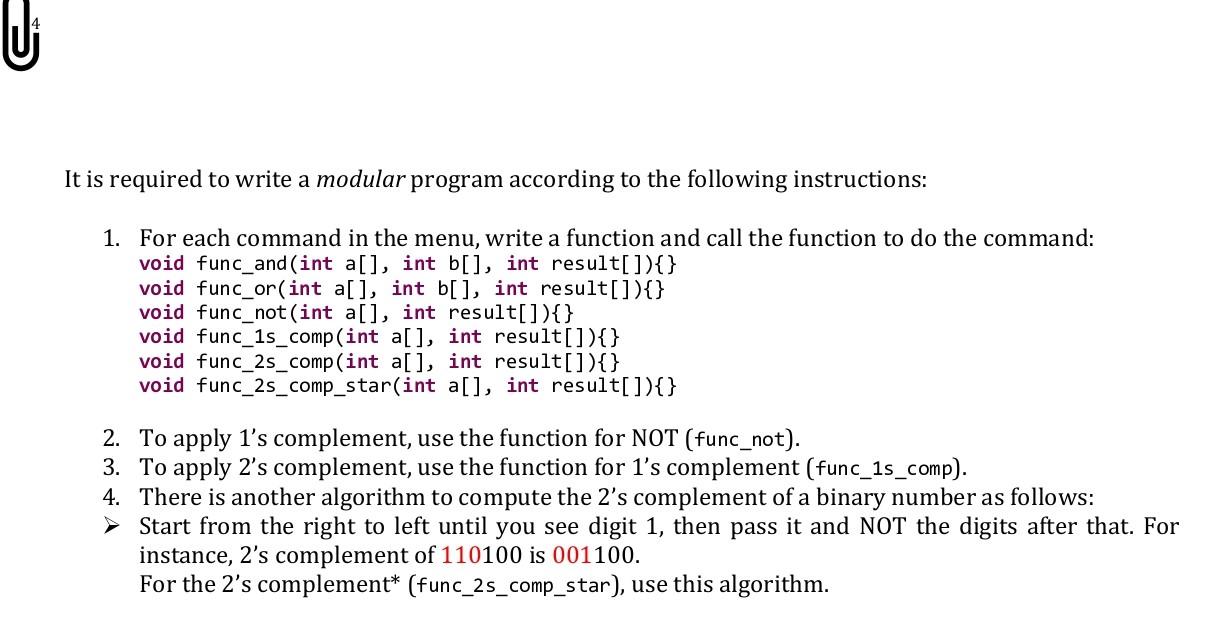
Question: Step 1. Environment Setup Our programing environment is the same as the previous lab (Lab02). In this lab, we want to extend our program to
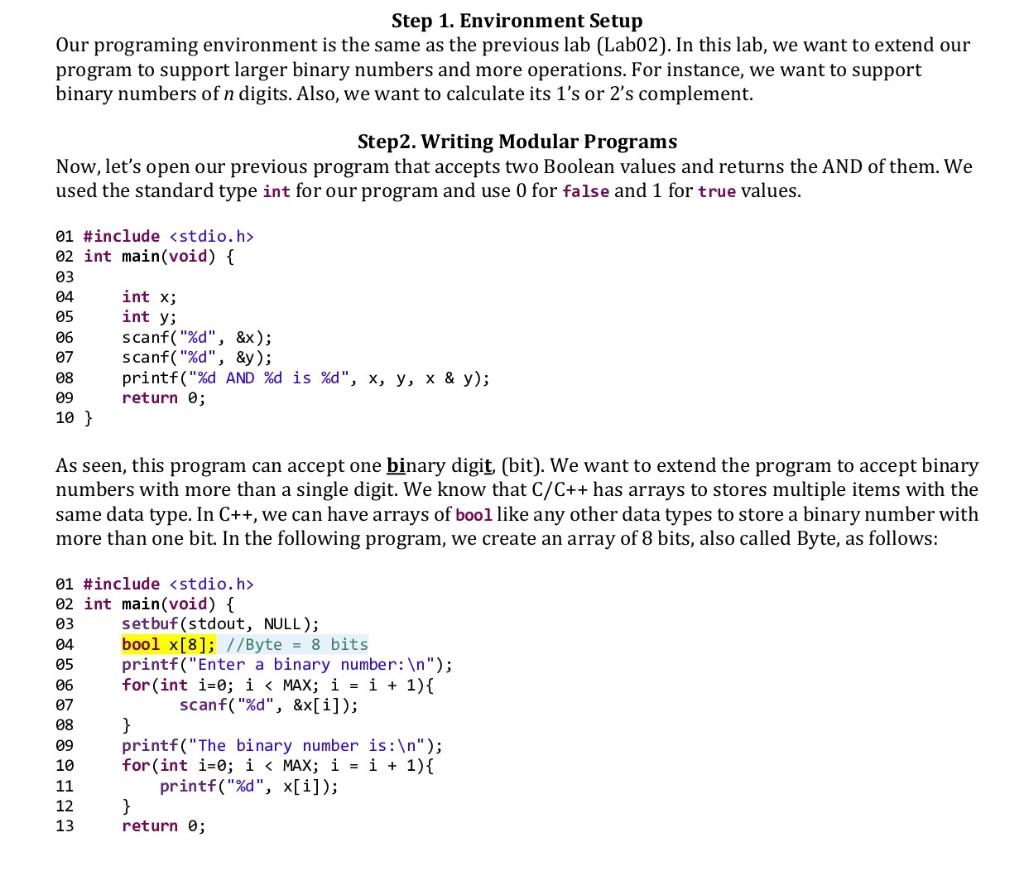
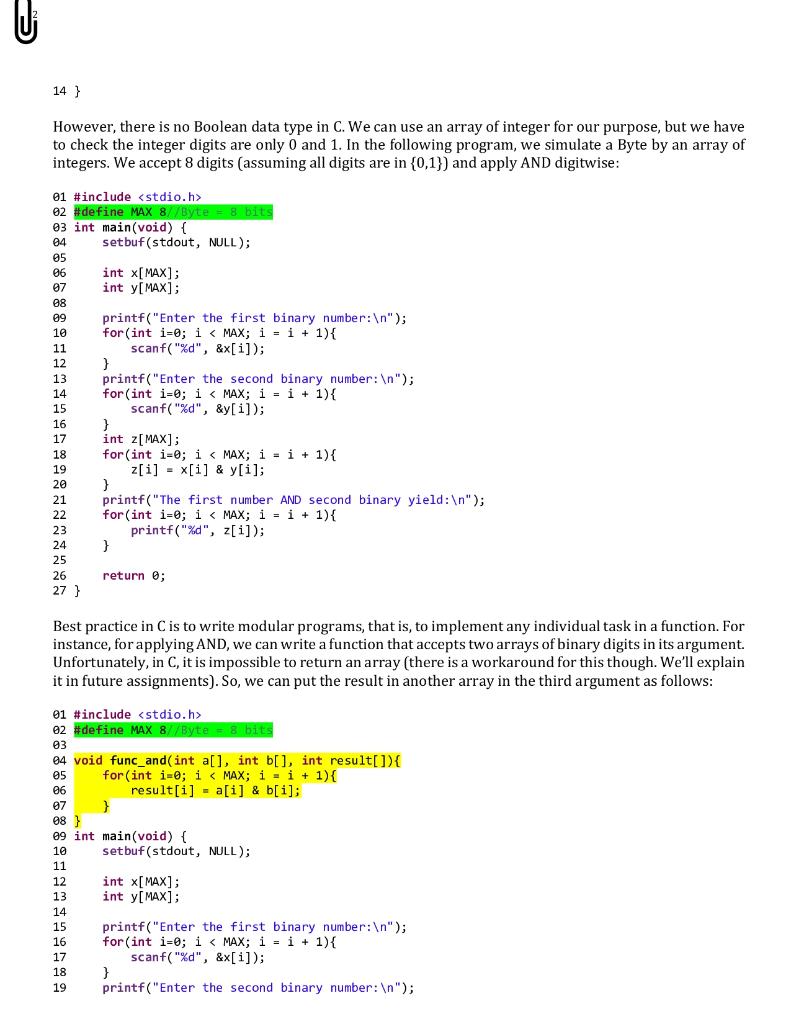
 Step 1. Environment Setup Our programing environment is the same asthe previous lab (Lab02). In this lab, we want to extend ourprogram to support larger binary numbers and more operations. For instance, wewant to support binary numbers of n digits. Also, we want to

Step 1. Environment Setup Our programing environment is the same as the previous lab (Lab02). In this lab, we want to extend our program to support larger binary numbers and more operations. For instance, we want to support binary numbers of n digits. Also, we want to calculate its 1's or 2's complement. Step2. Writing Modular Programs Now, let's open our previous program that accepts two Boolean values and returns the AND of them. We used the standard type int for our program and use 0 for false and 1 for true values. 01 #include 02 int main(void) { 03 04 int x; 05 int y; 06 scanf("%d", &x); 07 scanf("%d", &y); 08 printf("%d AND %d is %d", x, y, x & y); 09 return 0; 10 } As seen, this program can accept one binary digit (bit). We want to extend the program to accept binary numbers with more than a single digit. We know that C/C++ has arrays to stores multiple items with the same data type. In C++, we can have arrays of bool like any other data types to store a binary number with more than one bit. In the following program, we create an array of 8 bits, also called Byte, as follows: 01 #include 02 int main(void) { 03 setbuf(stdout, NULL); 04 bool x[8]; //Byte = 8 bits 05 printf("Enter a binary number: "); 06 for(int i=0; i 02 #define MAX 8//Byte 03 int main(void) { 04 setbuf(stdout, NULL); 05 06 int x[MAX]; 07 int y[ Max]; 98 09 printf("Enter the first binary number: "); 10 for(int i=0; i 02 #define MAX 8//Byte = 8 bits 03 94 void func_and(int a[], int b[], int result[]){ 05 for(int i=0; i
Step by Step Solution

There are 3 Steps involved in it

1 Expert Approved Answer
Step: 1 Unlock blur-text-image
Question Has Been Solved by an Expert!

Get step-by-step solutions from verified subject matter experts

Step: 2 Unlock
Step: 3 Unlock

Students Have Also Explored These Related Databases Questions!