







Question: Step 1: Quick Take: Bond Returns When a coupon bond is issued, the coupon is generally set at a level that causes the bond's market
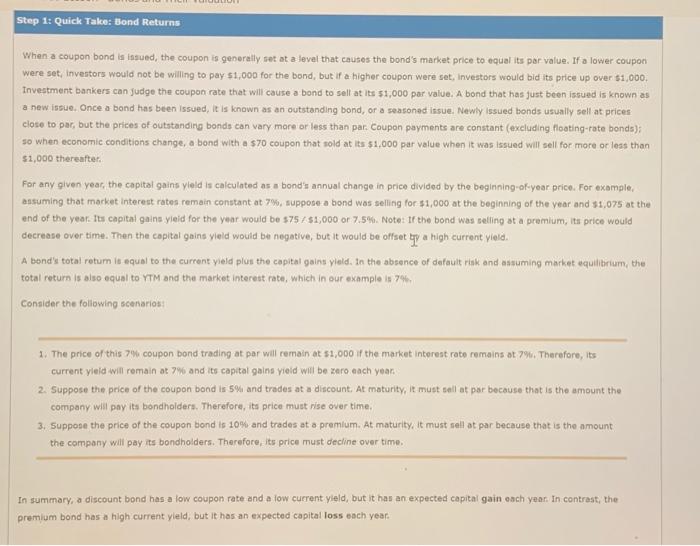
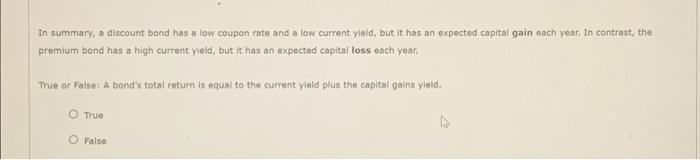
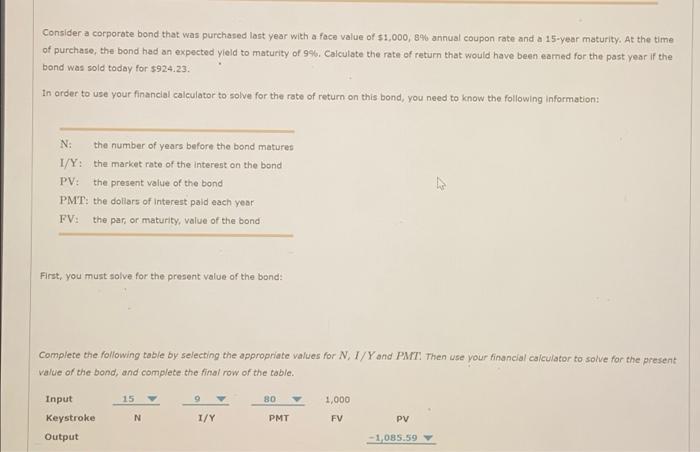
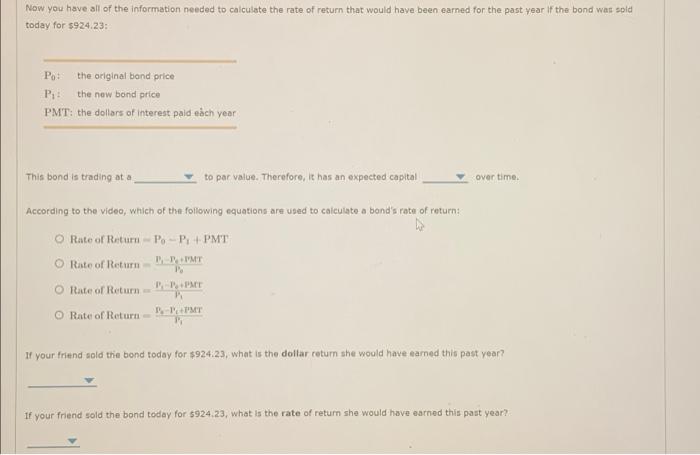

Step 1: Quick Take: Bond Returns When a coupon bond is issued, the coupon is generally set at a level that causes the bond's market price to equal its par value. If a lower coupon were set, Investors would not be willing to pay $1,000 for the bond, but if a higher coupon were set, investors would bid its price up over $1,000, Investment bankers can judge the coupon rate that will cause a bond to sell at its $1,000 par value. A bond that has just been issued is known as a new issue. Once a bond has been issued, it is known as an outstanding bond, or a seasoned issue. Newly issued bonds usually sell at prices close to par, but the prices of outstanding bonds can vary more or less than par. Coupon payments are constant (excluding floating-rate bonds); so when economic conditions change, a bond with a $70 coupon that sold at its $1,000 par value when it was issued will dell for more or less than $1,000 thereafter For any given year, the capital gains yield is calculated as a bond's annual change in price divided by the beginning-of-year price. For example, assuming that market interest rates remain constant at 7%, suppose a bond was selling for $1,000 at the beginning of the year and $1,075 at the end of the year. Its capital gains yield for the year would be $75 / $1,000 or 7,5%. Note: If the bond was selling at a premium, its price would decrease over time. Then the capital gains yield would be negative, but it would be offset ty a high current yield. A bond's total rotum is equal to the current yield plus the capital gains yield. In the absence of default risk and assuming market equilibrium, thu total return is also equal to YTM and the market interest rate, which in our example is 7% Consider the following scenarios 1. The price of this 7% coupon bond trading at par will remain at $1,000 if the market interest rato remains at 79. Therefore, its current yield will remain at 7% and its capital gaina yield will be zero each year 2. Suppose the price of the coupon bond is 5% and trades at a discount, At maturity, it must tell at par because that is the amount the company will pay its bondholders. Therefore, its price must rise over time, 3. Suppose the price of the coupon bond is 10% and trades at a premium. At maturity. It must sell at par because that is the amount the company will pay its bondholders. Therefore, its price must decline over time. In summary, a discount bond has a low coupon rate and a low current yield, but it has an expected capital gain each year. In contrast, the premium bond has a high current yield, but it has an expected capital loss ench year. In summary, a discount bond has a low coupon rate and a low current yield, but it has an expected capital gain each year. In contrast, the premium bond has a high current yield, but it has an expected capital loss each year True or False: A bond's total return is equal to the current yield plus the capital gains yield. True False Consider a corporate bond that was purchased last year with a face value of $1,000,8% annual coupon rate and a 15-year maturity. At the time of purchase, the bond had an expected yield to maturity of 996. Calculate the rate of return that would have been cared for the past year if the bond was sold today for $924.23. in order to use your financial calculator to solve for the rate of return on this bond, you need to know the following information: N: the number of years before the bond matures I/Y: the market rate of the interest on the bond PV: the present value of the bond PMT: the dollars of interest paid each year FV: the par, or maturity, value of the bond First, you must solve for the present value of the bond: Complete the following table by selecting the appropriate values for N. 1/Yand PMT. Then use your financial calculator to solve for the present value of the bond, and complete the final row of the table. 15 9 80 1,000 Input Keystroke Output N 1/Y PMT FV PV -1,085.59 Now you have all of the information needed to calculate the rate of return that would have been earned for the past year if the bond was sold today for $924.23: Po the original bond price P: the new bond price PMT: the dollars of interest paid each year This bond is trading at to par value. Therefore, it has an expected capital over time According to the video, which of the following equations are used to calculate a band's rate of return Rate of Return Po P, PMT O Rate of Return IN TIM P O Rate of Return PPP Rate of Return I'MY If your friend sold tria bond today for $924.23, what is the dollar return she would have earned this past year? If your friend sold the bond today for $924.23, what is the rate of return she would have earned this past year? Now it's time for you to practice what you've learned. Consider a corporate bond that was purchased last year with a face value of $1,000, 9% annual coupon rate and a 12-year maturity. At the time of purchase, the band had an expected yield to maturity of 10W. Calculate the rate of return that would have been earned for the past year if the bond was sold today for $936.21
Step by Step Solution
There are 3 Steps involved in it

Get step-by-step solutions from verified subject matter experts
 Study Help