







Question: Step 3 , The liquid is then filtered to remove the yeast and the ethanol is extracted by distillation to produce eight different types of
Step The liquid is then filtered to remove the yeast and the ethanol is extracted by
distillation to produce eight different types of ethanol for various industrial purposes.
For this assignment, we focus on the fermentation of whey.
A mathematical model of a stirred tank fermenter is given by the system of ordinary
differential equations shown below. The feed or substrate, is used by the yeast to
make ethanol The yeast, or biomass, will grow and as a result will turn the sugars
into ethanol faster. The yeast will die over time and only the living yeast will keep
producing ethanol from lactose. The fermentation is a heatreleasing exothermic
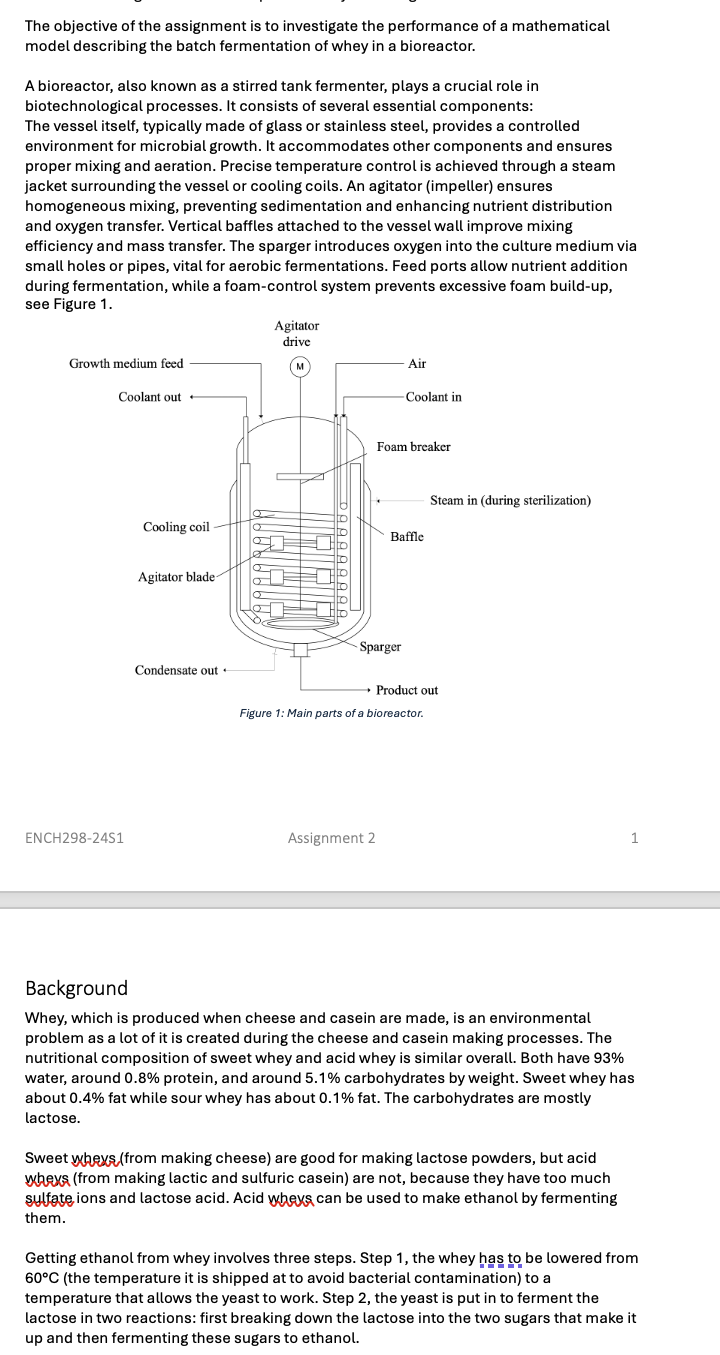
reaction that increases the broth temperature Therefore the vessel has cooling coils
to lower the broth temperature. Equation and explain these processes.
The specific growth rate is dependent on the substrate concentration and the
ethanol concentration
where the maximum specific growth rate is temperature dependent
and the is the maximum product inhibition, the ethanol concentration hinders
the growth of the yeast
The yeast deactivation can be describe by
The substrate utilisation rate
The ethanol production rate
Equations and describe the energy balance around the bioreactor and its cooling
circuit. The heat generated by the fermentation increases the broth temperature
T The energy removed by the cooling circuit is depending on the
coolant's temperature entering the cooling circuit its flowrate the heat
transfer surface area and the heat transfer coefficient Where the term
represent the driving force between the coolant's temperature within the cooling circuit
and the broth temperature lowered from
the temperature it is shipped at to avoid bacterial contamination to a
temperature that allows the yeast to work. Step the yeast is put in to ferment the
lactose in two reactions: first breaking down the lactose into the two sugars that make it
up and then fermenting these sugars to ethanol.
SOLVE TASKS to USING PYTHON CODE
Step by Step Solution
There are 3 Steps involved in it
1 Expert Approved Answer
Step: 1 Unlock

Question Has Been Solved by an Expert!
Get step-by-step solutions from verified subject matter experts
Step: 2 Unlock
Step: 3 Unlock
 Study Help