







Question: step by step answer please CASE STUDY TIME MARCHES ON; SO DOES THE INTEREST RATE Background Information During the last week, Sundara has read about
step by step answer please
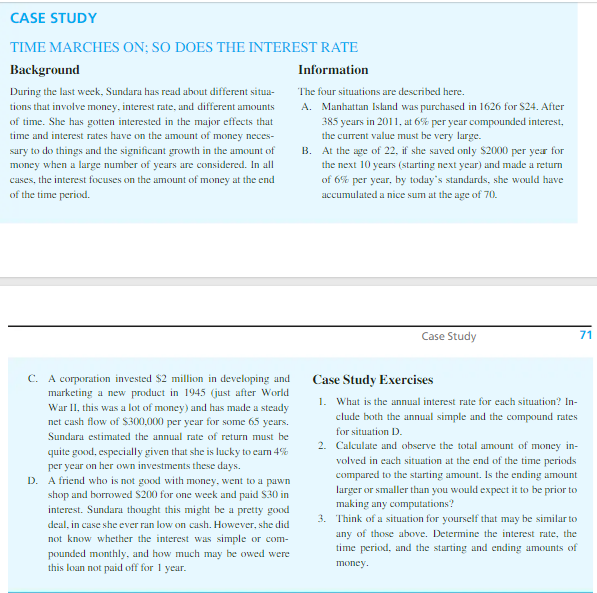
CASE STUDY TIME MARCHES ON; SO DOES THE INTEREST RATE Background Information During the last week, Sundara has read about different situa The four situations are described here. tions that involve money, interest rate, and different amounts A. Manhattan Island was purchased in 1626 for $24. After of time. She has gotten interested in the major effects that 385 years in 2011, at 6% per year compounded interest, time and interest rates have on the amount of money neces the current value must be very large. sary to do things and the significant growth in the amount of B. At the age of 22, if she saved only $2000 per year for money when a large number of years are considered. In all the next 10 years (starting next year) and made a return cases, the interest focuses on the amount of money at the end of 6% per year, by today's standards, she would have of the time period. accumulated a nice sum at the age of 70. Case Study 71 C. A corporation invested $2 million in developing and marketing a new product in 1945 (just after World War II, this was a lot of money) and has made a steady net cash flow of $300,000 per year for some 65 years. Sundara estimated the annual rate of return must be quite good, especially given that she is lucky to earn 4% per year on her own investments these days. D. A friend who is not good with money, went to a pawn shop and borrowed S200 for one week and paid $30 in interest. Sundara thought this might be a pretty good deal, in case she ever ran low on cash. However, she did not know whether the interest was simple or com- pounded monthly, and how much may he owed were this loan not paid off for 1 year. Case Study Exercises 1. What is the annual interest rate for each situation? In- clude both the annual simple and the compound rates for situation D. 2. Calculate and observe the total amount of money in- volved in each situation at the end of the time periods compared to the starting amount. Is the ending amount larger or smaller than you would expect it to be prior to making any computations? 3. Think of a situation for yourself that may be similar to any of those above. Determine the interest rate, the time period, and the starting and ending amounts of money
Step by Step Solution
There are 3 Steps involved in it

Get step-by-step solutions from verified subject matter experts
 Study Help