







Question: steps & excel formulas D- I Assume that you are nearing graduation and bave applied for a job with a local bank. The bank s
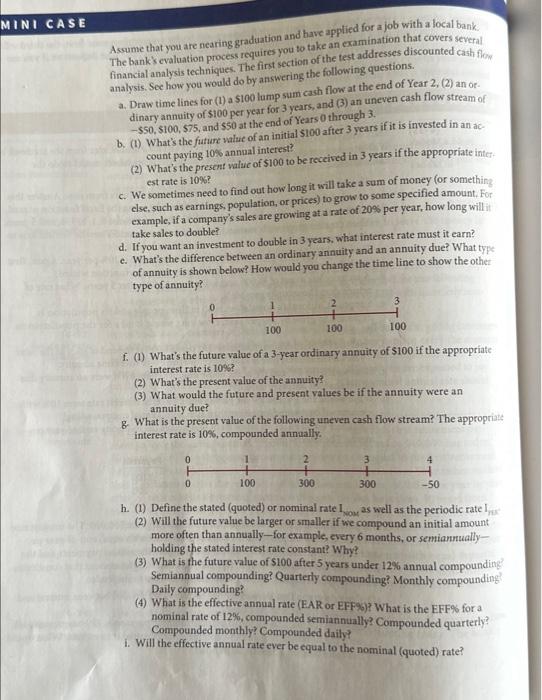
Assume that you are nearing graduation and bave applied for a job with a local bank. The bank s cvaluation process requires you to take an examination that covers several financial analysis techniques. The first section of the test addresses discounted cash flom analysis. See how you would do by answering the following questions. a. Draw time lines for (1) a 5100 lump sum cash flow at the end of Year 2, (2) an or. dinary annuity of $100 per year for 3 years, and (3) an uneven cash flow stream of $50,$100,575, and 550 at the end of Years 0 through 3. b. (1) What's the future value of an initial $100 after 3 years if it is invested in an ac- (2) What's the present value of $100 to be received in 3 years if the appropriate inter. count paying 108 annual interest? c. We sometimes need to find out how long it will take a sum of money (or something est rate is 10% ? clse, such as earnings, population, or prices) to grow to some specified amount. For example, if a company's sales are growing at a rate of 20% per year, how long willi d. If you want an investment to double in 3 years. what interest rate must it earn? take sales to double? e. What's the difference between an ordinary annuity and an annuity due? What type of annuity is shown below? How would you change the time line to show the other type of annuity? f. (I) What's the future value of a 3 -year ordinary annuity of $100 if the appropriate interest rate is 109 ? (2) What's the present value of the annuity? (3) What would the future and present values be if the annuity were an annuity due? g. What is the present value of the following uneven cash flow stream? The appropriate interest rate is 10%, compounded annually. h. (1) Define the stated (quoted) or nominal rate Ivous as well as the periodic rate I (2) Will the future value be larger or smaller if we compound an initial amount more often than annually-for example, every 6 months, or semiannuallyholding the stated interest rate constant? Why? (3) What is the future value of $100 after 5 years under 12% annual compoundinge Semiannual compounding? Quarterly compounding? Monthly compounding? Daily compounding? (4) What is the effective annual rate (EAR or EFF\%)? What is the EFF\% for a nominal rate of 12%, compounded semiannually? Compounded quarterly? Compounded monthly? Compounded daily? i. Will the effective annual rate ever be equal to the nominal (quoted) rate
Step by Step Solution
There are 3 Steps involved in it

Get step-by-step solutions from verified subject matter experts
 Study Help