







Question: Steve Young, a Senior Sales Development Representative at a local wellness gift shop, is preparing for the upcoming Chinese New Year ( CNY ) Sales.
Steve Young, a Senior Sales Development Representative at a local wellness gift shop, is preparing for the upcoming Chinese New Year CNY Sales. He is considering two new CNY gift products: "Healthy Treats" and "Forever Youth". While there is some overlap in their targeted customer groups, they are not complete substitutes for each other.
With only one month remaining to make his purchasing decision, Steve faces a time constraint due to the long lead time required for production and shipping to Singapore. Once a decision is made, he cannot alter the purchase quantity. Additionally, Steve is required to order both types of products; he cannot opt to order just one of them.
Steve needs to determine the specific purchasing quantity for each product within this month. The options are either units, indicating a low demand estimation, or units, indicating a high demand estimation. The unit purchasing cost for Healthy Treats is $ and for Forever Youth, it's $ The market prices are fixed at $ for Healthy Treats and $ for Forever Youth. If any products remain unsold during the CNY sales, the disposal costs are $ for Healthy Treats and $ for Forever Youth.
Based on a combination of experience and current trend analysis, Steve estimates a chance that the demand for Healthy Treats will be high, exceeding units.
Before finalizing his purchasing decision, Steve has the option to conduct a regional market research test to gauge potential customer interest in Healthy Treats, as the budget does not allow for research on both products. This test will cost $ However, it cannot predict market demand with absolute certainty. Past results indicate a chance of receiving a falsely positive signal in a weak market and a chance of a falsely negative signal in a strong market.
Despite the budget constraints limiting market tests to one product, there exists a notable correlation in demand between Healthy Treats and Forever Youth. A high demand for Healthy Treats corresponds to a likelihood of strong demand for Forever Youth, regardless of the market test results. Similarly, if demand for Healthy Treats is low, there's a chance that Forever Youth will also experience weak demand, independent of the market research outcomes.
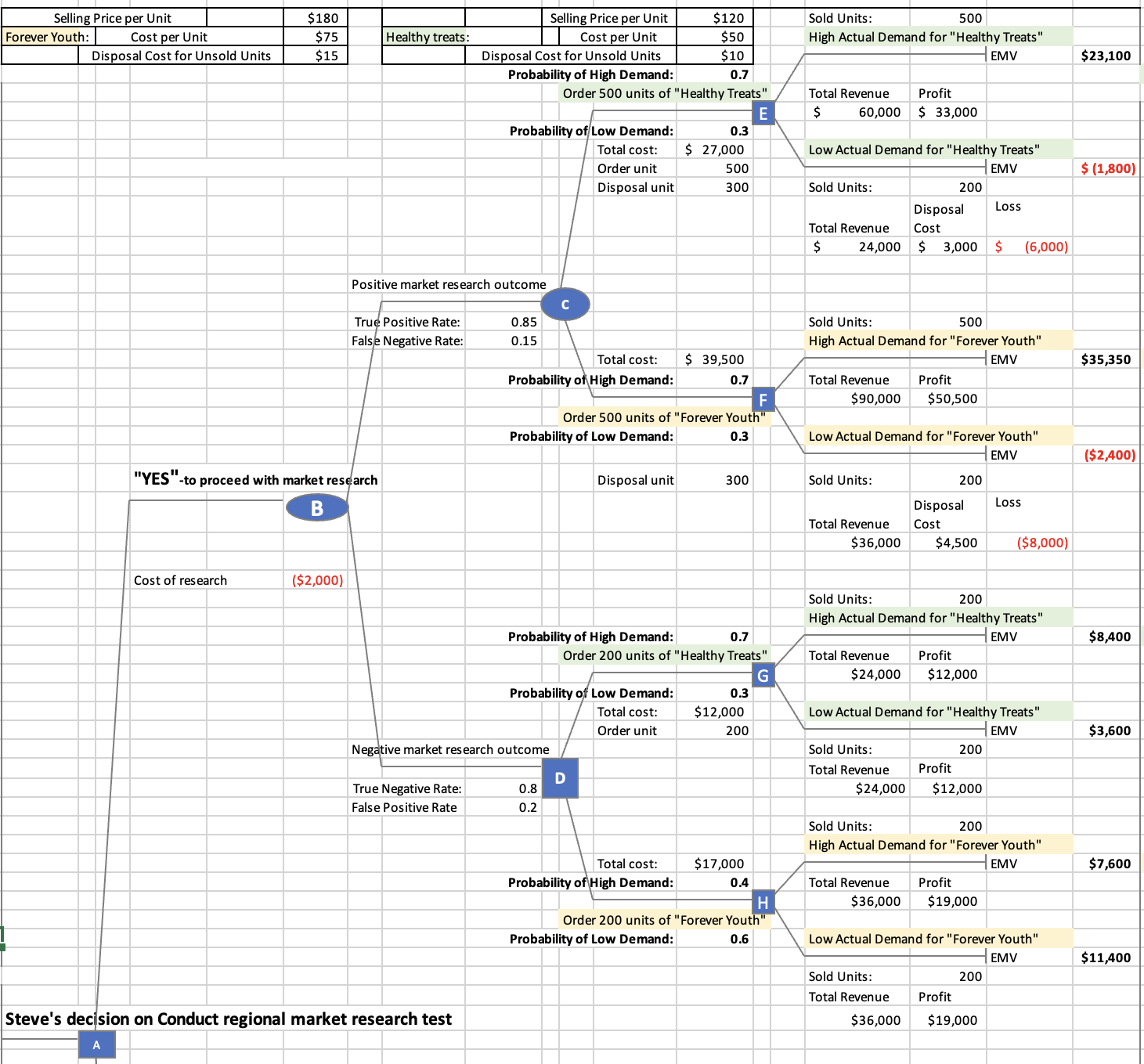
based on the Formulated decision tree, and given adjusted EMVs
For order of units of "Healthy Treats" under Positive market research outcome :
Adjusted EMV True Positive Rate EMV for High DemandFalse Negative Rate EMV for Low Demand
Adjusted EMV $$
Adjusted EMV: $
For order of units "Forever Youth"under Positive market research outcome:
Adjusted EMV True Positive Rate EMV for High DemandFalse Negative Rate EMV for Low Demand
Adjusted EMV $$
Adjusted EMV: $
For order of units "Healthy Treats" under Negative market research outcome:
Adjusted EMV True Negative Rate EMV for High DemandFalse Positive Rate EMV for Low Demand
Adjusted EMV $$
Adjusted EMV: $
For order of units of "Forever Youth"under Negative market research outcome:
Adjusted EMV True Negative Rate EMV for High DemandFalse Positive Rate EMV for Low Demand
Adjusted EMV $$
Adjusted EMV: $
Decision Outcomes Adjusted Expected Monetary Value EMV
Healthy Treats with Positive Market Signal units $
Forever Youth with Positive Market Signal units
$
Healthy Treats with Negative Market Signal units
$
Forever Youth with Negative Market Signal units $
specify the probabilities required to
effectively solve and analyze the decision tree and
Solve the optimal decision strategy and give your overall recommendation.
marks
dIn the context of the provided problem, discuss and explain how the optimal decision strategy is sensitive to key data factors, including the various uncertainties and data parameters involved. Detail how changes in these elements might influence the decisionmaking process.
marks
Step by Step Solution
There are 3 Steps involved in it
1 Expert Approved Answer
Step: 1 Unlock

Question Has Been Solved by an Expert!
Get step-by-step solutions from verified subject matter experts
Step: 2 Unlock
Step: 3 Unlock
 Study Help