







Question: Stock X has a 9.5% expected return, a beta coefficient of 0.8, and a 40% standard deviation of expected returns. Stock Y has a 12.5%
Stock X has a 9.5% expected return, a beta coefficient of 0.8, and a 40% standard deviation of expected returns. Stock Y has a 12.5% expected return, a beta coefficient of 1.2, and a 20.0% standard deviation. The risk-free rate is 6%, and the market risk premium is 5%.
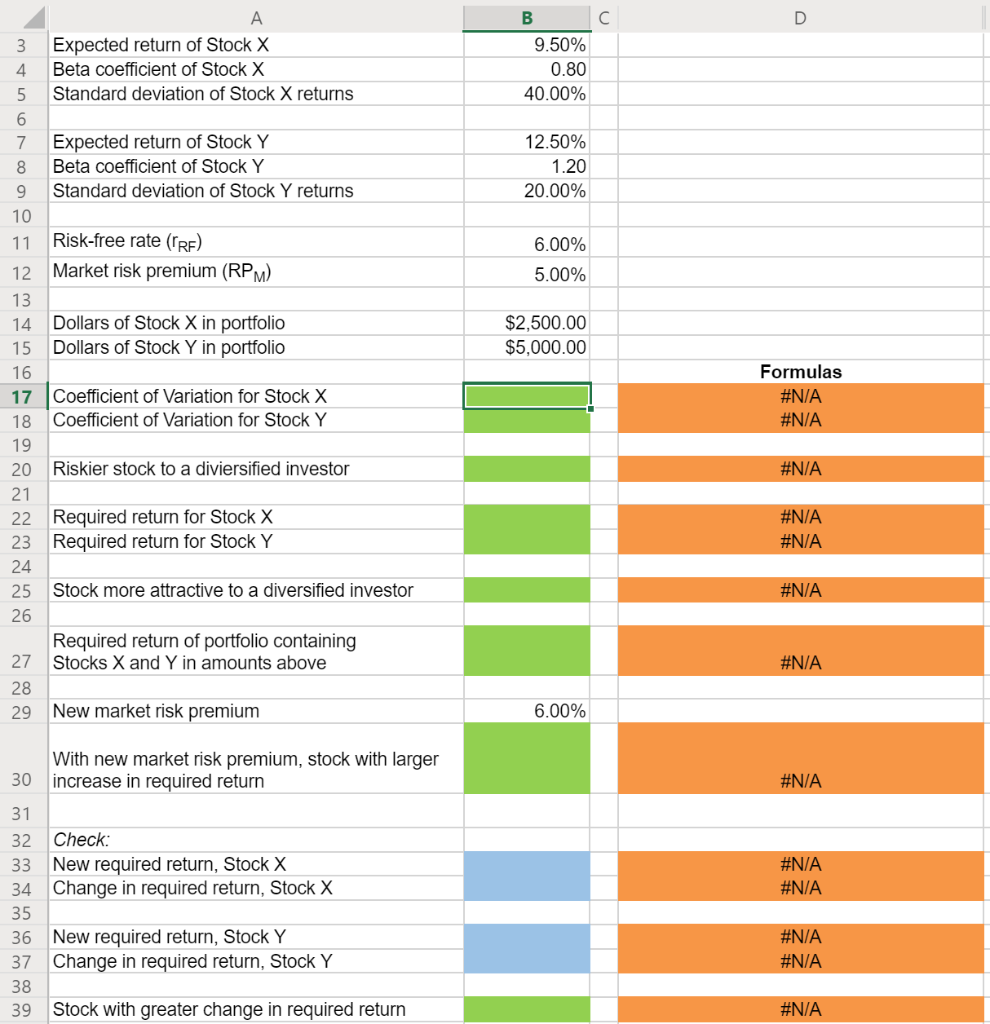
-
Calculate each stock's coefficient of variation. Round your answers to two decimal places. Do not round intermediate calculations.
CVx =
CVy =
-
Which stock is riskier for a diversified investor?
- For diversified investors the relevant risk is measured by standard deviation of expected returns. Therefore, the stock with the lower standard deviation of expected returns is more risky. Stock Y has the lower standard deviation so it is more risky than Stock X.
- For diversified investors the relevant risk is measured by beta. Therefore, the stock with the higher beta is less risky. Stock Y has the higher beta so it is less risky than Stock X.
- For diversified investors the relevant risk is measured by beta. Therefore, the stock with the higher beta is more risky. Stock Y has the higher beta so it is more risky than Stock X.
- For diversified investors the relevant risk is measured by standard deviation of expected returns. Therefore, the stock with the higher standard deviation of expected returns is more risky. Stock X has the higher standard deviation so it is more risky than Stock Y.
- For diversified investors the relevant risk is measured by beta. Therefore, the stock with the lower beta is more risky. Stock X has the lower beta so it is more risky than Stock Y.
-
Calculate each stock's required rate of return. Round your answers to two decimal places.
rx = %
ry = %
-
On the basis of the two stocks' expected and required returns, which stock would be more attractive to a diversified investor?
_________Stock X Stock Y
-
Calculate the required return of a portfolio that has $2,500 invested in Stock X and $5,000 invested in Stock Y. Do not round intermediate calculations. Round your answer to two decimal places.
rp = %
-
If the market risk premium increased to 6%, which of the two stocks would have the larger increase in its required return?
_________
B 3 Exp A Expected return of Stock X Beta coefficient of Stock X Standard deviation of Stock X returns 9.50% 0.80 40.00% 12.50% 1.20 20.00% Expected return of Stock Y Beta coefficient of Stock Y 9 Standard deviation of Stock Y returns 10 11 Risk-free rate (IRF) 12 Market risk premium (RPM) 6.00% 5.00% 14 15 Dollars of Stock X in portfolio Dollars of Stock Y in portfolio $2,500.00 $5,000.00 Coefficient of Variation for Stock X Coefficient of Variation for Stock Y Formulas #N/A #N/A Riskier stock to a diviersified investor #N/A Required return for Stock X Required return for Stock Y #N/A #N/A 23 Stock more attractive to a diversified investor #N/A 27 Required return of portfolio containing Stocks X and Y in amounts above #N/A 29 New market risk premium 6.00% With new market risk premium, stock with larger increase in required return 30 #N/A #N/A #N/A 32 Check: 33 New required return, Stock X 34 Change in required return, Stock X 35 New required return, Stock Y 37 Change in required return, Stock Y 38 Stock with greater change in required return 36 #N/A #N/A #N/A
Step by Step Solution
There are 3 Steps involved in it

Get step-by-step solutions from verified subject matter experts
 Study Help