



Question: STRATEGIC PROJECT MANAGEMENT 4.6. Partnering, Chartering and Scope Change Projects provide sufficient opportunity for project managers to utilize their negotiation skills. There are, however, three
STRATEGIC PROJECT MANAGEMENT
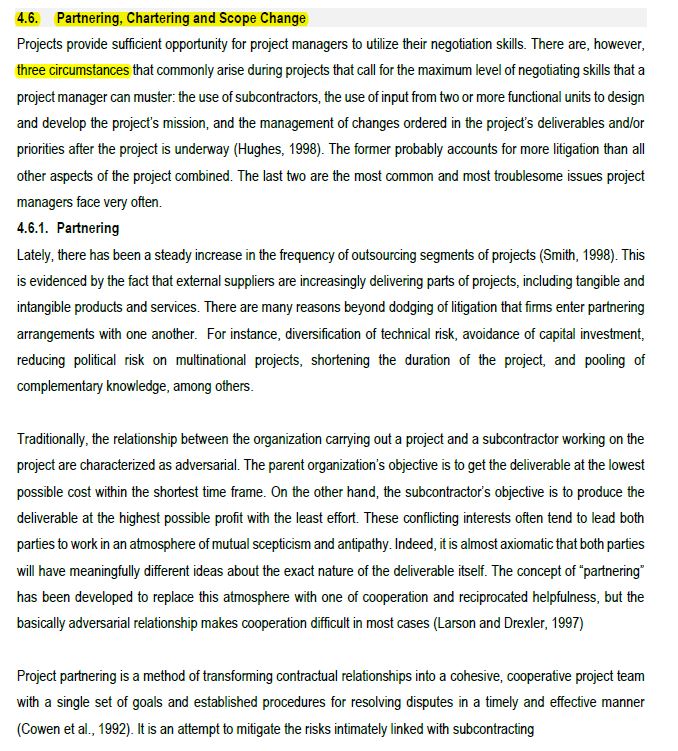
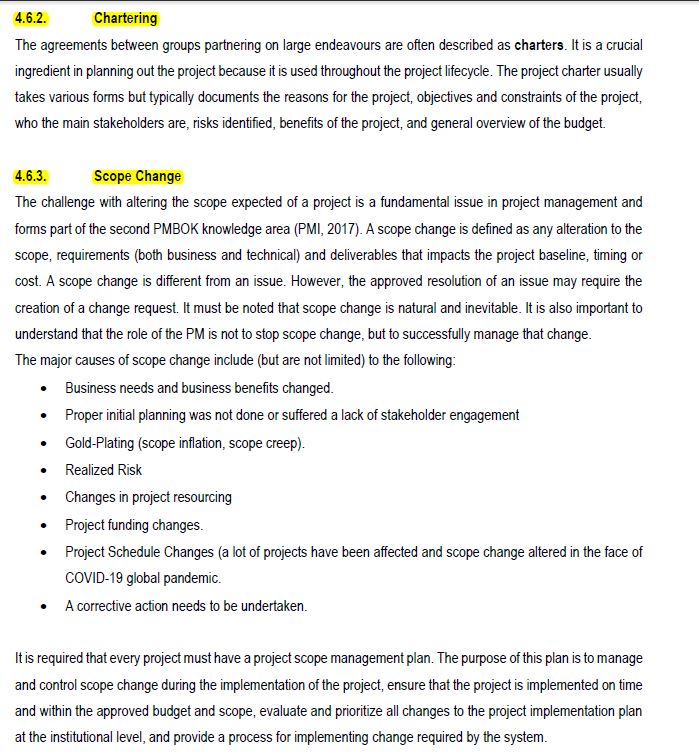
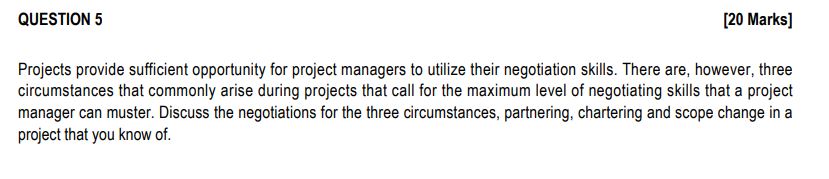
4.6. Partnering, Chartering and Scope Change Projects provide sufficient opportunity for project managers to utilize their negotiation skills. There are, however, three circumstances that commonly arise during projects that call for the maximum level of negotiating skills that a project manager can muster: the use of subcontractors, the use of input from two or more functional units to design and develop the project's mission, and the management of changes ordered in the project's deliverables and/or priorities after the project is underway (Hughes, 1998). The former probably accounts for more litigation than all other aspects of the project combined. The last two are the most common and most troublesome issues project managers face very often. 4.6.1. Partnering Lately, there has been a steady increase in the frequency of outsourcing segments of projects (Smith, 1998). This is evidenced by the fact that external suppliers are increasingly delivering parts of projects, including tangible and intangible products and services. There are many reasons beyond dodging of litigation that firms enter partnering arrangements with one another. For instance, diversification of technical risk, avoidance of capital investment, reducing political risk on multinational projects, shortening the duration of the project, and pooling of complementary knowledge, among others. Traditionally, the relationship between the organization carrying out a project and a subcontractor working on the project are characterized as adversarial. The parent organization's objective is to get the deliverable at the lowest possible cost within the shortest time frame. On the other hand, the subcontractor's objective is to produce the deliverable at the highest possible profit with the least effort. These conflicting interests often tend to lead both parties to work in an atmosphere of mutual scepticism and antipathy. Indeed, it is almost axiomatic that both parties will have meaningfully different ideas about the exact nature of the deliverable itself. The concept of "partnering" has been developed to replace this atmosphere with one of cooperation and reciprocated helpfulness, but the basically adversarial relationship makes cooperation difficult in most cases (Larson and Drexler, 1997) Project partnering is a method of transforming contractual relationships into a cohesive, cooperative project team with a single set of goals and established procedures for resolving disputes in a timely and effective manner (Cowen et al., 1992). It is an attempt to mitigate the risks intimately linked with subcontracting4.5.2. Charteiing The agreements between groups partnering on large endeavours are otten described as charters. It is a crucial ingredient 'I'I planning out the project because it is used throughout the project lifecvcte. The project charEr usuallyr takes various forms but typically documents the reasons for the project, objectives and constra'nts of the project, who the main stakeholders are, risks identied, benets of the project, and general overview of the budget 4.6.3. Scope Change The challenge with altering the scope expected of a project is a fundamental issue in project management and terms part of the second PtlelDtt knowledge area {Pl'itL EMT]. A scope change is dened as any.r alteration to the scope, requirements [both business and technican and deliverables that impacts the project baseline, tim'rig or cost. A scope change is different from an issue. However, the approved resoluon of an issue may require the creation of a change request. it must be noted that scope change is natural and inevitable. It is also important to understand that the role of the PM is not to stop scope change, but to soccesstullv manage that change. The major causes at scope change include [but are not limited} to the following: . Business needs and business benets changed. . Proper initial planning was not done or suttered a lack of stakeholder engagement . GoldPtang {scope ination, scope creep]. I Reazed Risk - Changes in project resourcing . Project tundiig changes. . Project Schedule Changes {a lot of projects have been attested and scope change altered in the face of SWIG19 global pandemic. I A corrective acon needs to be undertaken. It is required that everjr project must have a projectscope management plan. The purpose of this plan is to manage and control scope change duri'ig the irnplernentaon ot the project, ensure that the project is implemented on me and within the approved budget and scope, evaluate and primitize all changes to the project implementation plan at the instlional level, and provide a process for implementing change required by the system. oussnou s [an Marks: Projects provide sufcient opportunity for project managers to utilize their negotiation skills. There are. however. three circumstances that commonly arise during projects that call for the maximum level of negotiating skills that a project manager can muster. Discuss the negotiations for the three circumstances. partnering. chartering and scope change in a project that you know of
Step by Step Solution
There are 3 Steps involved in it

Get step-by-step solutions from verified subject matter experts