







Question: Structuring a Keep-or-Drop Product-Line Problem with Complementary Effects Shown below is a segmented income statement for Hickory Company's three wooden flooring product lines: Strip Plank
Structuring a Keep-or-Drop Product-Line Problem with Complementary Effects
Shown below is a segmented income statement for Hickory Company's three wooden flooring product lines:
| Strip | Plank | Parquet | Total | ||||||||
| Sales revenue | $409,000 | $180,000 | $303,000 | $892,000 | |||||||
| Less: Variable expenses | 210,000 | 120,000 | 235,000 | 565,000 | |||||||
| Contribution margin | $199,000 | $60,000 | $68,000 | $327,000 | |||||||
| Less direct fixed expenses: | |||||||||||
| Machine rent | (6,000) | (24,000) | (67,000) | (97,000) | |||||||
| Supervision | (10,500) | (7,000) | (3,500) | (21,000) | |||||||
| Depreciation | (45,500) | (13,000) | (32,500) | (91,000) | |||||||
| Segment margin | $137,000 | $16,000 | $(35,000) | $118,000 |
Hickory's management is deciding whether to keep or drop the parquet product line. Hickory's parquet flooring product line has a contribution margin of $68,000 (sales of $303,000 less total variable costs of $235,000). All variable costs are relevant.
Relevant fixed costs associated with this line include 80% of parquet's machine rent and all of parquet's supervision salaries. In addition, assume that dropping the parquet product line would reduce sales of the strip line by 10% and sales of the plank line by 10%. All other information remains the same.
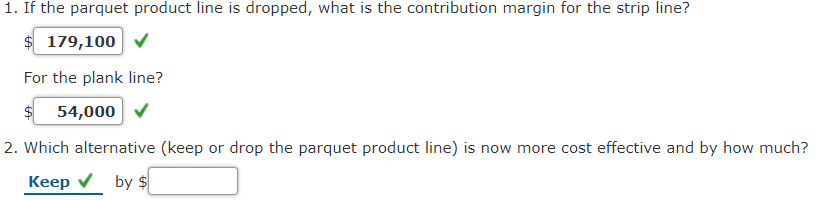
1. If the parquet product line is dropped, what is the contribution margin for the strip line? $ 179,100 For the plank line? 54,000 2. Which alternative (keep or drop the parquet product line) is now more cost effective and by how much? Keep by $
Step by Step Solution
There are 3 Steps involved in it

Get step-by-step solutions from verified subject matter experts
 Study Help