







Question: Struggling with a solution for my statistics probability class Motorola used the normal distribution to determine the probability of defects and the number of defects
Struggling with a solution for my statistics probability class
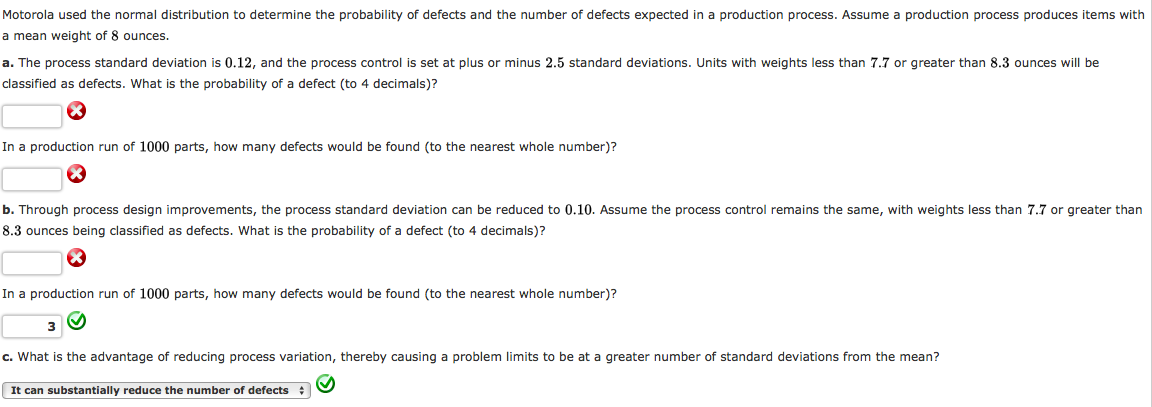
Motorola used the normal distribution to determine the probability of defects and the number of defects expected in a production process. Assume a production process produces items with a mean weight of 8 ounces. a. The process standard deviation is 0.12, and the process control is set at plus or minus 2.5 standard deviations. Units with weights less than 7.7 or greater than 8.3 ounces will be classified as defects. What is the probability of a defect (to 4 decimals)? In a production run of 1000 parts, how many defects would be found (to the nearest whole number)? b. Through process design improvements, the process standard deviation can be reduced to 0.10. Assume the process control remains the same, with weights less than 7.7 or greater than 8.3 ounces being classified as defects. What is the probability of a defect (to 4 decimals)? In a production run of 1000 parts, how many defects would be found (to the nearest whole number)? 3 c. What is the advantage of reducing process variation, thereby causing a problem limits to be at a greater number of standard deviations from the mean? It can substantially reduce the number of defects *
Step by Step Solution
There are 3 Steps involved in it

Get step-by-step solutions from verified subject matter experts
 Study Help