



Question: Stuck on these...possible for some help? Thank you! 1. A researcher, Bobby See, is interested in whether the provision of loans at planting time increases
Stuck on these...possible for some help? Thank you!
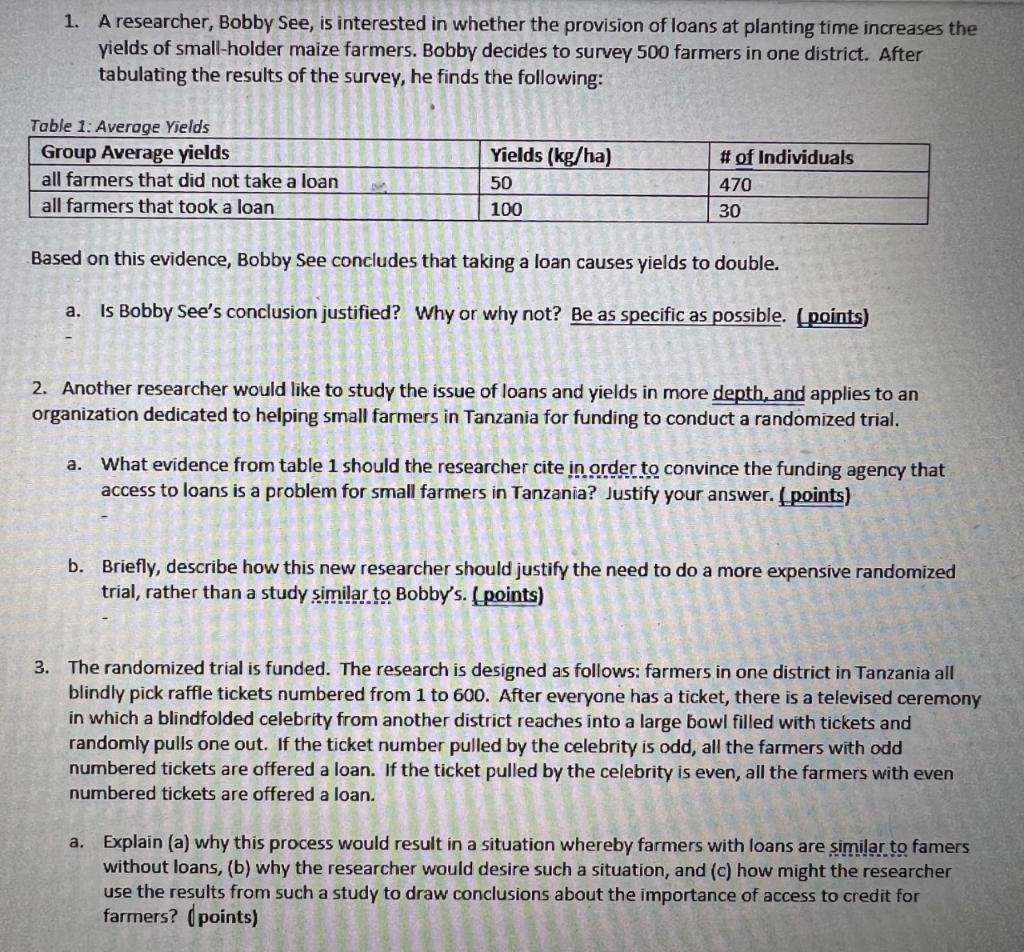
1. A researcher, Bobby See, is interested in whether the provision of loans at planting time increases the vields of small-holder maize farmers. Bobby decides to survey 500 farmers in one district. After tabulating the results of the survey, he finds the following: Based on this evidence, Bobby See concludes that taking a loan causes yields to double. a. Is Bobby See's conclusion justified? Why or why not? Be as specific as possible. [points) 2. Another researcher would like to study the issue of loans and yields in more depth, and applies to an organization dedicated to helping small farmers in Tanzania for funding to conduct a randomized trial. a. What evidence from table 1 should the researcher cite in order to convince the funding agency that access to loans is a problem for small farmers in Tanzania? Justify your answer. (points) b. Briefly, describe how this new researcher should justify the need to do a more expensive randomized trial, rather than a study similarto Bobby's. (points) 3. The randomized trial is funded. The research is designed as follows: farmers in one district in Tanzania all blindly pick raffle tickets numbered from 1 to 600 . After everyone has a ticket, there is a televised ceremony in which a blindfolded celebrity from another district reaches into a large bowl filled with tickets and randomly pulls one out. If the ticket number pulled by the celebrity is odd, all the farmers with odd numbered tickets are offered a loan. If the ticket pulled by the celebrity is even, all the farmers with even numbered tickets are offered a loan. a. Explain (a) why this process would result in a situation whereby farmers with loans are similar to famers without loans, (b) why the researcher would desire such a situation, and (c) how might the researcher use the results from such a study to draw conclusions about the importance of access to credit for farmers? (points) 1. A researcher, Bobby See, is interested in whether the provision of loans at planting time increases the vields of small-holder maize farmers. Bobby decides to survey 500 farmers in one district. After tabulating the results of the survey, he finds the following: Based on this evidence, Bobby See concludes that taking a loan causes yields to double. a. Is Bobby See's conclusion justified? Why or why not? Be as specific as possible. [points) 2. Another researcher would like to study the issue of loans and yields in more depth, and applies to an organization dedicated to helping small farmers in Tanzania for funding to conduct a randomized trial. a. What evidence from table 1 should the researcher cite in order to convince the funding agency that access to loans is a problem for small farmers in Tanzania? Justify your answer. (points) b. Briefly, describe how this new researcher should justify the need to do a more expensive randomized trial, rather than a study similarto Bobby's. (points) 3. The randomized trial is funded. The research is designed as follows: farmers in one district in Tanzania all blindly pick raffle tickets numbered from 1 to 600 . After everyone has a ticket, there is a televised ceremony in which a blindfolded celebrity from another district reaches into a large bowl filled with tickets and randomly pulls one out. If the ticket number pulled by the celebrity is odd, all the farmers with odd numbered tickets are offered a loan. If the ticket pulled by the celebrity is even, all the farmers with even numbered tickets are offered a loan. a. Explain (a) why this process would result in a situation whereby farmers with loans are similar to famers without loans, (b) why the researcher would desire such a situation, and (c) how might the researcher use the results from such a study to draw conclusions about the importance of access to credit for farmers? (points)
Step by Step Solution
There are 3 Steps involved in it

Get step-by-step solutions from verified subject matter experts