





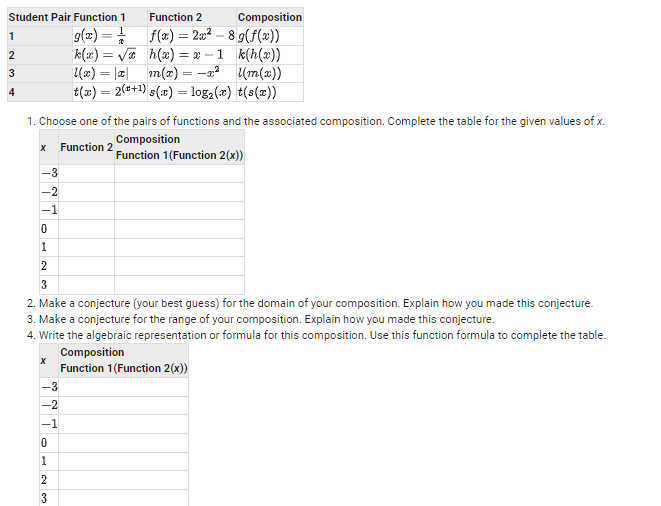
Question: Student Pair Function 1 Function 2 Composition g(@ ) = f(x) = 2x - 8 9(f(x)) k() = vo h(@) =>-1 k(h(>)) I(x) = =
Student Pair Function 1 Function 2 CompositionStudent Pair Function 1 Function 2 Composition
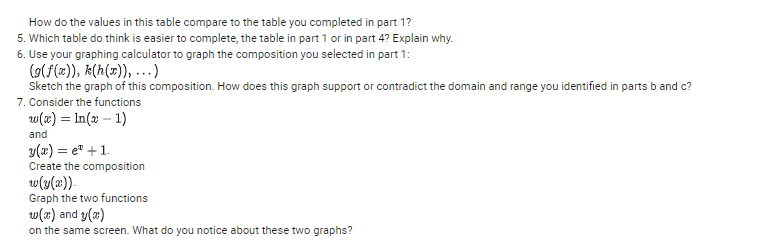
Student Pair Function 1 Function 2 Composition g(@ ) = f(x) = 2x - 8 9(f(x)) k() = vo h(@) =>-1 k(h(>)) I(x) = = m(x) =-x I(m(x)) t(x) = 2(#+1) s(x) = log2(x) t(s(x)) 1. Choose one of the pairs of functions and the associated composition. Complete the table for the given values of x. x Function 2- Composition Function 1 (Function 2(x)) -3 -2 0 2. Make a conjecture (your best guess) for the domain of your composition. Explain how you made this conjecture. 3. Make a conjecture for the range of your composition. Explain how you made this conjecture. 4. Write the algebraic representation or formula for this composition. Use this function formula to complete the table. Composition Function 1(Function 2(x)) -3 -2 0How do the values in this table compare to the table you completed in part 1? 5. Which table do think is easier to complete, the table in part 1 or in part 4? Explain why. 6. Use your graphing calculator to graph the composition you selected in part 1: (o(f(@)), k(h(x)), ...) Sketch the graph of this composition. How does this graph support or contradict the domain and range you identified in parts b and c? 7. Consider the functions w(xx) = In(x - 1) and y() = @+1. Create the composition why(@)) Graph the two functions w(x) and y(a) on the same screen. What do you notice about these two graphs

Step by Step Solution

There are 3 Steps involved in it

1 Expert Approved Answer
Step: 1 Unlock blur-text-image

Question Has Been Solved by an Expert!

Get step-by-step solutions from verified subject matter experts

Step: 2 Unlock
Step: 3 Unlock

Students Have Also Explored These Related Mathematics Questions!