







Question: Students in a biophysics class used a hinged beam setup (Figure 1) in order to simulate forces present in the human arm. A horizontal
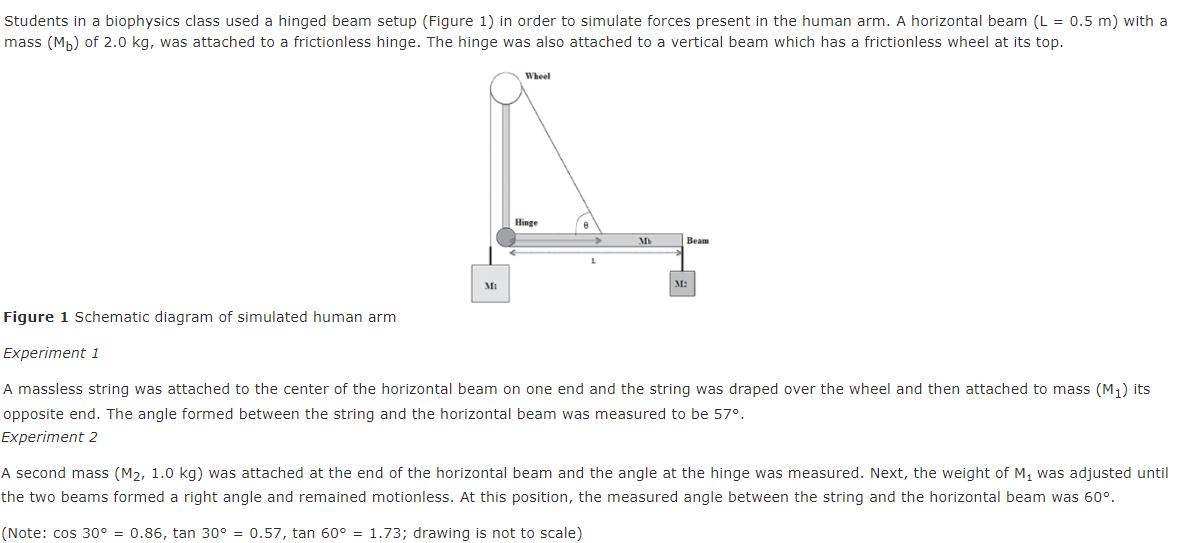

Students in a biophysics class used a hinged beam setup (Figure 1) in order to simulate forces present in the human arm. A horizontal beam (L = 0.5 m) with a mass (M) of 2.0 kg, was attached to a frictionless hinge. The hinge was also attached to a vertical beam which has a frictionless wheel at its top. Mi Wheel Hinge L M Beam M: Figure 1 Schematic diagram of simulated human arm Experiment 1 A massless string was attached to the center of the horizontal beam on one end and the string was draped over the wheel and then attached to mass (M) its opposite end. The angle formed between the string and the horizontal beam was measured to be 57. Experiment 2 A second mass (M2, 1.0 kg) was attached at the end of the horizontal beam and the angle at the hinge was measured. Next, the weight of M was adjusted until the two beams formed a right angle and remained motionless. At this position, the measured angle between the string and the horizontal beam was 60. (Note: cos 30 = 0.86, tan 30 = 0.57, tan 60 = 1.73; drawing is not to scale) At the conclusion of experiment 2, what is the length of the string between where it is attached to the horizontal beam and the point where it comes in contact with the wheel?
Step by Step Solution
3.40 Rating (150 Votes )
There are 3 Steps involved in it

Get step-by-step solutions from verified subject matter experts
 Study Help