







Question: Students will be given an engineering problem to determine and analyze the deformation, maximum stress of rectangular plate with hole and edge under plain stress
Students will be given an engineering problem to determine and analyze the deformation, maximum stress
of rectangular plate with hole and edge under plain stress Shown in details below using available
resources tool to understand the fundamental of stress concentration factor as a result from this problem
solving finding, as well as the effect of regular meshing Task : Theory of Elasticity Stress Concentration Factor Lab Test Week
Students will be given an engineering problem to determine and analyze the deformation, maximum stress
of rectangular plate with hole and edge under plain stress Shown in details below using available
resources tool to understand the fundamental of stress concentration factor as a result from this problem
solving finding, as well as the effect of regular meshing and the refine meshing with different levels Mesh
Sensitivity Analysis The required input data shown in Table Task below.
marks
Engineering Problem Details:
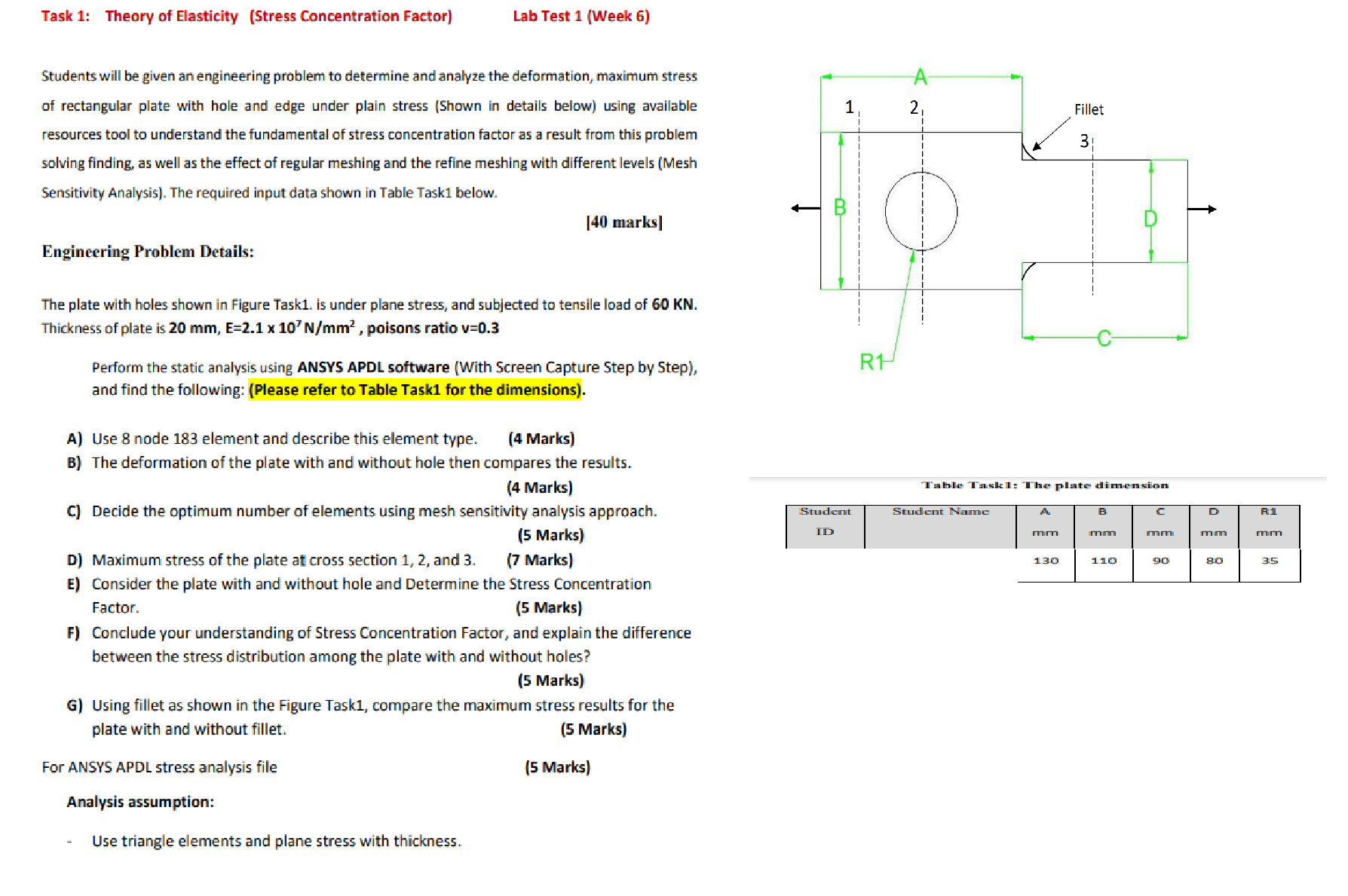
The plate with holes shown in Figure Task is under plane stress, and subjected to tensile load of KN
Thickness of plate is poisons ratio
Perform the static analysis using ANSYS APDL software With Screen Capture Step by Step
and find the following: Please refer to Table Task for the dimensions
A Use node element and describe this element type.
Marks
B The deformation of the plate with and without hole then compares the results.
Marks
C Decide the optimum number of elements using mesh sensitivity analysis approach.
Marks
D Maximum stress of the plate at cross section and
Marks
E Consider the plate with and without hole and Determine the Stress Concentration
Factor.
Marks
F Conclude your understanding of Stress Concentration Factor, and explain the difference
between the stress distribution among the plate with and without holes?
Marks
G Using fillet as shown in the Figure Task compare the maximum stress results for the
plate with and without fillet.
Marks
For ANSYS APDL stress analysis file
Marks
Analysis assumption:
Use triangle elements and plane stress with thickness.and the refine meshing with different levels Mesh
Sensitivity Analysis The required input data shown in Table Task below.
marks
Engineering Problem Details:
The plate with holes shown in Figure Task is under plane stress, and subjected to tensile load of KN
Thickness of plate is mm E x Nmm
poisons ratio v
Perform the static analysis using ANSYS APDL software With Screen Capture Step by Step
and find the following: Please refer to Table Task for the dimensions
A Use node element and describe this element type. Marks
B The deformation of the plate with and without hole then compares the results.
Marks
C Decide the optimum number of elements using mesh sensitivity analysis approach.
Marks
D Maximum stress of the plate at cross section and Marks
E Consider the plate with and without hole and Determine the Stress Concentration
Factor. Marks
F Conclude your understanding of Stress Concentration Factor, and explain the difference
between the stress distribution among the plate with and without holes?
Marks
G Using fillet as shown in the Figure Task compare the maximum stress results for the
plate with and without fillet. Marks
For ANSYS APDL stress analysis file Marks
Step by Step Solution
There are 3 Steps involved in it
1 Expert Approved Answer
Step: 1 Unlock

Question Has Been Solved by an Expert!
Get step-by-step solutions from verified subject matter experts
Step: 2 Unlock
Step: 3 Unlock
 Study Help