







Question: Study Design Study Design 4: One hundred students were selected at random from those enrolled at a large college. Each of the selected students was
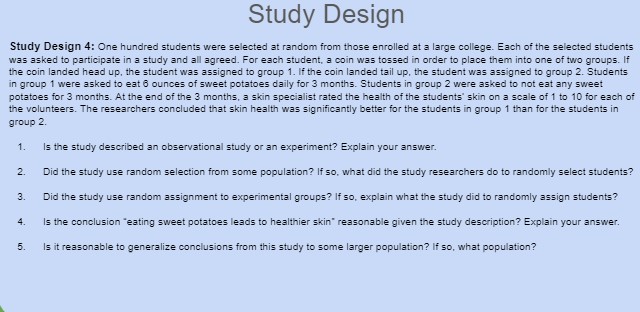
Study Design Study Design 4: One hundred students were selected at random from those enrolled at a large college. Each of the selected students was asked to participate in a study and all agreed. For each student, a coin was tossed in order to place them into one of two groups. If the coin landed head up, the student was assigned to group 1. If the coin landed tail up, the student was assigned to group 2. Students in group 1 were asked to eat 6 ounces of sweet potatoes daily for 3 months. Students in group 2 were asked to not eat any sweet potatoes for 3 months. At the end of the 3 months, a skin specialist rated the health of the students' skin on a scale of 1 to 10 for each of the volunteers. The researchers concluded that skin health was significantly better for the students in group 1 than for the students in group 2. 1. Is the study described an observational study or an experiment? Explain your answer. 2. Did the study use random selection from some population? If so, what did the study researchers do to randomly select students? 3. Did the study use random assignment to experimental groups? If so, explain what the study did to randomly assign students? 4. Is the conclusion "eating sweet potatoes leads to healthier skin" reasonable given the study description? Explain your answer. 5. Is it reasonable to generalize conclusions from this study to some larger population? If so, what population
Step by Step Solution
There are 3 Steps involved in it

Get step-by-step solutions from verified subject matter experts
 Study Help