





Question: Study Guide Exam 1 Helpful Hints: 1. The exam will contain 4-5 major quantitative and / or analysis questions with multiple parts. In total there

Study Guide Exam 1 Helpful Hints: 1. The examStudy Guide Exam 1 Helpful Hints: 1. The exam
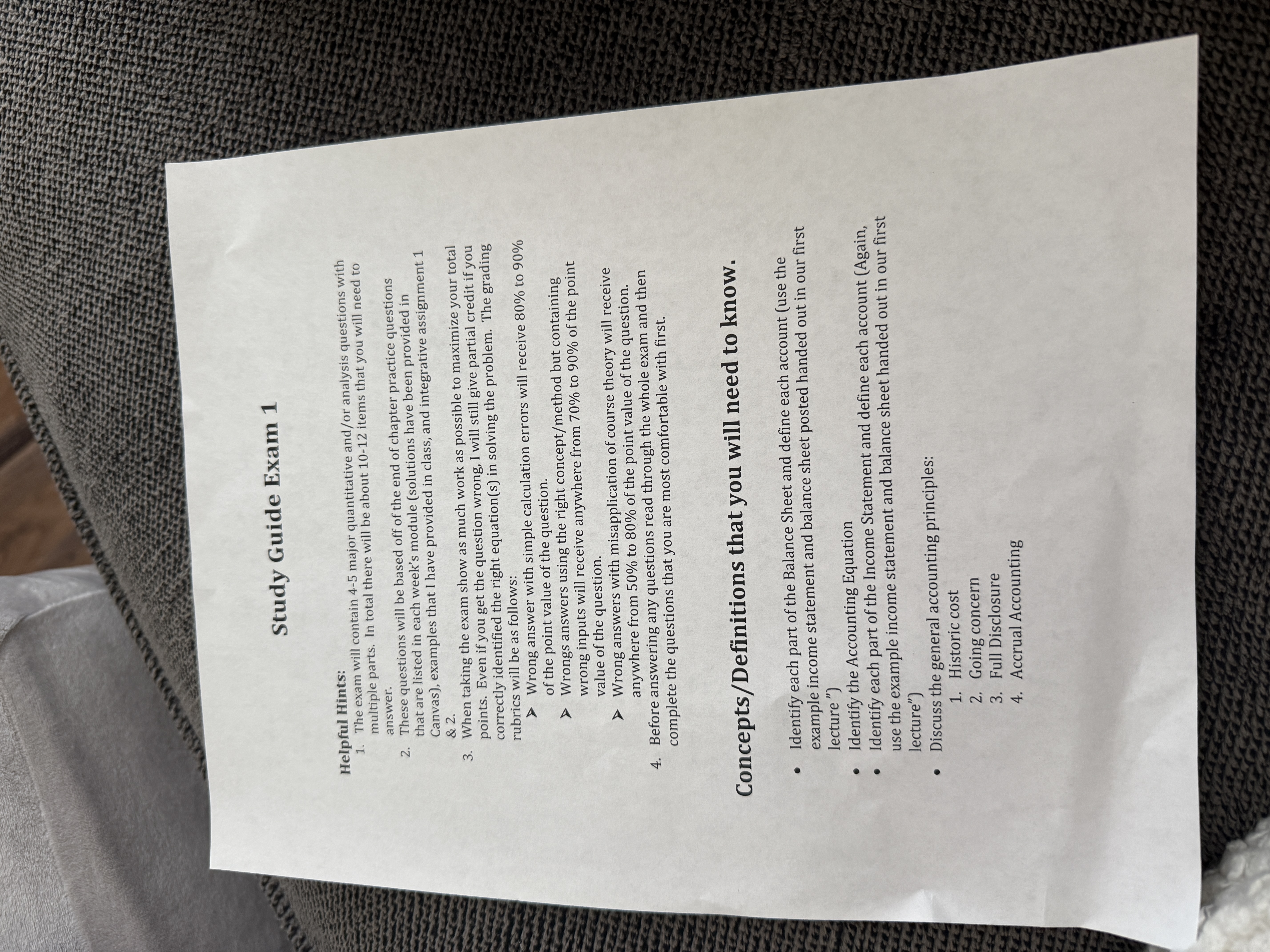
Study Guide Exam 1 Helpful Hints: 1. The exam will contain 4-5 major quantitative and / or analysis questions with multiple parts. In total there will be about 10-12 items that you will need to answer. These questions will be based off of the end of chapter practice questions that are listed in each week's module (solutions have been provided in Canvas), examples that I have provided in class, and integrative assignment 1 & 2. 3. When taking the exam show as much work as possible to maximize your total points. Even if you get the question wrong, I will still give partial credit if you correctly identified the right equation(s) in solving the problem. The grading rubrics will be as follows: > Wrong answer with simple calculation errors will receive 80% to 90% of the point value of the question. Wrongs answers using the right concept/method but containing wrong inputs will receive anywhere from 70% to 90% of the point value of the question. Wrong answers with misapplication of course theory will receive anywhere from 50% to 80% of the point value of the question. 4. Before answering any questions read through the whole exam and then complete the questions that you are most comfortable with first. Concepts/Definitions that you will need to know. Identify each part of the Balance Sheet and define each account (use the example income statement and balance sheet posted handed out in our first lecture ") Identify the Accounting Equation Identify each part of the Income Statement and define each account (Again, use the example income statement and balance sheet handed out in our first lecture") Discuss the general accounting principles: 1. Historic cost 2. Going concern 3. Full Disclosure 4. Accrual AccountingApplication and Problem Solving that you will need to have mastery over. Analyze financial transactions and determine the impact to specific income statement or balance sheet accounts using the "financial impact template" form (as used on in-class assignments). Accounting for Assets: 1. Calculate Bad Debt expense and allowance for bad debt. 2. Calculate Cost of Goods Sold and ending inventory balances using average costing method, LIFO, and/ or FIFO. 3. Calculate Depreciation Expense and Accumulated Depreciation balances using the straight line, or double declining balance. To do this you will also need to be able to calculate the "Depreciable Amount" of the asset (the total amount that will be depreciated). Accounting for Liabilities: 1. Determine if a company should pay early if offered a discount on A/P 2. Account for warranty expenses and show how these expenses impact the income statement and balance sheet. 3. Calculate the interest expense and principal payment on debt. 4. Determine how the balance sheet and income statement are impacted as bonds are sold at a premium, discount, or par (you will not have to amortize the bond premium or calculate the prize of bonds using the present value table). 5. Determine the impact to the balance sheet and income statement when a company repurchases it bonds for more money or less money than the par value of its bonds. . Equity: 1. Calculate Par value of stock 2. Calculate Paid in Additions to Capital 3. Determine the impact to the balance sheet when the company buys its own stock or sells its treasury stock. 4. Calculate Stock Dividends and its impact to the balance sheet. 5. Calculate Cash Dividends and its impact to the balance sheet. 6. Determine the timing of when to recognize stock or cash dividends

Step by Step Solution

There are 3 Steps involved in it

1 Expert Approved Answer
Step: 1 Unlock blur-text-image

Question Has Been Solved by an Expert!

Get step-by-step solutions from verified subject matter experts

Step: 2 Unlock
Step: 3 Unlock

Students Have Also Explored These Related Accounting Questions!