







Question: Study Guide for Lab Exam 2 ( roughly 2 5 - 3 0 questions ) Bacterial DNA Isolation Use a micropipette correctly and read the
Study Guide for Lab Exam
roughly questions
Bacterial DNA Isolation
Use a micropipette correctly and read the volume measurement settings on a micropipette.
List the basic steps of bacterial DNA isolation from the Introduction section, not the directions Describe the purpose of each step.
Explain how a spectrophotometer can be used to measure determine the concentration and purity of a DNA sample.
Given an measurement, calculate the DNA concentration in
Interpret an ratio, explaining whether the DNA is pure, contaminated with protein, or too dilute.
Biochemical Tests I and II
Identify some major differences between bacteria species.
Define selective and differential media. Know which media we used belong in each category.
For each type of selective media: know what type of bacteria are able to grow on that media.
For each type of differential media or test: know which characteristic is being differentiated and how to interpret the results.
By comparing known species on selective and differential media, be able to identify the species in an unknown sample.
The Quick Reference Guide for Media is an important study tool for this experiment! You can find it in the Content section on DLPlease note that this study tool does not include the catalase test or oxidase test, which you will be required to know for the exam.
Influenza film Killer Flu
Explain the features of the influenza pandemic that made it unique from other influenza epidemics.
Identify the clinical sign associated with severe influenza in the pandemic.
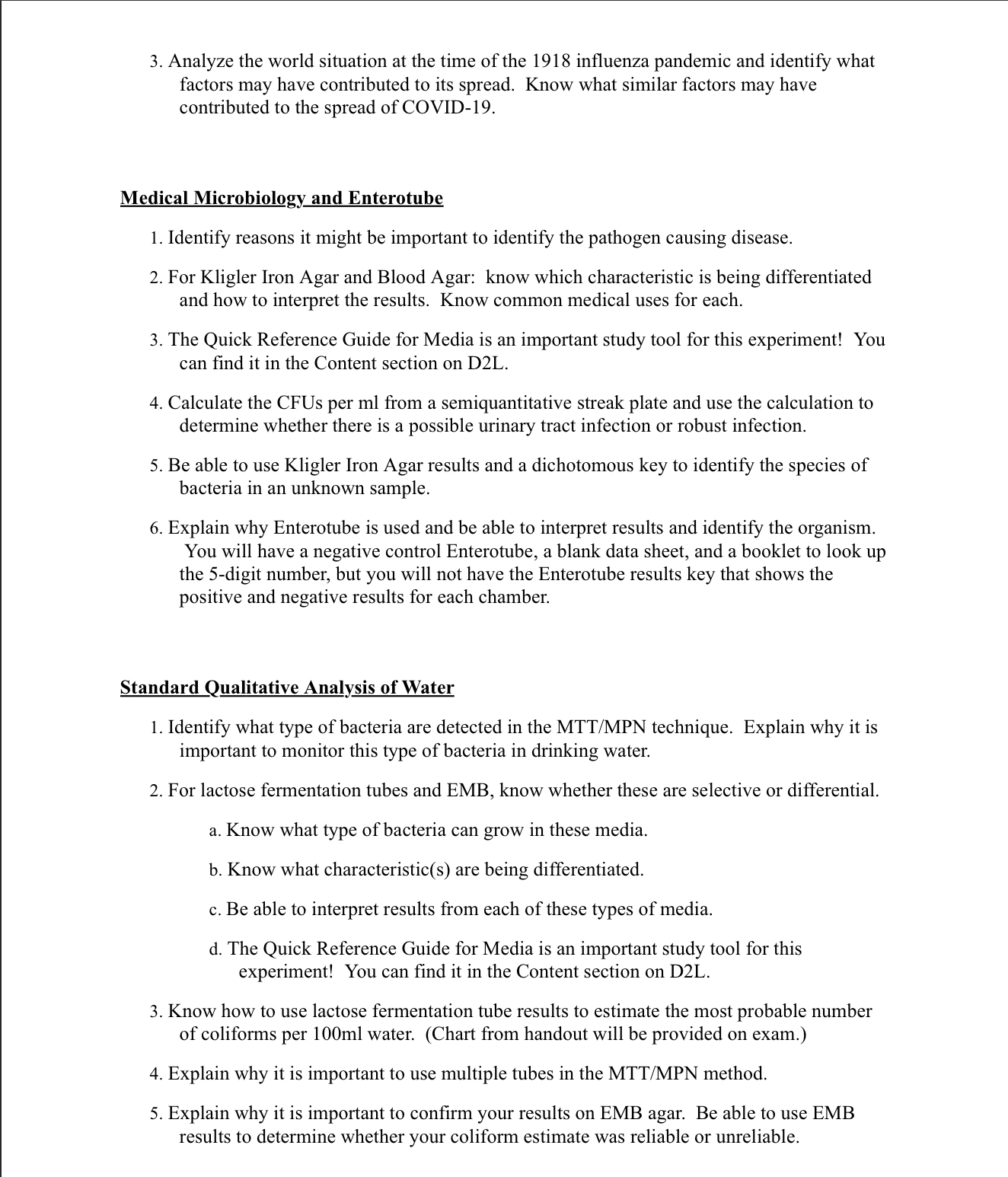
Analyze the world situation at the time of the influenza pandemic and identify what factors may have contributed to its spread. Know what similar factors may have contributed to the spread of COVID
Medical Microbiology and Enterotube
Identify reasons it might be important to identify the pathogen causing disease.
For Kligler Iron Agar and Blood Agar: know which characteristic is being differentiated and how to interpret the results. Know common medical uses for each.
The Quick Reference Guide for Media is an important study tool for this experiment!You can find it in the Content section on DL
Calculate the CFUs per ml from a semiquantitative streak plate and use the calculation to determine whether there is a possible urinary tract infection or robust infection.
Be able to use Kligler Iron Agar results and a dichotomous key to identify the species of bacteria in an unknown sample.
Explain why Enterotube is used and be able to interpret results and identify the organism. You will have a negative control Enterotube, a blank data sheet, and a booklet to look up the digit number, but you will not have the Enterotube results key that shows the positive and negative results for each chamber.
Standard Qualitative Analysis of Water
Identify what type of bacteria are detected in the MTTMPN technique. Explain why it is important to monitor this type of bacteria in drinking water.
For lactose fermentation tubes and EMB, know whether these are selective or differential.
a Know what type of bacteria can grow in these media.
b Know what characteristics are being differentiated.
c Be able to interpret results from each of these types of media.
d The Quick Reference Guide for Media is an important study tool for this experiment! You can find it in the Content section on DL
Know how to use lactose fermentation tube results to estimate the most probable number of coliforms per ml water. Chart from handout will be provided on exam.
Explain why it is important to use multiple tubes in the MTTMPN method.
Explain why it is important to confirm your results on EMB agar. Be able to use EMB results to determine whether your coliform estimate was reliable or unreliable.
Step by Step Solution
There are 3 Steps involved in it
1 Expert Approved Answer
Step: 1 Unlock

Question Has Been Solved by an Expert!
Get step-by-step solutions from verified subject matter experts
Step: 2 Unlock
Step: 3 Unlock
 Study Help