



Question: Study review questions QUESTION 9 Given the following AM modulated signal, determine the original message, m(t) s(t) 51+0.5 cos(2n100t)] cos(2n1 60E6t) a. m(t) -2.5cos(2160MHz*t) C.
Study review questions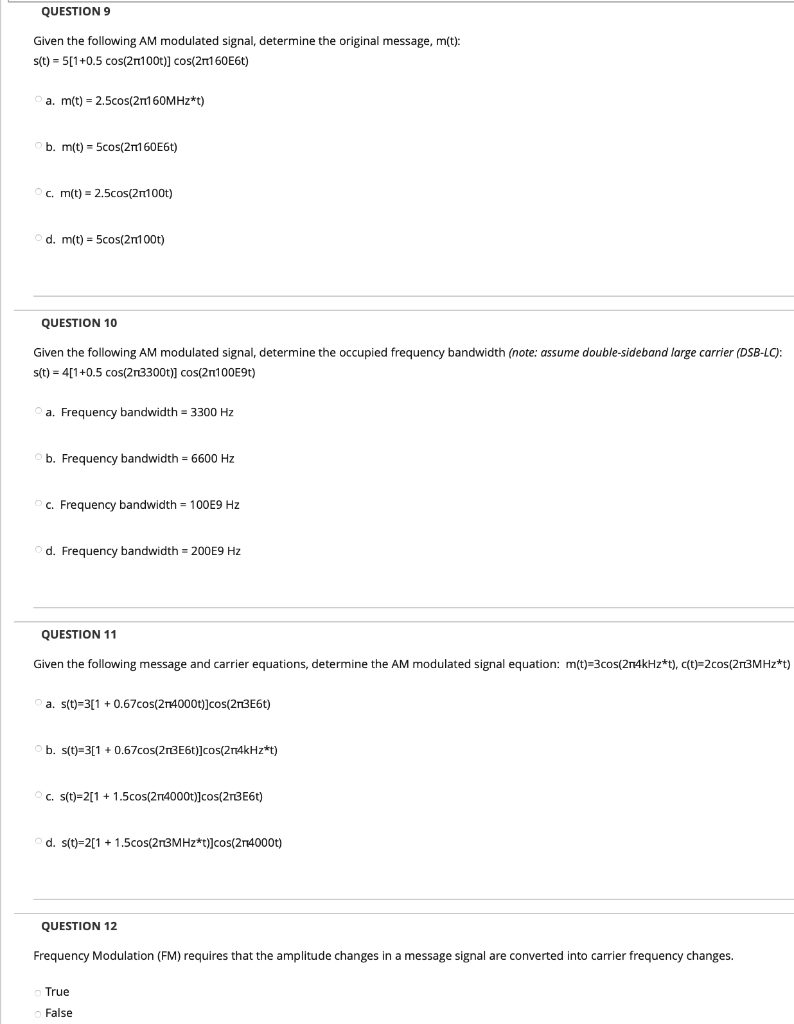
QUESTION 9 Given the following AM modulated signal, determine the original message, m(t) s(t) 51+0.5 cos(2n100t)] cos(2n1 60E6t) a. m(t) -2.5cos(2160MHz*t) C. m(t)2.5cos(2t100t) d. m(t)- 5cos(2100t) QUESTION 10 Given the following AM modulated signal, determine the occupied frequency bandwidth (note: assume double-sideband large carrier (DSB-LC): s(t)-401+0.5 cos(2rn3300t)] cos(2n100E9t) a. Frequency bandwidth 3300 Hz b. Frequency bandwidth 6600 Hz C. Frequency bandwidth 100E9 Hz d. Frequency bandwidth 200E9 Hz QUESTION 11 Given the following message and carrier equations, determine the AM modulated signal equation: m(t)=3cos(2n4kHz*t), c(t)=2cos(2t3MHz*t) a. s(t)#3[1 +0.67cos(2TH000t)]cos(2n3E6t) b. s(t)-3110.67cos(2n3E6t)cos(24kHz*t) C. S(t)=2(1 + 1 .5cos(2n4000t]cos(2nBE60 d. s(t)-2011.5cos(2T3MHz*)o(24000t) QUESTION 12 Frequency Modulation (FM) requires that the amplitude changes in a message signal are converted into carrier frequency changes. True False
Step by Step Solution
There are 3 Steps involved in it

Get step-by-step solutions from verified subject matter experts