Question: Styles 1. How does the implementation of tariffs, or the threat of implementation of tariffs, affect supply chain quality? If you wish, you can include
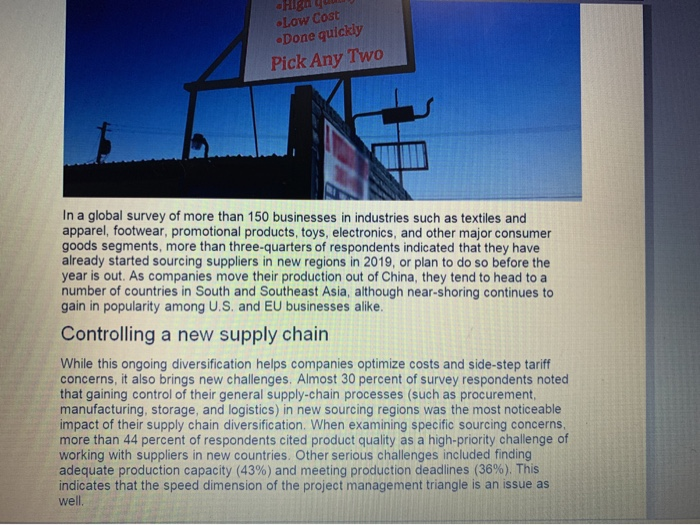
Styles 1. How does the implementation of tariffs, or the threat of implementation of tariffs, affect supply chain quality? If you wish, you can include effects of new tariffs on the EC as well. 2. What reasons would a company choose to continue sourcing in China (or in Europe), despite tariffs? Are there any US auto manufacturers who might choose this route? Why or why not? 3. What are the political and economic goals of tariffs? Can tariffs also improve the quality of supply chains? Why or why not? Quality Control in the Tariff-Challenged Supply Chain New sourcing markets emphasize the classic quality- speed-cost constraint-with quality the most likely to lose out Published: Thursday, September 12, 2019 Paragraph Styles 6 Whether it be a move forced by the U.S.-China tariff turmoil, or a sourcing strategy long in the works, the exodus from China is a reality for a host of businesses, from small to medium-sized enterprises to multinationals. While the departure is widespread, it isn't universal-some major players, Nike and Intel among them, openly announce they have no intention to pull out of China, in a large part due to its importance as a consumer market. However, for businesses in pursuit of low-cost outsourcing, China is becoming an increasingly less feasible choice. With Vietnam-arguably the biggest beneficiary from the trade war fallout-almost at capacity, global supply chains in price-sensitive consumer goods segments are exploring new sourcing horizons, That said, shifting one's supply chain into a new country is never a trouble-free process. In the classic project management triangle of quality vs. speed vs. cost, only two facets out of three are available at any given time. The latest data collected by quality and compliance solution provider QIMA (Links to an external site.) indicate that as buyers move into new sourcing regions, the quality dimension is the most likely to suffer. Higu Low Cost Done quickly Pick Any Two In a global survey of more than 150 businesses in industries such as textiles and apparel, footwear, promotional products, toys, electronics, and other major consumer goods segments, more than three-quarters of respondents indicated that they have already started sourcing suppliers in new regions in 2019, or plan to do so before the year is out. As companies move their production out of China, they tend to head to a number of countries in South and Southeast Asia, although near-shoring continues to gain in popularity among U.S. and EU businesses alike. Controlling a new supply chain While this ongoing diversification helps companies optimize costs and side-step tariff concerns, it also brings new challenges. Almost 30 percent of survey respondents noted that gaining control of their general supply-chain processes (such as procurement manufacturing, storage, and logistics) in new sourcing regions was the most noticeable impact of their supply chain diversification. When examining specific sourcing concerns, more than 44 percent of respondents cited product quality as a high-priority challenge of working with suppliers in new countries. Other serious challenges included finding adequate production capacity (43%) and meeting production deadlines (36%). This indicates that the speed dimension of the project management triangle is an issue as well. Data gathered during onsite quality control checks show that businesses' concerns about new regions are far from baseless. As a rule, the less mature the sourcing market, the more likely it is to struggle with quality issues. A vivid example of this is Cambodia, where local suppliers are enjoying increased demand from overseas buyersbut lack the time or resources necessary to establish proper quality management processes or train new personnel. As a result, more than 40 percent of all goods inspected in Cambodian factories during the second quarter of 2019 were found outside of acceptable quality limits (compare that with China, where 25 percent of inspection reports made during that same time reported out-of-spec issues, a +13- percent, year-over-year improvement). By comparison, Turkey, a more mature market for apparel, handled the increased production pace better. After a brief spike in quality issues around the turn of year, local suppliers succeeded at pushing the inspection failure rate below 25 percent during the second quarter of 2019-despite the influx of new orders from European buyers, for whom Turkey represents a prime geography for near-shoring, South Asia product quality has deteriorated Meanwhile, the positive correlation between sourcing-region maturity and manufacturing quality doesn't seem to hold up in South Asia, based on product quality data from the ground. This region of textile powerhouses is enjoying renewed popularity with U.S. buyers, but product quality there has notably deteriorated since the start of 2019. In India, 33 percent of all goods inspected during the second quarter of 2019 (including almost 40 percent of all textile and apparel products) failed to meet client specifications, while quality failure rates were even higher in Pakistan. Both countries are seasoned textile and apparel producers, and India in particular has been hard at work during the past few years carving out a path toward innovation in textiles, with new technologies and automation Paragraph Styles 5 gooos inspected in Cambodian actories during the second quarter or 2019 Were Yound outside of acceptable quality limits (compare that with China, where 25 percent of inspection reports made during that same time reported out-of-spec issues, a +13- percent year-over-year improvement). By comparison, Turkey, a more mature market for apparel, handled the increased production pace better. After a brief spike in quality issues around the turn of year, local suppliers succeeded at pushing the inspection failure rate below 25 percent during the second quarter of 2019_despite the influx of new orders from European buyers, for whom Turkey represents a prime geography for near-shoring. South Asia product quality has deteriorated Meanwhile, the positive correlation between sourcing-region maturity and manufacturing quality doesn't seem to hold up in South Asia, based on product quality data from the ground. This region of textile powerhouses is enjoying renewed popularity with U.S. buyers, but product quality there has notably deteriorated since the start of 2019. In India, 33 percent of all goods inspected during the second quarter of 2019 (including almost 40 percent of all textile and apparel products) failed to meet client specifications, while quality failure rates were even higher in Pakistan. Both countries are seasoned textile and apparel producers, and India in particular has been hard at work during the past few years carving out a path toward innovation in textiles, with new technologies and automation Then why such depressing quality performance? The most likely explanation is the speed-cost-quality triangle at work again. After all, a business that moves regions to chase low costs is more likely to choose a low-balling bidder within the new country, and a low manufacturer price point tends to translate to small facilities and manual labor, especially in the textile and apparel sectors. In summary, the trends observed on the ground, and the business sentiment expressed through the survey, point to the same takeaway: This period of global trade uncertainty and the resultant shift away from China, is definitely not the time to let quality concerns fall by the wayside. On the contrary, when expanding a supply chain into new sourcing markets, buyers must increase their focus on product quality and safety, especially when it comes to moving from established sourcing regions to less mature ones









 Study Help