Question: Sub : Current Issue in Business CASE Globalizing Your Career Companies have been moving people around for centuries, capturing the benefits of putting the right
Sub : Current Issue in Business
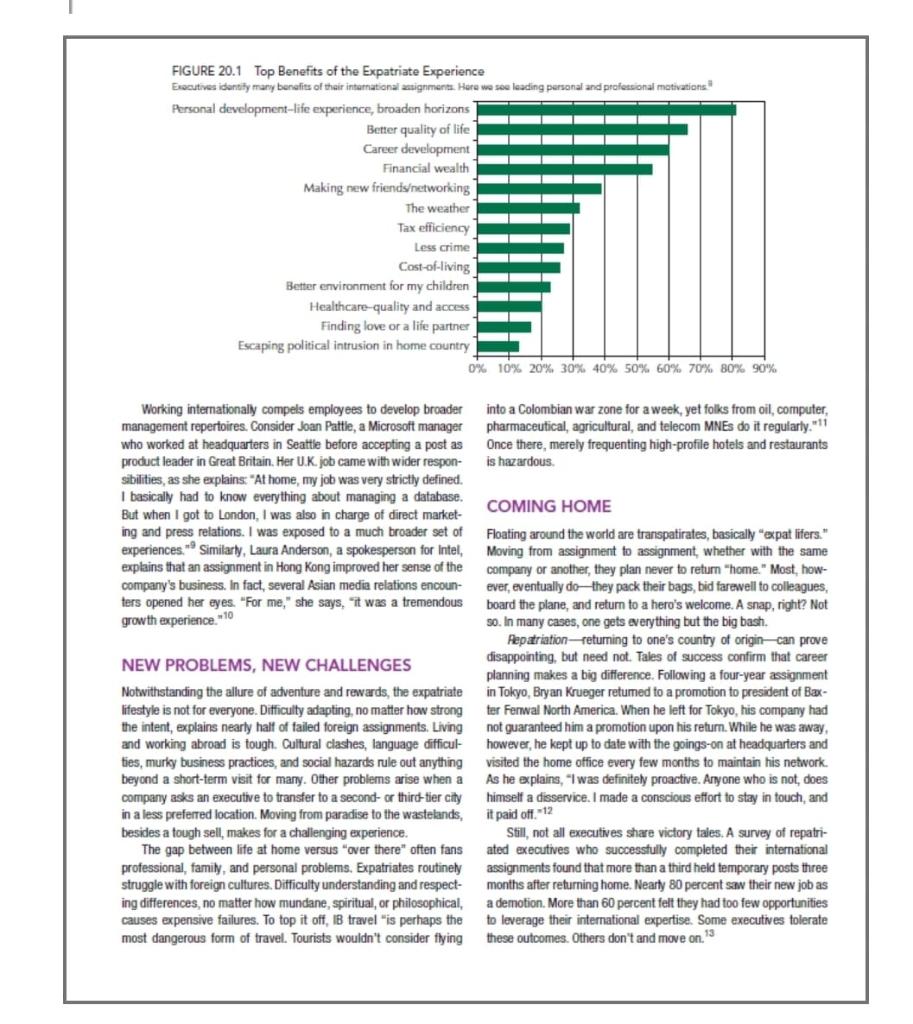
CASE Globalizing Your Career Companies have been moving people around for centuries, capturing the benefits of putting the right person into the right job at the right place at the right time at the right pay for the right stretch. Contemporary market trends, strategic imperatives, and executive performance standards intensify this task. Today, career success requires at the least, expanding your global awareness and ideally, your experiential knowledge of the ways that the world works. Globalization, by spurring trade, capital, and investment flows, expands the scope of the hundreds of thousands of existing sub- sidiaries that operate in the 214 markets that compose the global business environment. Each unit, established and emerging, requires executives who command the competencies to navigate economic complexities, cultural ambiguities, and political challenges, all the while maximizing the MNE's global efficiency and optimizing its local responsiveness. GE'S Jeffrey Immelt explains, "A good global com- pany does three things: It's a global sales company-meaning it's number one with customers all over the world, whether in Chicago or Paris or Tokyo. It's a global products company, with technologies, fac- tories, and products made for the world, not just for a single region. And, most important, it's a global people company--a company that keeps getting better by capturing global markets and brains." By no means must one immediately pack up, say good-bye, and head abroad. For those who do, fear not, as an international assign- ment has many benefits (see Figure 20.1). Moreover, the word is out: A Gallup World Poll reports that 1.1 billion people, or one-quarter of the earth's adults, want to move temporarily to another country to find a higher paying job. Another 630 million aim to move abroad per- manently. Still, even if your career plans anchor you to your home market, globalizing markets encourage globalizing your mindset. From Afghanistan to Zimbabwe, effective leadership increas- ingly calls for a global mindset. "You have have an intuitive sense of how the world works and how people behave," says Paul Lau- dicina, vice president of A. T. Kearney. Observed Daniel Meiland of Egon Zehender International, an executive search firm, "The world is getting smaller, and markets are getting bigger. In my more than 25 years in the executive search profession, we ve always talked about the global executive, but the need to find managers who can be effective in many different settings is growing ever more urgent In addition to looking for intelligence, specific skills, and technical insights, MNEs are also looking for executives who are comfortable on the world stage. send many. Unfortunately, few standards stipulate why, when, and where MNEs should use expatriates (a person who works outside their native country). Moreover, ambiguity complicates selecting the night expatriates, developing the right predeparture programs, de- signing the right compensation packages, setting the right stretch of time for the assignments, and determining the right way to rein- tegrate them into the home company when they complete their tour of duty. The consequences of success and failure press MNEs to man- age their human resources proactively. Honeywell like many, begins developing potential expatriatesyears before they might head abroad. It assesses candidates' cross-cultural skills and prescribes training paths that anticipate likely points of culture shock. We give them a horizon, a perspective, and gradually, we tell them they are poten- tially on an international path," says Honeywell's VP of HR. "We want them to develop a cross-cultural intellect, what we call strategic accountability. Honeywell might advise employees to network with experienced expatriates or improve their personal and professional resourcefulness. Nestle leaves less to chance in developing its expa- triate pipeline. High performers typically rotate through two stays at corporate headquarters in Vevey, Switzerland; the first early on in an individual's career and the other when one reaches middle manage- ment. The pace of globalization, particularly for MNEs in emerging economies like India, China, and the Philippines, accelerates prepa- ration. Indeed, some managers identify expatriate candidates upon hire. Sanjay Joshi, chief executive of global programs at India's Wipro Technologies, notes, "A big part of our recruiting is telling people that they will get a chance to work abroad." This approach, he believes, improves the quality of new hires while fortifying the company's expatriate pipeline NEW PLACES, NEW FACES, NEW WAYS Figure 20.1 lists the benefits of working abroad. Enduring constants spotlight improving job prospects, engaging new challenges, boost- ing the quality of life, and increasing earning potential. Accomplished expatriates testify to the merits of the quest, describing how the experience changed their perception of business and their sense of self. Mary note that working abroad pushed them, sometimes gently, sometimes harshly, to interpret situations differently. Galina Naumenko, of PwC Russia, says an international assignment "spurs global networking among employees, gives them an understanding of different cultures, and gets them thinking about alterative ways of approaching problems and solving them." Adds Michael Cannon- Brookes, head of strategy for IBM's Growth Markets, "You get very different thinking if you sit in Shanghai or So Paulo or Dubai than if you sit in New York THE EXPATRIATE MNEs often send managers to live and work in another country to run their foreign operations. Some, such as W.L. Gore and J&J, send only a few. Others, like Royal Dutch Shell and Wipro Technologies, FIGURE 20.1 Top Benefits of the Expatriate Experience Executives identity many benefits of their international assignments. Here we see leading personal and professional motivations" Personal development-life experience, broaden horizons Better quality of life Career development Financial wealth Making new friendsetworking The weather Tax efficiency Less crime Cost-of-living Better environment for my children Healthcare-quality and access Finding love or a life partner Escaping political intrusion in home country 0% 10% 20% 30% 40% 50% 60% 70% 80% 90% into a Colombian war zone for a week, yet folks from oil, computer, pharmaceutical, agricultural, and telecom MNEs do it regularly. *11 Once there, merely frequenting high-profile hotels and restaurants is hazardous Working internationally compels employees to develop broader management repertoires. Consider Joan Pattie, a Microsoft manager who worked at headquarters in Seattle before accepting a post as product leader in Great Britain. Her U.K.job came with wider respon- sibilities, as she explains: "At home, my job was very strictly defined. I basically had to know everything about managing a database. But when I got to London, I was also in charge of direct market- ing and press relations. I was exposed to a much broader set of experiences. ** Similarly, Laura Anderson, a spokesperson for Intel explains that an assignment in Hong Kong improved her sense of the company's business. In fact, several Asian media relations encoun- ters opened her eyes. "For me," she says, it was a tremendous growth experience. *10 COMING HOME Floating around the world are transpatirates, basically expat lifers." Moving from assignment to assignment, whether with the same company or another, they plan never to return "home" Most, how- ever, eventually do they pack their bags, bid farewell to colleagues, board the plane, and return to a hero's welcome. A snap, right? Not 50. In many cases, one gets everything but the big bash. Repatriation-returning to one's country of origincan prove disappointing, but need not. Tales of success confirm that career planning makes a big difference. Following a four-year assignment in Tokyo, Bryan Krueger retumed to a promotion to president of Bax- ter Fenwal North America. When he left for Tokyo, his company had not guaranteed him a promotion upon his return. While he was away, however, he kept up to date with the goings-on at headquarters and visited the home office every few months maintain his network. As he explains, "I was definitely proactive. Anyone who is not, does himself a disservice. I made a conscious effort to stay in touch, and NEW PROBLEMS, NEW CHALLENGES Notwithstanding the allure of adventure and rewards, the expatriate lifestyle is not for everyone. Difficulty adapting, no matter how strong the intent, explains nearly half of failed foreign assignments. Living and working abroad is tough. Cultural clashes, language difficul- ties, murky business practices, and social hazards rule out anything beyond a short-term visit for many. Other problems arise when a company asks an executive to transfer to a second- or third-tier city in a less preferred location. Moving from paradise to the wastelands, besides a tough sell, makes for a challenging experience. The gap between life at home versus "over there often fans professional, family, and personal problems. Expatriates routinely struggle with foreign cultures. Difficulty understanding and respect- ing differences, no matter how mundane, spiritual, or philosophical, causes expensive failures. To top it off, I travel "is perhaps the most dangerous form of travel. Tourists wouldn't consider flying it paid off -12 Still, not all executives share victory tales. A survey of repatri- ated executives who successfully completed their international assignments found that more than a third held temporary posts three months after returning home. Nearly 80 percent saw their new job as a demotion. More than 60 percent felt they had too few opportunities to leverage their international expertise. Some executives tolerate these outcomes. Others don't and move on. RISK AND RETURN skills needed to drive a high productivity economy.*17 Shortages will amplify the value of a global mindset The choice to work abroad has a high upside, but a steep downside. By changing the game, globalization also changes performance On balance, the allure of an international assignment usually tips the standards. Increasingly, MNEs regard international experience as the scale. While overseas, an expatriate is well-paid, has big responsi- cornerstone of a high-impact career. Nearly 40 percent of FTSE 100 bilities, and commands high status. The adventure of living abroad companies have a foreign national as CEO, and about 70 percent have makes an international career irresistible to some, effectively creat- had a foreign assignment. Among the Fortune 100, the figures clock ing so-called "global nomads" who travel from one country to the in at 10 percent and 33 percent respectively. At Procter & Gamble, next. For example, after stints in Singapore and London, a Morgan nearly all of the company's top global executives have had a foreign Stanley expat in India said, "I still don't want to go back to the United assignment, and a good share were born outside the United States. States. It's a big world-lots of things to see.17 Global awareness and experience are "ingredient[s] you must have Still, the risks of a career detour loom large. Some MNEs tout if you aspire to be a global player in the long term," says P&G's HR a foreign assignment as a meaningful experience that prepares director. 19 P&G expects its leaders to be both innovative and worldly: managers for broader responsibilities, indeed, career devel- they cannot rise to the top without running operations in a foreign opment drives nearly a quarter of expat assignments. 15 As the market. 20 its German rival, Henkel, insists on the same, requiring reasoning goes, it improves skills and expertise, fosters cultural executives to live in at least two different countries prior to promo- awareness, increases confidence in overcoming challenges, and tion. 21 Boyden, an executive search firm, notes that nearly 3 of every enhances creativity through exposure to different ways of doing 4 dients request international experience when seeking C-suite things. A neutral or negative career outcome, however, is not out executives or board members of those, roughly half now expect of the question. As Tom Schiro of Deloitte & Touche observes, candidates career records to show overseas experience. Bluntly 22 "Some MNEs just send somebody overseas and forget about put, multinational experience is as as multifunctional and them for two years. 16 Then, after returning, the company may multiproduct experiences. Consequently, MNEs post high-potential be slow to reward a manager's successful experience with an executives overseas, giving them the opportunity to step up to the expanded leadership role. challenge, test their skills, and fine-tune their global mindset. EMERGING STANDARDS In summary, aspiring executives increasingly look abroad to move ahead. While perhaps overty hyped, personal ambition, environmental The expanding scale and scope of globalization triggers short sup- trends, market conditions, and workplace standards create situations plies of talented executives. MNEs report difficulty finding skilled where the people with the top jobs in large corporations, even in the candidates, investing more time interviewing and hiring, and wor- United States, will be those who have lived in several cultures and rying about rivals poaching their high performers. Despite the global who can converse in at least two languages. Most CEOs will have had economic slowdown, shortages worsen. Manpower, a multinational true global exposure, and their MNEs will be all the stronger for it. -23 human resource consulting firm, found that 34 percent of employ- ers worldwide struggle to fill expatriate slots. According to the global QUESTIONS consultancy McKinsey & Company, (1) only 43 percent of employers in leading markets such as Brazil, Germany, India, Mexico, Saudi Ara- 20-1. Identify three compelling reasons to pursue an expatriate bia, Turkey, and the United States can find enough skilled workers, assignment. (2) the world will be short 40 million college-educated workers in 20-2. Explain why you would seek or, alternatively, avoid an 2020, and (3) "there will be far too few workers with the advanced expatriate assignment









 Study Help