







Question: Sub: managerial mathematics please answer them all. show all the steps please..formula table is given below. will give thumbs up c) What is the future
Sub: managerial mathematics please answer them all. show all the steps please..formula table is given below. will give thumbs up

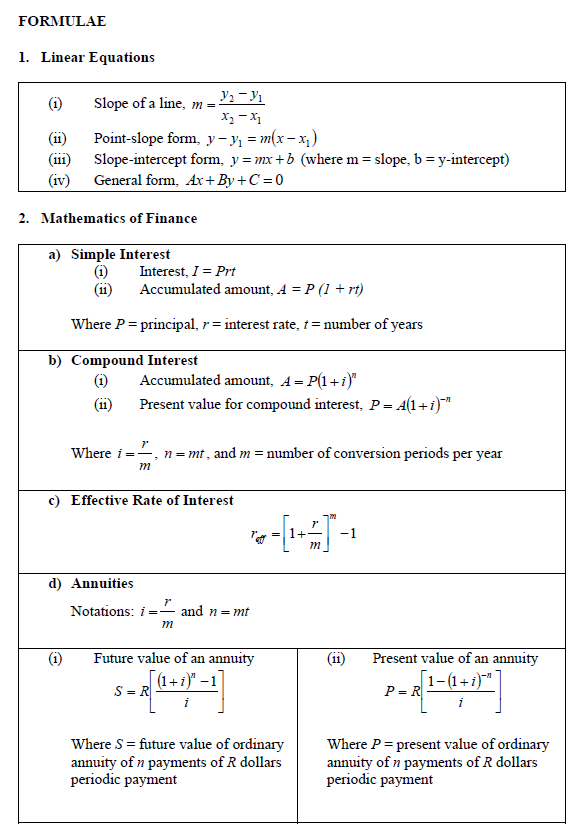
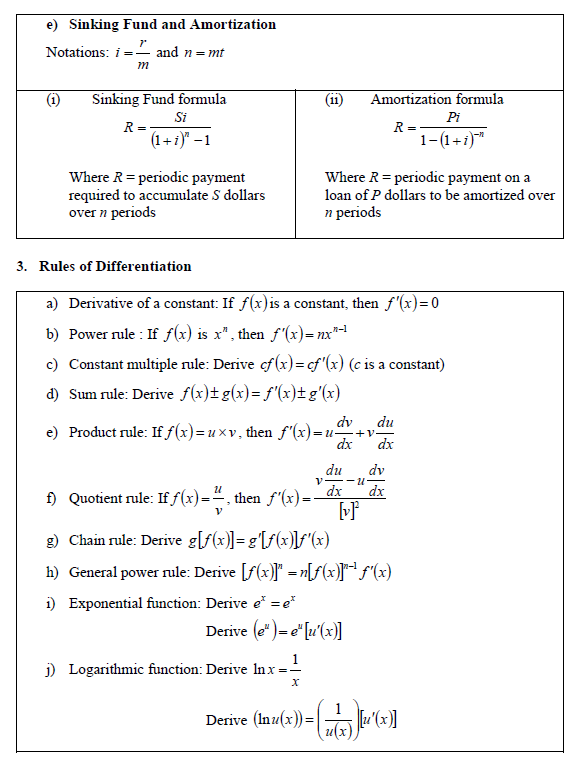
c) What is the future value of an ordinary annuity at the end of 5 years if $370 is deposited each month into an account earning 2.4% compounded monthly? FORMULAE 1. Linear Equations (1) Slope of a line, m= Y: - X-X, Point-slope form, y-y = m(x - x) (111) Slope-intercept form, y = mx +b (where m = slope, b = y-intercept) (iv) General form, Ax+By+C =0 2. Mathematics of Finance a) Simple Interest (1) Interest, I = Prt Accumulated amount. A = P (1 + rt) Where P = principal, r = interest rate, t = number of years b) Compound Interest (1) Accumulated amount, A=P(1+i)" Present value for compound interest, P = 4(1+i)** Where i = ", n = mt, and m = number of conversion periods per year m c) Effective Rate of Interest -1 1+ m d) Annuities Notations i= m r and n=mt (11) Future value of an annuity (1+i)"-1 S=R (4=;*' Present value of an annuity 1-(1+i)" PER Where S = future value of ordinary annuity of n payments of R dollars periodic payment Where P = present value of ordinary annuity of n payments of R dollars periodic payment e) Sinking Fund and Amortization Notations: 1 =- and n = mt m (11) Sinking Fund formula Si R- (1+i)" -1 Amortization formula Pi R= 1-(1+i)" Where R= periodic payment required to accumulate S dollars over n periods Where R = periodic payment on a loan of P dollars to be amortized over n periods 3. Rules of Differentiation a) Derivative of a constant: If f(x)is a constant, then f'(x)=0 b) Power rule : If f(x) is x, then f'(x)= nx-1 c) Constant multiple rule: Derive cf(x)= cf'(x) (c is a constant) d) Sum rule: Derive f(x)+ g(x) = f'(x)+ g'(x) du u V e) Product rule: If f(x)=uxv, then f'(x)=u +y dx dx du dy -U f) Quotient rule: If f(x)= then f'(x)= dx dx [v] g) Chain rule: Derive g[f(x)]=g'[f(x)]f'(x) h) General power rule: Derive [f(x)}" =n[f(x)]*4 f'(x) 1) Exponential function: Derive et = e* Derive (e)=e" [u'(x)] 1 j) Logarithmic function: Derive Inx== Derive (nu(x)=(eta) (2[3] ][+(+)]
Step by Step Solution
There are 3 Steps involved in it

Get step-by-step solutions from verified subject matter experts
 Study Help