







Question: Subject: Applied probability Question-1: In this course, we have already learnt about the transmission of a binary message (i.e., bit ' 0 ' or '
Subject: Applied probability
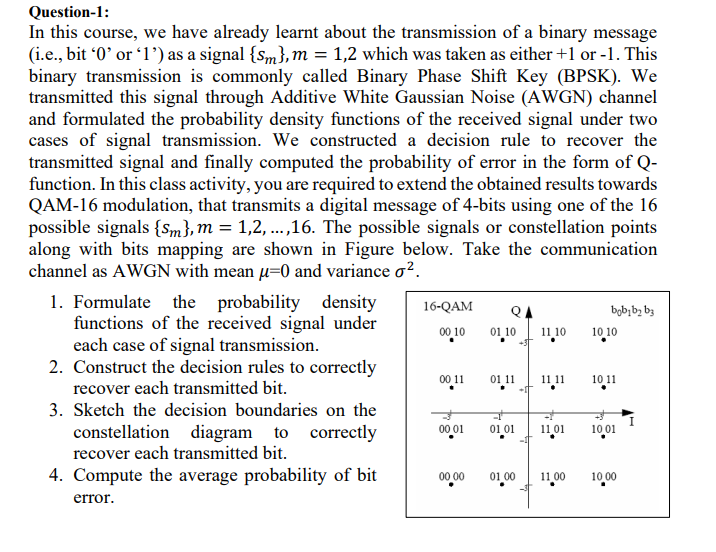
Question-1: In this course, we have already learnt about the transmission of a binary message (i.e., bit ' 0 ' or ' 1 ') as a signal {sm},m=1,2 which was taken as either +1 or -1 . This binary transmission is commonly called Binary Phase Shift Key (BPSK). We transmitted this signal through Additive White Gaussian Noise (AWGN) channel and formulated the probability density functions of the received signal under two cases of signal transmission. We constructed a decision rule to recover the transmitted signal and finally computed the probability of error in the form of Qfunction. In this class activity, you are required to extend the obtained results towards QAM-16 modulation, that transmits a digital message of 4-bits using one of the 16 possible signals {sm},m=1,2,,16. The possible signals or constellation points along with bits mapping are shown in Figure below. Take the communication channel as AWGN with mean =0 and variance 2. 1. Formulate the probability density functions of the received signal under each case of signal transmission. 2. Construct the decision rules to correctly recover each transmitted bit. 3. Sketch the decision boundaries on the constellation diagram to correctly recover each transmitted bit. 4. Compute the average probability of bit error
Step by Step Solution
There are 3 Steps involved in it

Get step-by-step solutions from verified subject matter experts
 Study Help