







Question: Subject : Assignment Give the Answer Question : Note on how Toshiba Inc. violated IFRS recommended principles of revenue or expense recognition. Cash Study Toshiba
Subject : Assignment Give the Answer
Question : Note on how Toshiba Inc. violated IFRS recommended principles of revenue or expense recognition.
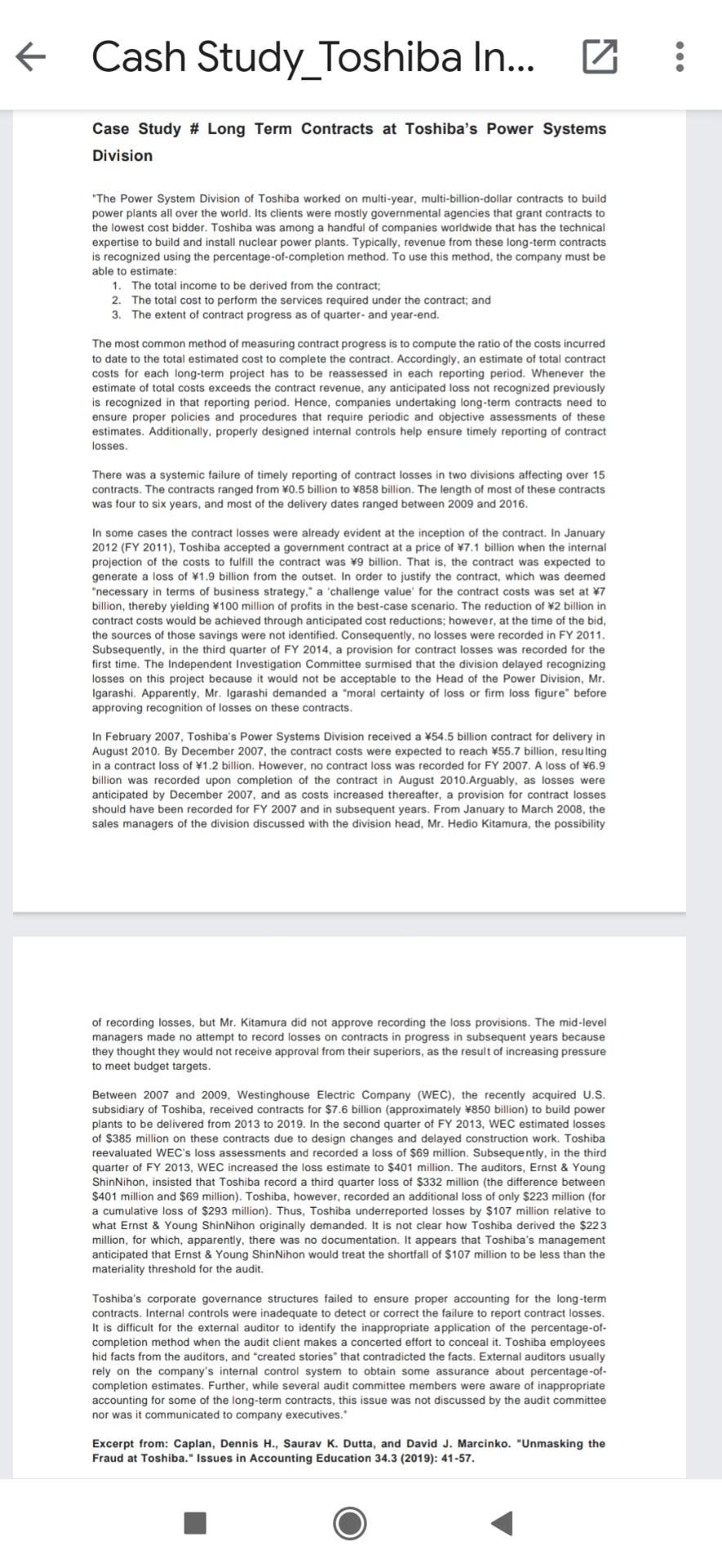
Cash Study Toshiba In... Case Study # Long Term Contracts at Toshiba's Power Systems Division "The Power System Division of Toshiba worked on multi-year, multi-billion-dollar contracts to build power plants all over the world. Its clients were mostly governmental agencies that grant contracts to the lowest cost bidder. Toshiba was among a handful of companies worldwide that has the technical expertise to build and install nuclear power plants. Typically, revenue from these long-term contracts is recognized using the percentage-of-completion method. To use this method, the company must be able to estimate: 1. The total income to be derived from the contract; 2. The total cost to perform the services required under the contract; and 3. The extent of contract progress as of quarter- and year-end. The most common method of measuring contract progress is to compute the ratio of the costs incurred to date to the total estimated cost to complete the contract. Accordingly, an estimate of total contract costs for each long-term project has to be reassessed in each reporting period. Whenever the estimate of total costs exceeds the contract revenue, any anticipated loss not recognized previously is recognized in that reporting period. Hence, companies undertaking long-term contracts need to ensure proper policies and procedures that require periodic and objective assessments of these estimates. Additionally, properly designed internal controls help ensure timely reporting of contract losses There was a systemic failure of timely reporting of contract losses in two divisions affecting over 15 contracts. The contracts ranged from 0.5 billion to W858 billion. The length of most of these contracts was four to six years, and most of the delivery dates ranged between 2009 and 2016. In some cases the contract losses were already evident at the inception of the contract. In January 2012 (FY 2011), Toshiba accepted a government contract at a price of 7.1 billion when the internal projection of the costs to fulfill the contract was 9 billion. That is, the contract was expected to generate a loss of 1.9 billion from the outset. In order to justify the contract, which was deemed "necessary in terms of business strategy," a challenge value for the contract costs was set at #7 billion, thereby yielding 100 million of profits in the best-case scenario. The reduction of 2 billion in contract costs would be achieved through anticipated cost reductions; however, at the time of the bid, the sources of those savings were not identified. Consequently, no losses were recorded in FY 2011. Subsequently, in the third quarter of FY 2014, provision for contract losses was recorded for the first time. The Independent Investigation Committee surmised that the division delayed recognizing losses on this project because it would not be acceptable to the Head of the Power Division, Mr. Igarashi. Apparently, Mr. Igarashi demanded a "moral certainty of loss or firm loss figure" before approving recognition of losses on these contracts. In February 2007, Toshiba's Power Systems Division received a 54.5 billion contract for delivery in August 2010. By December 2007, the contract costs were expected to reach 55.7 billion, resulting in a contract loss of 1.2 billion. However, no contract loss was recorded for FY 2007. A loss of 6.9 billion was recorded upon completion of the contract in August 2010.Arguably, as losses were anticipated by December 2007, and as costs increased thereafter, a provision for contract losses should have been recorded for FY 2007 and in subsequent years. From January to March 2008, the sales managers of the division discussed with the division head, Mr. Hedio Kitamura, the possibility of recording losses, but Mr. Kitamura did not approve recording the loss provisions. The mid-level managers made no attempt to record losses on contracts in progress in subsequent years because they thought they would not receive approval from their superiors, as the result of increasing pressure to meet budget targets. Between 2007 and 2009, Westinghouse Electric Company (WEC), the recently acquired U.S. subsidiary of Toshiba, received contracts for $7.6 billion (approximately 850 billion) to build power plants to be delivered from 2013 to 2019. In the second quarter of FY 2013, WEC estimated losses of $385 million on these contracts due to design changes and delayed construction work. Toshiba reevaluated WEC's loss assessments and recorded a loss of $69 million. Subsequently, in the third quarter of FY 2013, WEC increased the loss estimate to $401 million. The auditors, Ernst & Young ShinNihon, insisted that Toshiba record a third quarter loss of $332 million (the difference between $401 million and $69 million). Toshiba, however, recorded an additional loss of only $223 million (for a cumulative loss of $293 million). Thus, Toshiba underreported losses by $107 million relative to what Ernst & Young ShinNihon originally demanded. It is not clear how Toshiba derived the $223 million, for which, apparently, there was no documentation. It appears that Toshiba's management anticipated that Ernst & Young Shin Nihon would treat the shortfall of $107 million to be less than the materiality threshold for the audit. Toshiba's corporate governance structures failed to ensure proper accounting for the long-term contracts. Internal controls were inadequate to detect or correct the failure to report contract losses. It is difficult for the external auditor to identify the inappropriate application of the percentage-of- completion method when the audit client makes a concerted effort to conceal it. Toshiba employees hid facts from the auditors, and "created stories that contradicted the facts. External auditors usually rely on the company's internal control system to obtain some assurance about percentage-of- completion estimates. Further, while several audit committee members were aware of inappropriate accounting for some of the long-term contracts, this issue was not discussed by the audit committee nor was it communicated to company executives." Excerpt from: Caplan, Dennis H., Saurav K. Dutta, and David J. Marcinko. "Unmasking the Fraud at Toshiba." Issues in Accounting Education 34.3 (2019): 41-57
Step by Step Solution
There are 3 Steps involved in it

Get step-by-step solutions from verified subject matter experts
 Study Help