







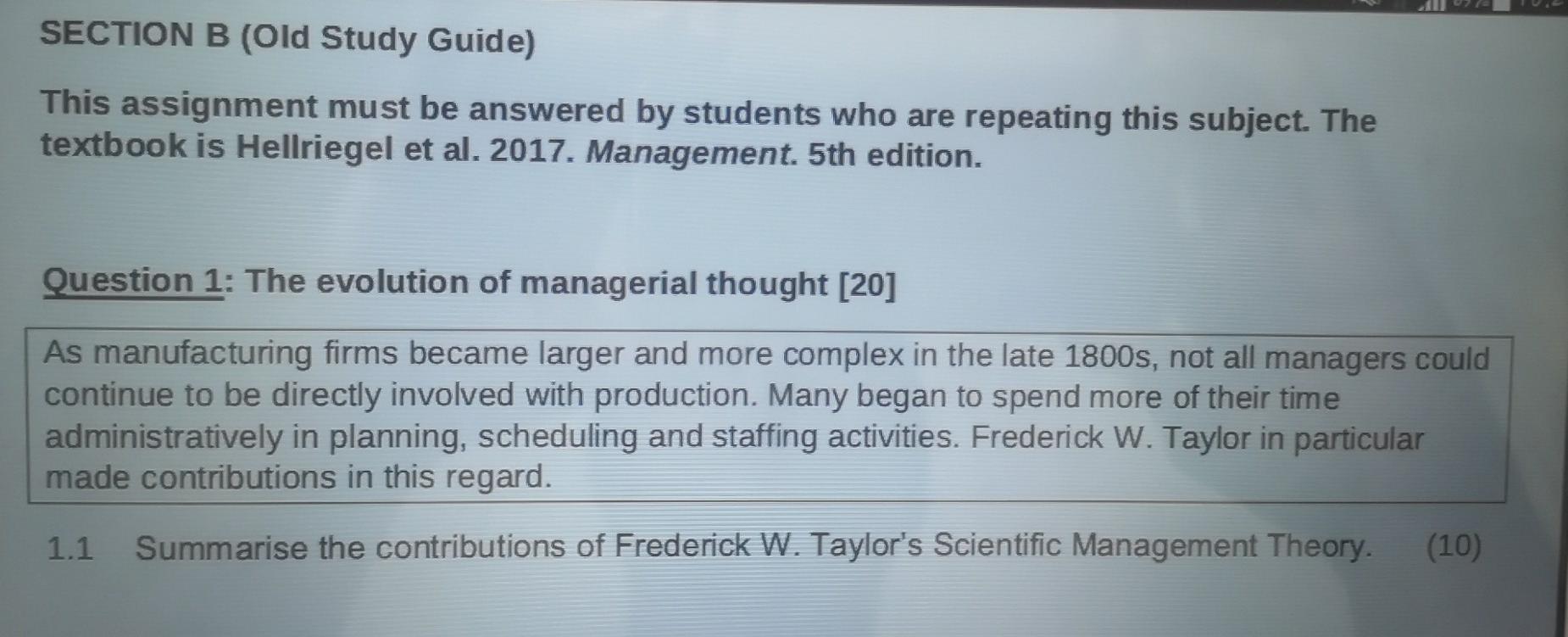
Question: SUBJECT: BUSINESS MANAGEMENT II SECTION B (Old Study Guide) This assignment must be answered by students who are repeating this subject. The textbook is Hellriegel

SUBJECT: BUSINESS MANAGEMENT II
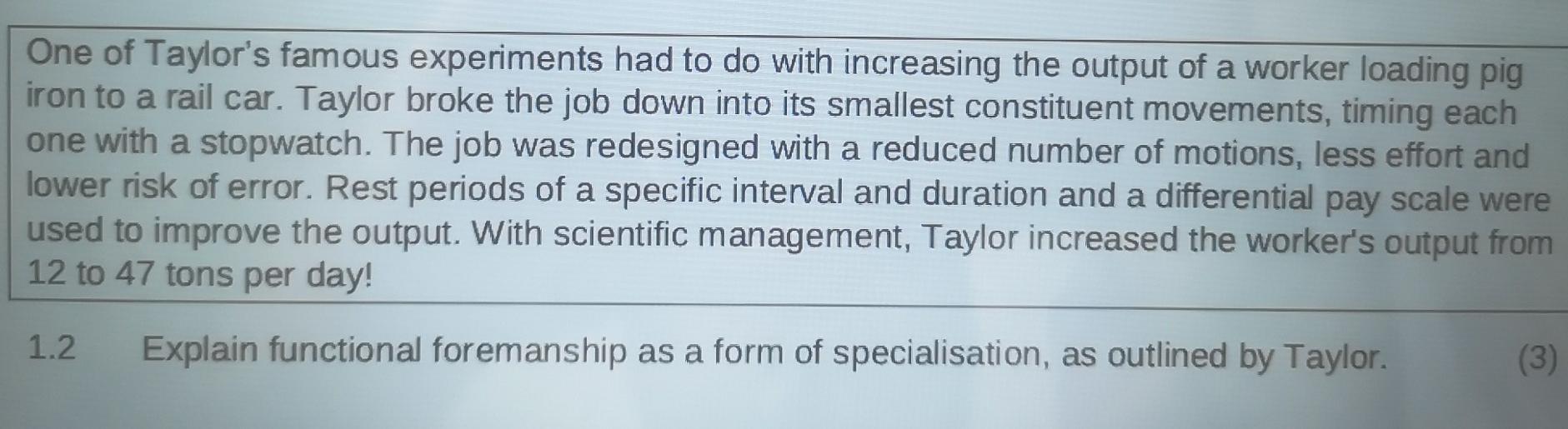
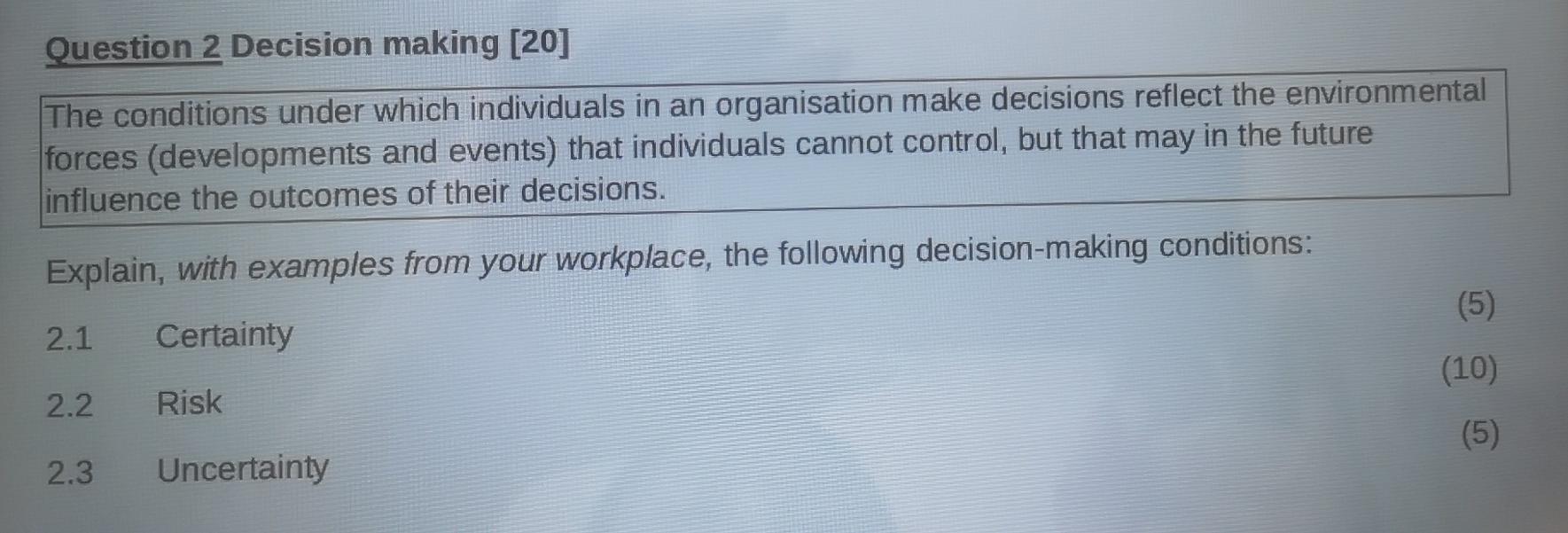
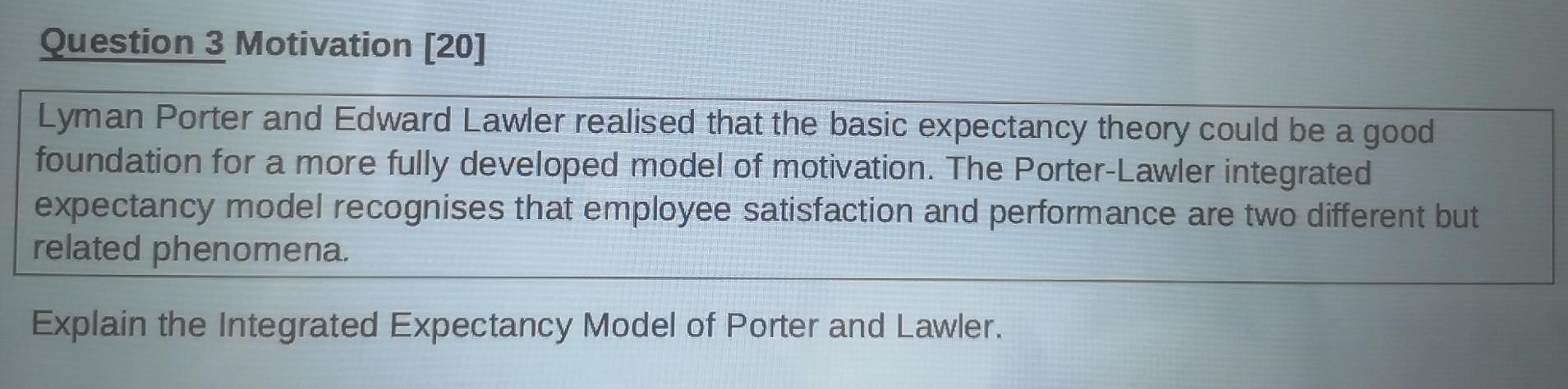
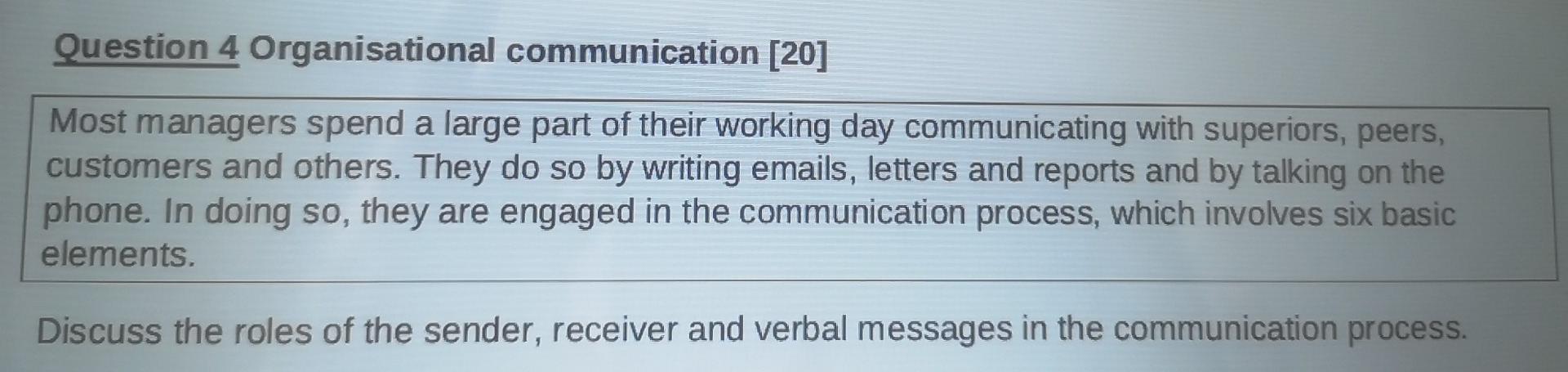
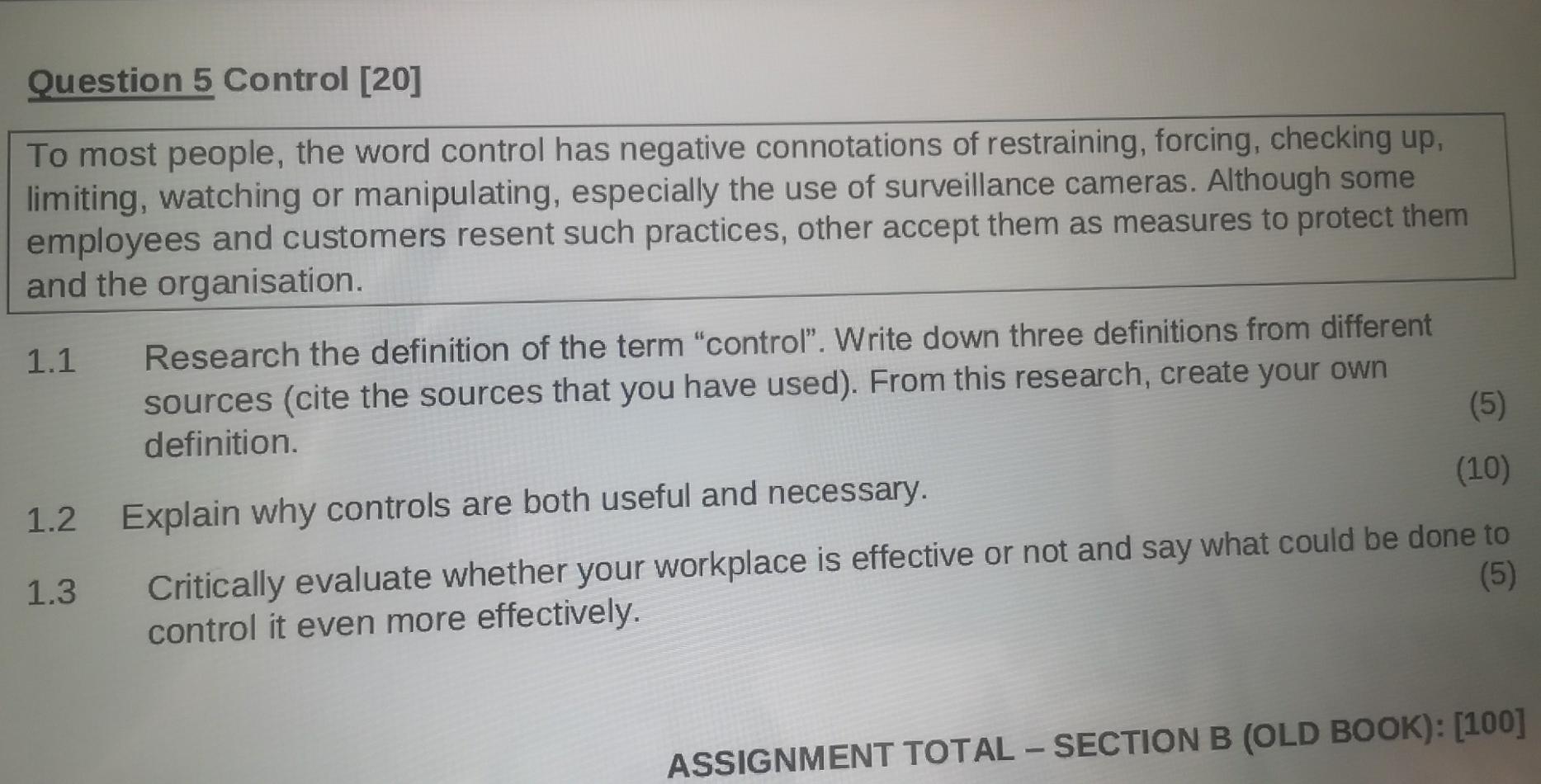
SECTION B (Old Study Guide) This assignment must be answered by students who are repeating this subject. The textbook is Hellriegel et al. 2017. Management. 5th edition. Question 1: The evolution of managerial thought [20] As manufacturing firms became larger and more complex in the late 1800s, not all managers could continue to be directly involved with production. Many began to spend more of their time administratively in planning, scheduling and staffing activities. Frederick W. Taylor in particular made contributions in this regard. 1.1 Summarise the contributions of Frederick W. Taylor's Scientific Management Theory. (10) One of Taylor's famous experiments had to do with increasing the output of a worker loading pig iron to a rail car. Taylor broke the job down into its smallest constituent movements, timing each one with a stopwatch. The job was redesigned with a reduced number of motions, less effort and lower risk of error. Rest periods of a specific interval and duration and a differential pay scale were used to improve the output. With scientific management, Taylor increased the worker's output from 12 to 47 tons per day! 1.2 Explain functional foremanship as a form of specialisation, as outlined by Taylor (3) Taylor's work has led contemporary managers to improve their employee selection and training processes, and to seek one best way to perform each task. Unfortunately, most proponents of scientific management misread the human side of work. 1.3 Discuss the above statement. Question 2 Decision making [20] The conditions under which individuals in an organisation make decisions reflect the environmental forces (developments and events) that individuals cannot control, but that may in the future influence the outcomes of their decisions. Explain, with examples from your workplace, the following decision-making conditions: (5) 2.1 Certainty (10) 2.2 Risk (5) 2.3 Uncertainty Question 3 Motivation [20] Lyman Porter and Edward Lawler realised that the basic expectancy theory could be a good foundation for a more fully developed model of motivation. The Porter-Lawler integrated expectancy model recognises that employee satisfaction and performance are two different but related phenomena. Explain the Integrated Expectancy Model of Porter and Lawler. Question 4 Organisational communication [20] Most managers spend a large part of their working day communicating with superiors, peers, customers and others. They do so by writing emails, letters and reports and by talking on the phone. In doing so, they are engaged in the communication process, which involves six basic elements Discuss the roles of the sender, receiver and verbal messages in the communication process. Question 5 Control [20] To most people, the word control has negative connotations of restraining, forcing, checking up, limiting, watching or manipulating, especially the use of surveillance cameras. Although some employees and customers resent such practices, other accept them as measures to protect them and the organisation. 1.1 Research the definition of the term "control". Write down three definitions from different sources (cite the sources that you have used). From this research, create your own definition. (5) (10) 1.2. Explain why controls are both useful and necessary. 1.3 Critically evaluate whether your workplace is effective or not and say what could be done to control it even more effectively. (5) ASSIGNMENT TOTAL - SECTION B OLD BOOK): [100]Step by Step Solution
There are 3 Steps involved in it
1 Expert Approved Answer
Step: 1 Unlock

Question Has Been Solved by an Expert!
Get step-by-step solutions from verified subject matter experts
Step: 2 Unlock
Step: 3 Unlock
 Study Help