







Question: subject: Business Research Methods b. Draft a problem statement along with research objectives and research questions, draw conceptual model and state the relevant hypotheses (10)
subject: Business Research Methods
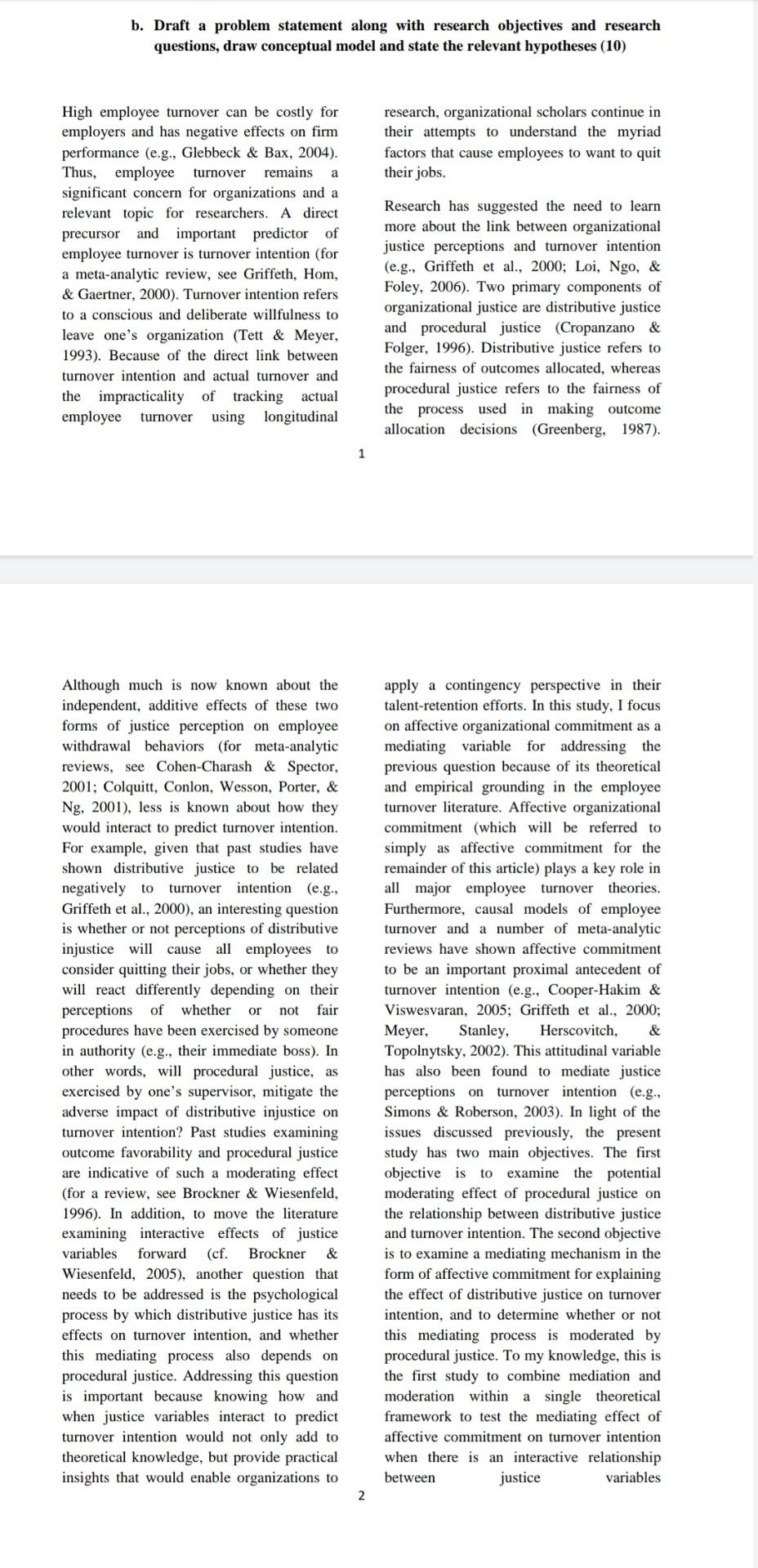
b. Draft a problem statement along with research objectives and research questions, draw conceptual model and state the relevant hypotheses (10) research, organizational scholars continue in their attempts to understand the myriad factors that cause employees to want to quit their jobs. a High employee turnover can be costly for employers and has negative effects on firm performance (e.g., Glebbeck & Bax, 2004). Thus, employee turnover remains significant concern for organizations and a relevant topic for researchers. A direct precursor and important predictor of employee turnover is turnover intention (for a meta-analytic review, see Griffeth, Hom, & Gaertner, 2000). Turnover intention refers to a conscious and deliberate willfulness to leave one's organization (Tett & Meyer, 1993). Because of the direct link between turnover intention and actual turnover and the impracticality of tracking actual employee turnover using longitudinal Research has suggested the need to learn more about the link between organizational justice perceptions and turnover intention (e.g., Griffeth et al., 2000; Loi, Ngo, & Foley, 2006). Two primary components of organizational justice are distributive justice and procedural justice (Cropanzano & Folger, 1996). Distributive justice refers to the fairness of outcomes allocated, whereas procedural justice refers to the fairness of the process used in making outcome allocation decisions (Greenberg, 1987). 1 Although much is now known about the independent, additive effects of these two forms of justice perception on employee withdrawal behaviors (for meta-analytic reviews, see Cohen-Charash & Spector, 2001; Colquitt, Conlon, Wesson, Porter, & Ng, 2001), less is known about how they would interact to predict turnover intention. For example, given that past studies have shown distributive justice to be related negatively to turnover intention (e.g., Griffeth et al., 2000), an interesting question is whether or not perceptions of distributive injustice will cause all employees to consider quitting their jobs, or whether they will react differently depending on their perceptions of whether or not fair procedures have been exercised by someone authority (e.g., their diate boss). In other words, will procedural justice, as exercised by one's supervisor, mitigate the adverse impact of distributive injustice on turnover intention? Past studies examining outcome favorability and procedural justice are indicative of such a moderating effect (for a review, see Brockner & Wiesenfeld, 1996). In addition, to move the literature examining interactive effects of justice variables forward (cf. Brockner & Wiesenfeld, 2005), another question that needs to be addressed is the psychological process by which distributive justice has its effects on turnover intention, and whether this mediating process also depends on procedural justice. Addressing this question is important because knowing how and when justice variables interact to predict turnover intention would not only add to theoretical knowledge, but provide practical insights that would enable organizations to apply a contingency perspective in their talent-retention efforts. In this study, I focus on affective organizational commitment as a mediating variable for addressing the previous question because of its theoretical and empirical grounding in the employee turnover literature. Affective organizational commitment (which will be referred to simply as affective commitment for the remainder of this article) plays a key role in all major employee turnover theories. Furthermore, causal models of employee turnover and a number of meta-analytic reviews have shown affective commitment to be an important proximal antecedent of turnover intention (e.g., Cooper-Hakim & Viswesvaran, 2005; Griffeth et al., 2000; Meyer, Stanley, Herscovitch, & Topolnytsky, 02). This attitudinal variable has also been found to mediate justice perceptions on turnover intention (e.g., Simons & Roberson, 2003). In light of the issues discussed previously, the present study has two main objectives. The first objective is to examine the potential moderating effect of procedural justice on the relationship between distributive justice and turnover intention. The second objective is to examine a mediating mechanism in the form of affective commitment for explaining the effect of distributive justice on turnover intention, and to determine whether or not this mediating process is moderated by procedural justice. To my knowledge, this is the first study to combine mediation and moderation within a single theoretical framework to test the mediating effect of affective commitment on turnover intention when there is an interactive relationship between justice variables 2 b. Draft a problem statement along with research objectives and research questions, draw conceptual model and state the relevant hypotheses (10) research, organizational scholars continue in their attempts to understand the myriad factors that cause employees to want to quit their jobs. a High employee turnover can be costly for employers and has negative effects on firm performance (e.g., Glebbeck & Bax, 2004). Thus, employee turnover remains significant concern for organizations and a relevant topic for researchers. A direct precursor and important predictor of employee turnover is turnover intention (for a meta-analytic review, see Griffeth, Hom, & Gaertner, 2000). Turnover intention refers to a conscious and deliberate willfulness to leave one's organization (Tett & Meyer, 1993). Because of the direct link between turnover intention and actual turnover and the impracticality of tracking actual employee turnover using longitudinal Research has suggested the need to learn more about the link between organizational justice perceptions and turnover intention (e.g., Griffeth et al., 2000; Loi, Ngo, & Foley, 2006). Two primary components of organizational justice are distributive justice and procedural justice (Cropanzano & Folger, 1996). Distributive justice refers to the fairness of outcomes allocated, whereas procedural justice refers to the fairness of the process used in making outcome allocation decisions (Greenberg, 1987). 1 Although much is now known about the independent, additive effects of these two forms of justice perception on employee withdrawal behaviors (for meta-analytic reviews, see Cohen-Charash & Spector, 2001; Colquitt, Conlon, Wesson, Porter, & Ng, 2001), less is known about how they would interact to predict turnover intention. For example, given that past studies have shown distributive justice to be related negatively to turnover intention (e.g., Griffeth et al., 2000), an interesting question is whether or not perceptions of distributive injustice will cause all employees to consider quitting their jobs, or whether they will react differently depending on their perceptions of whether or not fair procedures have been exercised by someone authority (e.g., their diate boss). In other words, will procedural justice, as exercised by one's supervisor, mitigate the adverse impact of distributive injustice on turnover intention? Past studies examining outcome favorability and procedural justice are indicative of such a moderating effect (for a review, see Brockner & Wiesenfeld, 1996). In addition, to move the literature examining interactive effects of justice variables forward (cf. Brockner & Wiesenfeld, 2005), another question that needs to be addressed is the psychological process by which distributive justice has its effects on turnover intention, and whether this mediating process also depends on procedural justice. Addressing this question is important because knowing how and when justice variables interact to predict turnover intention would not only add to theoretical knowledge, but provide practical insights that would enable organizations to apply a contingency perspective in their talent-retention efforts. In this study, I focus on affective organizational commitment as a mediating variable for addressing the previous question because of its theoretical and empirical grounding in the employee turnover literature. Affective organizational commitment (which will be referred to simply as affective commitment for the remainder of this article) plays a key role in all major employee turnover theories. Furthermore, causal models of employee turnover and a number of meta-analytic reviews have shown affective commitment to be an important proximal antecedent of turnover intention (e.g., Cooper-Hakim & Viswesvaran, 2005; Griffeth et al., 2000; Meyer, Stanley, Herscovitch, & Topolnytsky, 02). This attitudinal variable has also been found to mediate justice perceptions on turnover intention (e.g., Simons & Roberson, 2003). In light of the issues discussed previously, the present study has two main objectives. The first objective is to examine the potential moderating effect of procedural justice on the relationship between distributive justice and turnover intention. The second objective is to examine a mediating mechanism in the form of affective commitment for explaining the effect of distributive justice on turnover intention, and to determine whether or not this mediating process is moderated by procedural justice. To my knowledge, this is the first study to combine mediation and moderation within a single theoretical framework to test the mediating effect of affective commitment on turnover intention when there is an interactive relationship between justice variables 2Step by Step Solution
There are 3 Steps involved in it
1 Expert Approved Answer
Step: 1 Unlock

Question Has Been Solved by an Expert!
Get step-by-step solutions from verified subject matter experts
Step: 2 Unlock
Step: 3 Unlock
 Study Help