







Question: subject computer architecture and organization answer with showing the steps section digital logic design QUESTION 1: (a) Assume that 4-bit two's complement scheme is used
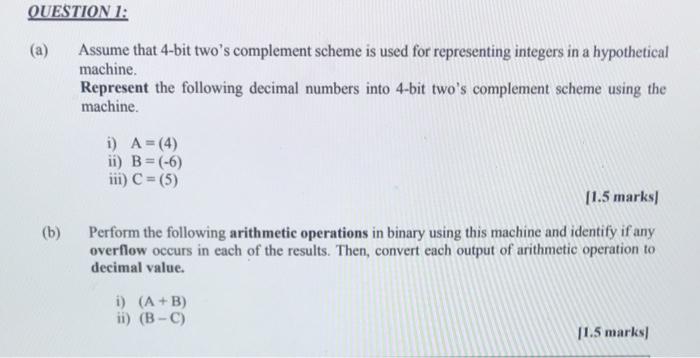
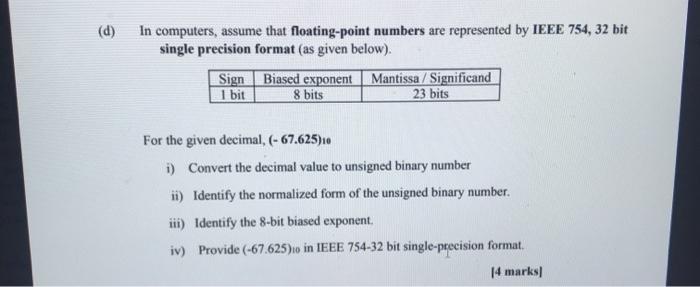
QUESTION 1: (a) Assume that 4-bit two's complement scheme is used for representing integers in a hypothetical machine. Represent the following decimal numbers into 4-bit two's complement scheme using the machine. i) A=(4) ii) B=(-6) in) C = (5) [1.5 marks Perform the following arithmetic operations in binary using this machine and identify if any overflow occurs in each of the results. Then, convert each output of arithmetic operation to decimal value. (b) i) (A + B) ii) (B-C) 11.5 marks) (d) In computers, assume that floating-point numbers are represented by IEEE 754, 32 bit single precision format (as given below) Sign Biased exponent Mantissa / Significand 1 bit 8 bits 23 bits For the given decimal, (- 67.625), i) Convert the decimal value to unsigned binary number ii) Identify the normalized form of the unsigned binary number iii) Identify the 8-bit biased exponent. iv) Provide (-67.625)io in IEEE 754-32 bit single-precision format 14 marks
Step by Step Solution
There are 3 Steps involved in it

Get step-by-step solutions from verified subject matter experts
 Study Help