







Question: subject: Computer Architecture Question 2 A cache is a smaller, faster memory, located closer to a processor core, which stores copies of the data from
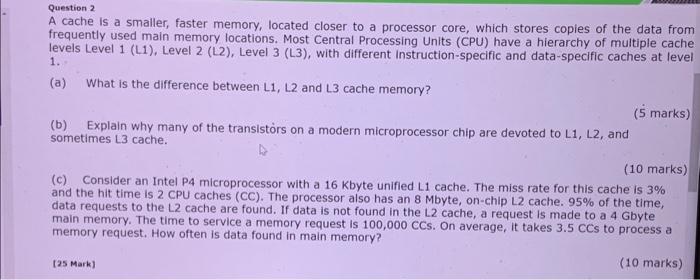
Question 2 A cache is a smaller, faster memory, located closer to a processor core, which stores copies of the data from frequently used main memory locations. Most Central Processing Units (CPU) have a hierarchy of multiple cache levels Level 1 (L1), Level 2 (L2), Level 3 (L3), with different instruction-specific and data-specific caches at level 1. (a) What is the difference between L1,L2 and L3 cache memory? (b) Explain why many of the transistrs on a modern microprocessor chip are devoted to L1, L2, and sometimes L3 cache. (10 marks) (c) Consider an Intel P4 microprocessor with a 16 Kbyte unified L1 cache. The miss rate for this cache is 3% and the hit time is 2CPU caches (CC). The processor also has an 8 Mbyte, on-chip L2 cache. 95% of the time, data requests to the LL cache are found. If data is not found in the L2 cache, a request is made to a 4 Gbyte main memory. The time to service a memory request is 100,000 CCs. On average, it takes 3.5 CCs to process a memory request. How often is data found in main memory
Step by Step Solution
There are 3 Steps involved in it

Get step-by-step solutions from verified subject matter experts
 Study Help