Question: Subject: Consumer Behavior Please answer the question by 12pm today. Read the case study entitled It is Brewing: Single-Serve Coffeemakers are Hot and then answer
Subject: Consumer Behavior
Please answer the question by 12pm today.
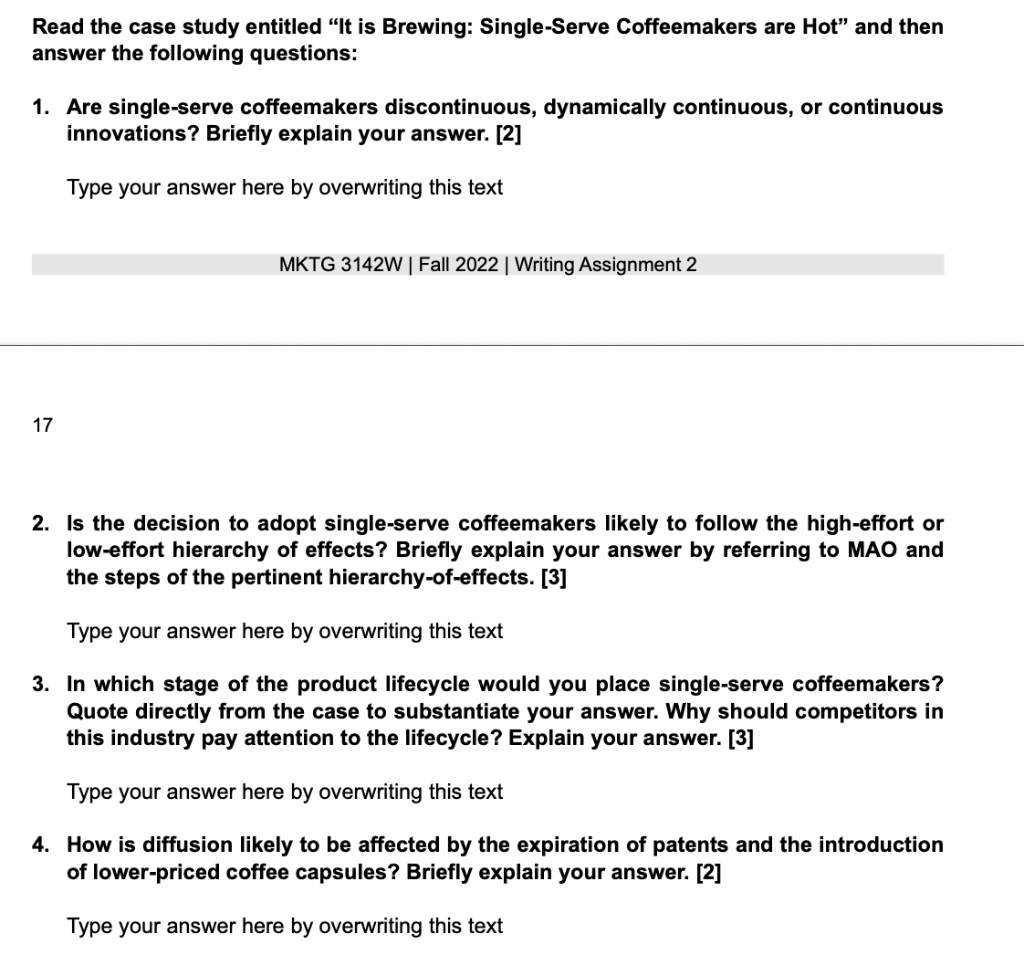
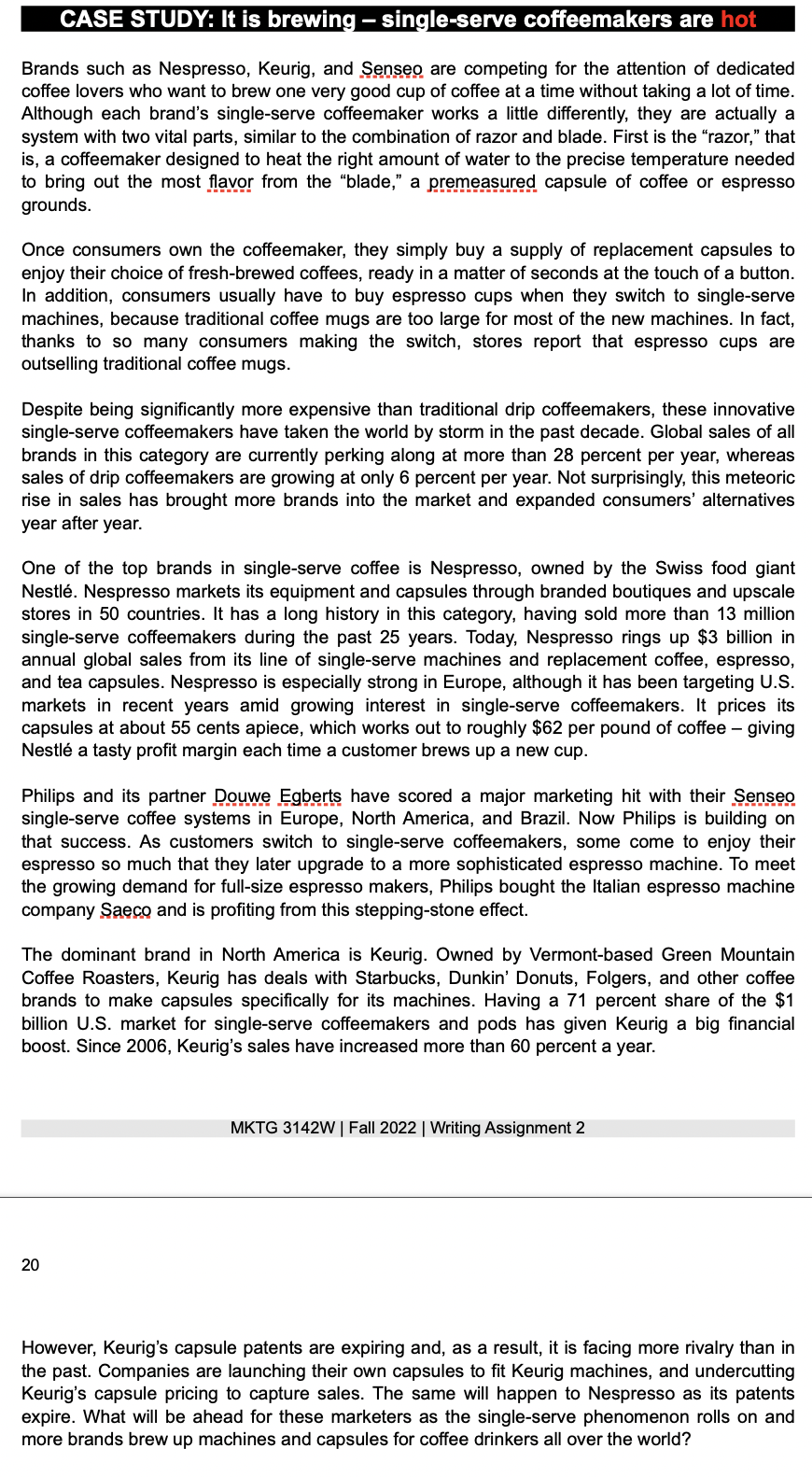
Read the case study entitled "It is Brewing: Single-Serve Coffeemakers are Hot" and then answer the following questions: 1. Are single-serve coffeemakers discontinuous, dynamically continuous, or continuous innovations? Briefly explain your answer. [2] Type your answer here by overwriting this text MKTG 3142W | Fall 2022 | Writing Assignment 2 17 2. Is the decision to adopt single-serve coffeemakers likely to follow the high-effort or low-effort hierarchy of effects? Briefly explain your answer by referring to MAO and the steps of the pertinent hierarchy-of-effects. [3] Type your answer here by overwriting this text 3. In which stage of the product lifecycle would you place single-serve coffeemakers? Quote directly from the case to substantiate your answer. Why should competitors in this industry pay attention to the lifecycle? Explain your answer. [3] Type your answer here by overwriting this text 4. How is diffusion likely to be affected by the expiration of patents and the introduction of lower-priced coffee capsules? Briefly explain your answer. [2] Type your answer here by overwriting this text Brands such as Nespresso, Keurig, and Senseo are competing for the attention of dedicated coffee lovers who want to brew one very good cup of coffee at a time without taking a lot of time. Although each brand's single-serve coffeemaker works a little differently, they are actually a system with two vital parts, similar to the combination of razor and blade. First is the "razor," that is, a coffeemaker designed to heat the right amount of water to the precise temperature needed to bring out the most flavor from the "blade," a premeasured capsule of coffee or espresso grounds. Once consumers own the coffeemaker, they simply buy a supply of replacement capsules to enjoy their choice of fresh-brewed coffees, ready in a matter of seconds at the touch of a button. In addition, consumers usually have to buy espresso cups when they switch to single-serve machines, because traditional coffee mugs are too large for most of the new machines. In fact, thanks to so many consumers making the switch, stores report that espresso cups are outselling traditional coffee mugs. Despite being significantly more expensive than traditional drip coffeemakers, these innovative single-serve coffeemakers have taken the world by storm in the past decade. Global sales of all brands in this category are currently perking along at more than 28 percent per year, whereas sales of drip coffeemakers are growing at only 6 percent per year. Not surprisingly, this meteoric rise in sales has brought more brands into the market and expanded consumers' alternatives year after year. One of the top brands in single-serve coffee is Nespresso, owned by the Swiss food giant Nestl. Nespresso markets its equipment and capsules through branded boutiques and upscale stores in 50 countries. It has a long history in this category, having sold more than 13 million single-serve coffeemakers during the past 25 years. Today, Nespresso rings up $3 billion in annual global sales from its line of single-serve machines and replacement coffee, espresso, and tea capsules. Nespresso is especially strong in Europe, although it has been targeting U.S. markets in recent years amid growing interest in single-serve coffeemakers. It prices its capsules at about 55 cents apiece, which works out to roughly $62 per pound of coffee giving Nestl a tasty profit margin each time a customer brews up a new cup. Philips and its partner Douwe Egberts have scored a major marketing hit with their Senseo single-serve coffee systems in Europe, North America, and Brazil. Now Philips is building on that success. As customers switch to single-serve coffeemakers, some come to enjoy their espresso so much that they later upgrade to a more sophisticated espresso machine. To meet the growing demand for full-size espresso makers, Philips bought the Italian espresso machine company Saeco and is profiting from this stepping-stone effect. The dominant brand in North America is Keurig. Owned by Vermont-based Green Mountain Coffee Roasters, Keurig has deals with Starbucks, Dunkin' Donuts, Folgers, and other coffee brands to make capsules specifically for its machines. Having a 71 percent share of the \$1 billion U.S. market for single-serve coffeemakers and pods has given Keurig a big financial boost. Since 2006, Keurig's sales have increased more than 60 percent a year. MKTG 3142W | Fall 2022 | Writing Assignment 2 20 However, Keurig's capsule patents are expiring and, as a result, it is facing more rivalry than in the past. Companies are launching their own capsules to fit Keurig machines, and undercutting Keurig's capsule pricing to capture sales. The same will happen to Nespresso as its patents expire. What will be ahead for these marketers as the single-serve phenomenon rolls on and more brands brew up machines and capsules for coffee drinkers all over the world









 Study Help