Question: Subject: Discrete Math Topics can be : 1. Algebraic Structures (Abstract Algebra, Binary structures) 2. Graph Theory 3. Graph Theory (Special graphs and Trees) 4.
Subject: Discrete Math
Topics can be :
1. Algebraic Structures (Abstract Algebra, Binary structures) 2. Graph Theory 3. Graph Theory (Special graphs and Trees) 4. Graph Theory Problems and Applications
LETTERS ONLY
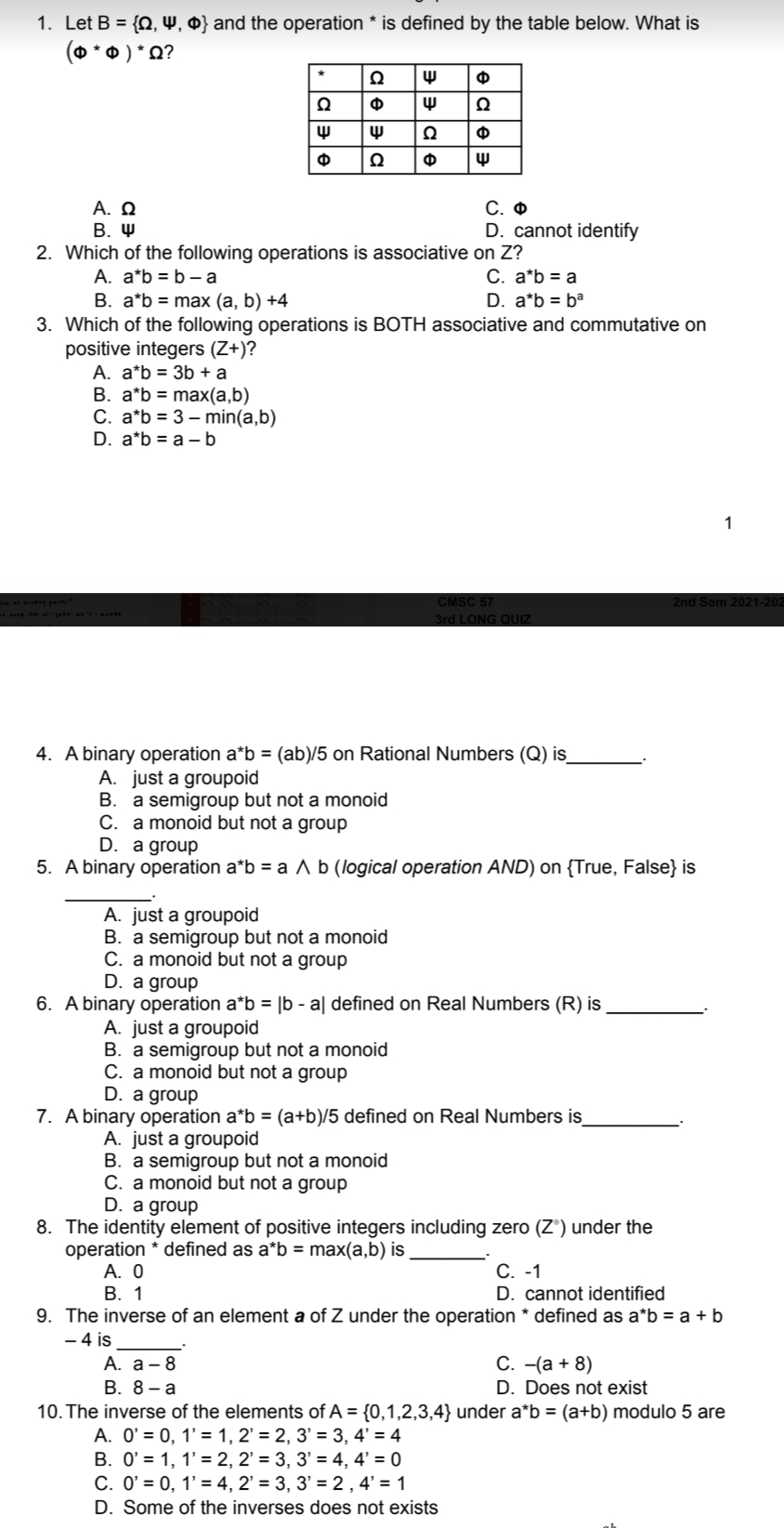
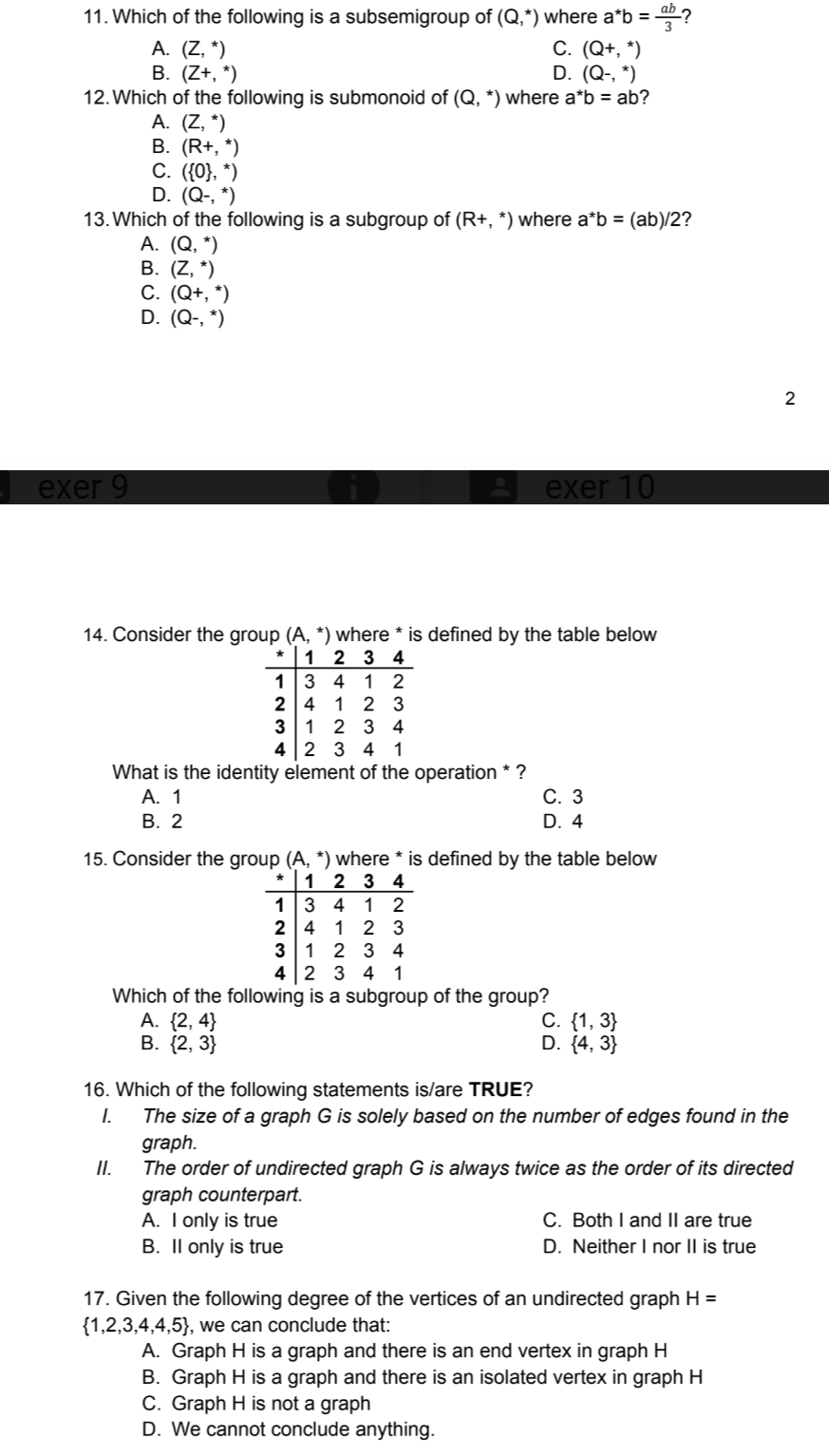
1. Let B = {Q, ", @} and the operation * is defined by the table below. What is (0 *0 )*Q? W O W W W Q Q W A. Q C. Q B. W D. cannot identify 2. Which of the following operations is associative on Z? A. a*b = b -a C. a*b = a B. a*b = max (a, b) +4 D. a*b = ba 3. Which of the following operations is BOTH associative and commutative on positive integers (Z+)? A. a*b = 3b + a B. a*b = max(a,b) C. a*b = 3 - min(a,b) D. a*b = a -b CMSC 57 4. A binary operation a*b = (ab)/5 on Rational Numbers (Q) is A. just a groupoid B. a semigroup but not a monoid C. a monoid but not a group D. a group 5. A binary operation a*b = a A b (logical operation AND) on {True, False} is A. just a groupoid B. a semigroup but not a monoid C. a monoid but not a group D. a group 6. A binary operation a*b = [b - al defined on Real Numbers (R) is A. just a groupoid B. a semigroup but not a monoid C. a monoid but not a group D. a group 7. A binary operation a*b = (a+b)/5 defined on Real Numbers is A. just a groupoid B. a semigroup but not a monoid C. a monoid but not a group D. a group 8. The identity element of positive integers including zero (Z ) under the operation * defined as a*b = max(a,b) is A. 0 C. -1 B. 1 D. cannot identified 9. The inverse of an element a of Z under the operation * defined as a*b = a + b - 4 is A. a - 8 C. -(a + 8) B. 8 - a D. Does not exist 10. The inverse of the elements of A = {0, 1,2,3,4} under a*b = (a+b) modulo 5 are A. O' = 0, 1' = 1, 2' = 2, 3' = 3, 4' = 4 B. O' = 1, 1' = 2, 2' = 3, 3' = 4, 4' = 0 C. 0' = 0, 1' = 4, 2' = 3, 3' = 2, 4' = 1 D. Some of the inverses does not exists11. Which of the following is a subsernigroup of (Q.*) where a*b = %? A. (z, *) c. (0+, *) B. (2+. *) D. (0-. *) 12.Which of the following is submonoid of (Q. *) where a*b = ab? A. (z, *) B. (R+, ') C. ({0}. *) D. (o. *) 13.Which of the following is a subgroup of (R+, *) where a'b = (abyZ? A. (Q. *) B. (Z, 'J C. (0+, *) D. (0-, *) 14. Consider the group (A, *) where * is dened by the table below 2 3 4 1 4 1 2 3 What is the identity element of the operation * ? A. 1 C. 3 B. 2 D. 4 2 4 4 2 1 3 2 4 3 1 Which of the following is a subgroup of the group? A. {2, 4} C. {1, 3} B. {2, 3} D. {4, 3} 16. Which of the following statements isiare TRUE? i. The size of a graph G is solely based on the number of edges found in the graph. ii. The order of undirected graph G is always twice as the order of its directed graph counterpart. A. I only is true C. Both I and II are tme B. ll only is true D. Neither I nor II is true 17. Given the following degree of the vertices of an undirected graph H = {1 ,2,3,4,4,5}, we can conclude that: A. Graph H is a graph and there is an end vertex in graph H B. Graph H is a graph and there is an isolated vertex in graph H 0. Graph H is not a graph D. We cannot conclude anything
Step by Step Solution
There are 3 Steps involved in it
1 Expert Approved Answer
Step: 1 Unlock
Question Has Been Solved by an Expert!
Get step-by-step solutions from verified subject matter experts
Step: 2 Unlock
Step: 3 Unlock
Students Have Also Explored These Related Mathematics Questions!









 Study Help