







Question: Subject: Human Resource Management(HRM) Case Study (10marks) The text: question: The Role of HRMin Restructured Fimmg Although there has not been a complete elimination of
Subject: Human Resource Management(HRM)
Case Study (10marks)
The text:
question:

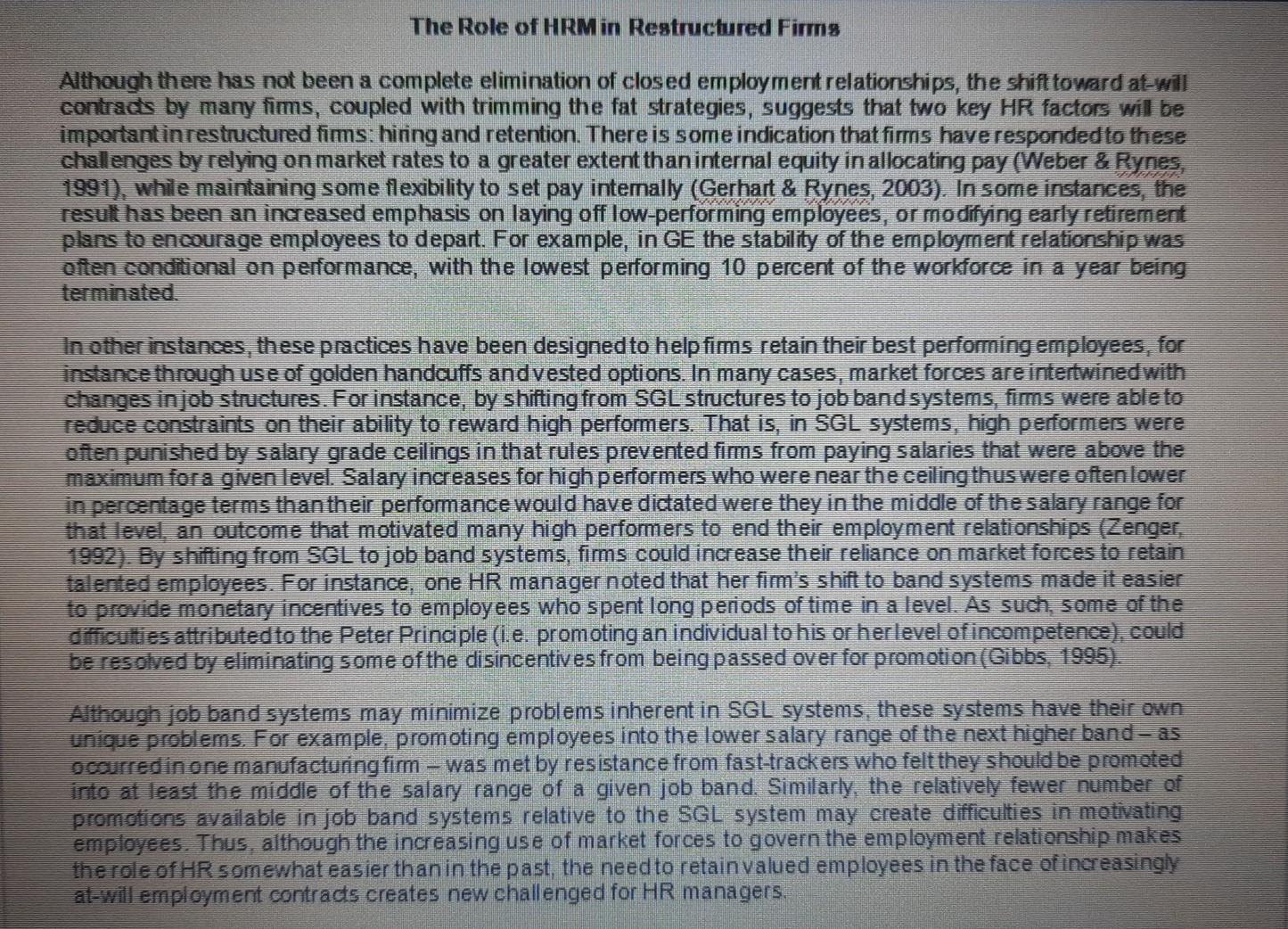
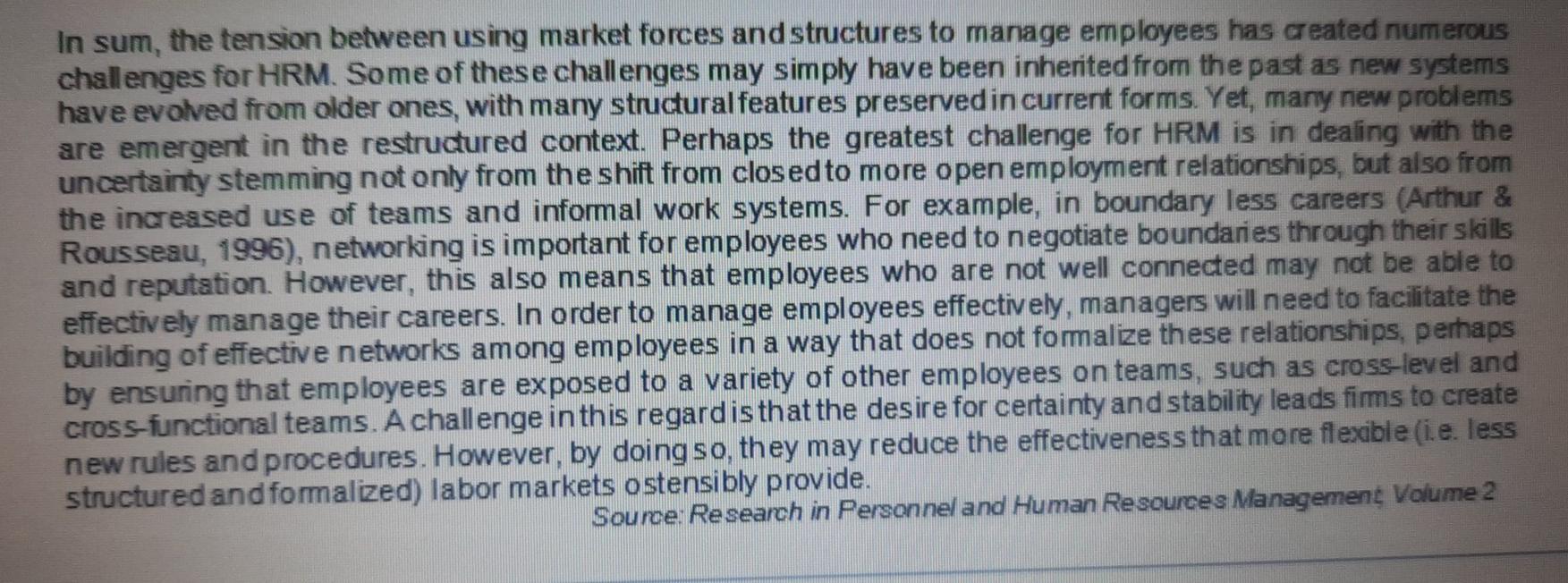
The Role of HRMin Restructured Fimmg Although there has not been a complete elimination of closed employment relationships, the shift toward at-will contracts by many fims, coupled with trimming the fat strategies, suggests that two key HR factors will be importantinrestructured fims: hiring and retention. There is some indication that firms have responded to these challenges by relying on market rates to a greater extent than internal equity in allocating pay (Weber & Rynes, 1991), while maintaining some flexibility to set pay intemally (Gerhart & Rynes, 2003). In some instances, the resut has been an increased emphasis on laying off low-performing employees, or modifying early retirement plans to encourage employees to depart. For example, in GE the stability of the employment relationship was often conditional on performance, with the lowest performing 10 percent of the workforce in a year being terminated In other instances, these practices have been designed to help fims retain their best performing employees, for instance through use of golden handauffs andvested options. In many cases, market forces are intertwined with changes injob structures. For instance, by shifting from SGL structures to job band systems, fims were able to reduce constraints on their ability to reward high performers. That is, in SGL systems, high performers were often punished by salary grade ceilings in that rules prevented firms from paying salaries that were above the maximum fora given level. Salary increases for high performers who were near the ceiling thus were often lower in percentage terms than their performance would have didated were they in the middle of the salary range for that level, an outcome that motivated many high performers to end their employment relationships (Zenger, 1992). By shifting from SGL to job band systems, firms could increase their reliance on market forces to retain talented employees. For instance, one HR manager noted that her firm's shift to band systems made it easier to provide monetary incentives to employees who spent long periods of time in a level. As such, some of the dificulties attributed to the Peter Principle (i.e. promoting an individual to his or herlevel of incompetence), could be resolved by eliminating some of the disincentives from being passed over for promotion (Gibbs, 1995). Although job band systems may minimize problems inherent in SGL systems, these systems have their own unique problems. For example, promoting employees into the lower salary range of the next higher band - as ocourred in one manufacturing fim was met by resistance from fast-trackers who felt they should be promoted into at least the middle of the salary range of a given job band. Similarly, the relatively fewer number of promotions available in job band systems relative to the SGL system may create difficulties in motivating employees. Thus, although the increasing use of market forces to govern the employment relationship makes the role of HR somewhat easier than in the past, the need to retain valued employees in the face of increasingly at-will employment contracts creates new challenged for HR managers. In sum, the tension between using market forces and structures to manage employees has created numerous challenges for HRM. Some of these challenges may simply have been inherited from the past as new systems have evolved from older ones, with many structural features preservedin current forms. Yet, many new problems are emergent in the restructured context. Perhaps the greatest challenge for HRM is in dealing with the uncertainty stemming not only from the shift from closed to more open employment relationships, but also from the increased use of teams and informal work systems. For example, in boundary less careers (Arthur & Rousseau, 1996), networking is important for employees who need to negotiate boundaries through their skills and reputation. However, this also means that employees who are not well connected may not be able to effectively manage their careers. In order to manage employees effectively, managers will need to facilitate the building of effective networks among employees in a way that does not formalize these relationships, perhaps by ensuring that employees are exposed to a variety of other employees on teams, such as cross-level and cross-functional teams. A challenge in this regard is that the desire for certainty and stability leads fims to create new rules and procedures. However, by doing so, they may reduce the effectiveness that more flexible (i.e. less structured and formalized) labor markets ostensibly provide. Source Research in Personnel and Human Resources Management Volume 2 Based on the situation given discuss three (3) three Human Resources Management issues, processes/ practices highlighted in this case. Justify your answer and provide relevant evidence for the stated point. (10 marks)
Step by Step Solution
There are 3 Steps involved in it
1 Expert Approved Answer
Step: 1 Unlock

Question Has Been Solved by an Expert!
Get step-by-step solutions from verified subject matter experts
Step: 2 Unlock
Step: 3 Unlock
 Study Help