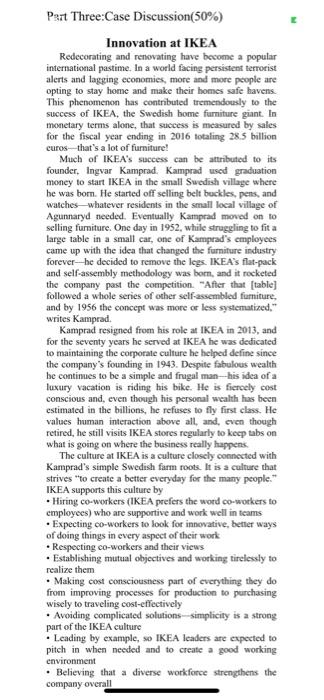
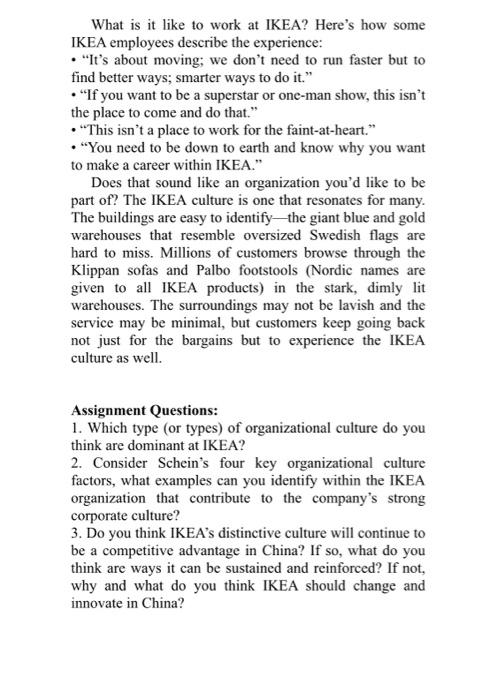
Question: Subject is leadership Please answer the question based on this case study 7:35 4 Part Throe:Case Thiscussion(505%) Innovation at IKEA Rudrcuttingive statiseud potsmetroche factng yeomuru
Subject is leadership
Please answer the question based on this case study
7:35 4 Part Throe:Case Thiscussion(505%) Innovation at IKEA Rudrcuttingive statiseud potsmetroche factng yeomuru alors and lagging ping This phe people an and h sayo and make the has contid endly de of DREASud ete fortune maturis Ficaleerenda in 2016 25 ' Mach of IKEA's son le bed. undet va AntS br e iatiel of alling fet hilodon watches-whatever is in alle of Agary code Exemally Kengal mal w selling Samuture. Oue dry am 1902 Large: able of cof faml conec up with the idoe ful churged intere fianteari-be dociol to actene the pegs and bly methodology was hom, and it c whederation of oldors a andby 1956mitt writes Kamprad dm for the levity yoaste he to-maintaining the poo dic coepany" retl Dheipitu her coetituteacx ter be a oleanlad luxurycans riding beyon DC and cilp Ban t Certiemnathod in thie blams he rstauz to dy fine cdax tie ale nation av all, and though Apah ntatin gong o iethinie the harscapsa The cultura IKEA cut cloty with strings"o cninate abure IKEA port this cute by (cupdaysiens) atho sir suppontan oor Respecting and devien Eattiling woadkvcifuoms e Making coc part of everything they d prolaipockaling wisely to traveling only Aviding completed in pt of the IKEA Lendingbalea in whened and we good waking Beiering has Whet.ib a Skc bor rock. IAamts ben IKEA employees +0 find better ways, Wywaret superstar or one-man s and de the place This place to work for the faint ou tood to be doeto cuth ade E too tfhort eyedke on wation oedeterfe The IKEA is a The boldinpamc conder a Mie omnm he Kippan enta and radhe tombstach thutem= a IKEA poducts danby te watthousar. The so fh an sury behoucp tjas for the bargai hat to experience the LA w Avigament Que 2With topo (or typo amude Scion, what cumpl organization du cobey's ming ? E eChe lk are mitys it carbtate and shar rpiin oev ((. . Part Three:Case Discussion (50%) Innovation at IKEA Redecorating and renovating have become a popular international pastime. In a world facing persistent terrorist alerts and lagging economies, more and more people are opting to stay home and make their homes safe havens. This phenomenon has contributed tremendously to the success of IKEA, the Swedish home furniture giant. In monetary terms alone, that success is measured by sales for the fiscal year ending in 2016 totaling 28.5 billion curos-that's a lot of furniture! Much of IKEA's success can be attributed to its founder, Ingvar Kamprad. Kamprad used graduation money to start IKEA in the small Swedish village where he was born. He started off selling belt buckles, pens, and watches-whatever residents in the small local village of Agunnaryd needed. Eventually Kamprad moved on to selling furniture. One day in 1952, while struggling to fit a large table in a small car, one of Kamprad's employees came up with the idea that changed the furniture industry forever-he decided to remove the legs. IKEA's flat-pack and self-assembly methodology was born, and it rocketed the company past the competition. "After that [table] followed a whole series of other self-assembled furniture, and by 1956 the concept was more or less systematized." writes Kamprad. Kamprad resigned from his role at IKEA in 2013, and for the seventy years he served at IKEA he was dedicated to maintaining the corporate culture he helped define since the company's founding in 1943. Despite fabulous wealth he continues to be a simple and frugal man-his idea of a luxury vacation is riding his bike. He is fiercely cost conscious and, even though his personal wealth has been estimated in the billions, he refuses to fly first class. He values human interaction above all, and, even though retired, he still visits IKEA stores regularly to keep tabs on what is going on where the business really happens. The culture at IKEA is a culture closely connected with Kamprad's simple Swedish farm roots. It is a culture that strives to create a better everyday for the many people." IKEA supports this culture by Hiring co-workers (IKEA prefers the word co-workers to employees) who are supportive and work well in teams Expecting co-workers to look for innovative, better ways of doing things in every aspect of their work Respecting co-workers and their views Establishing mutual objectives and working tirelessly to realize them Making cost consciousness part of everything they do from improving processes for production to purchasing wisely to traveling cost-effectively Avoiding complicated solutions-simplicity is a strong part of the IKEA culture Leading by example, so IKEA leaders are expected to pitch in when needed and to create a good working environment Believing that a diverse workforce strengthens the company overall What is it like to work at IKEA? Here's how some IKEA employees describe the experience: "It's about moving; we don't need to run faster but to find better ways; smarter ways to do it." "If you want to be a superstar or one-man show, this isn't the place to come and do that." "This isn't a place to work for the faint-at-heart." "You need to be down to earth and know why you want to make a career within IKEA." Does that sound like an organization you'd like to be part of? The IKEA culture is one that resonates for many. The buildings are easy to identify the giant blue and gold warehouses that resemble oversized Swedish flags are hard to miss. Millions of customers browse through the Klippan sofas and Palbo footstools (Nordic names are given to all IKEA products) in the stark, dimly lit warehouses. The surroundings may not be lavish and the service may be minimal, but customers keep going back not just for the bargains but to experience the IKEA culture as well. Assignment Questions: 1. Which type (or types) of organizational culture do you think are dominant at IKEA? 2. Consider Schein's four key organizational culture factors, what examples can you identify within the IKEA organization that contribute to the company's strong corporate culture? 3. Do you think IKEA's distinctive culture will continue to be a competitive advantage in China? If so, what do you think are ways it can be sustained and reinforced? If not, why and what do you think IKEA should change and innovate in China