







Question: subject is survey sampling answer e and f and this the information which we have In the problem of estimating total hospitalization costs for kidney
subject is survey sampling 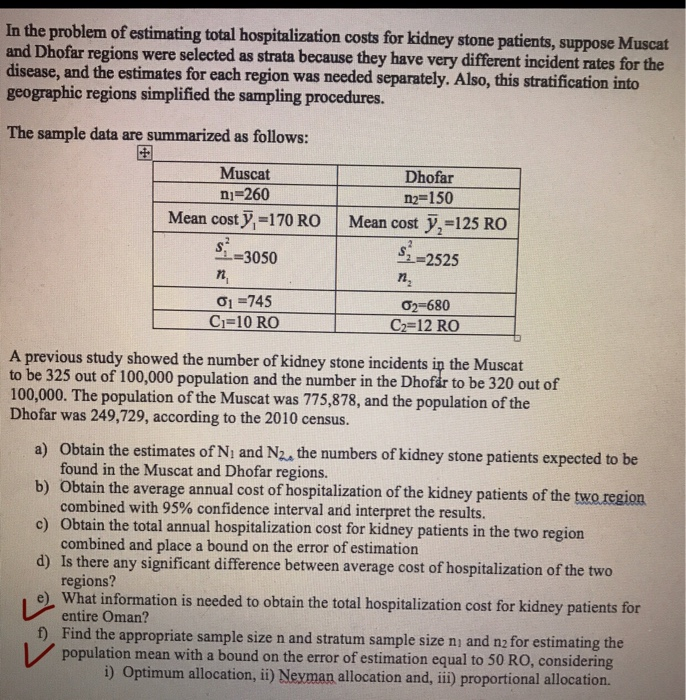
answer e and f and this the information which we have 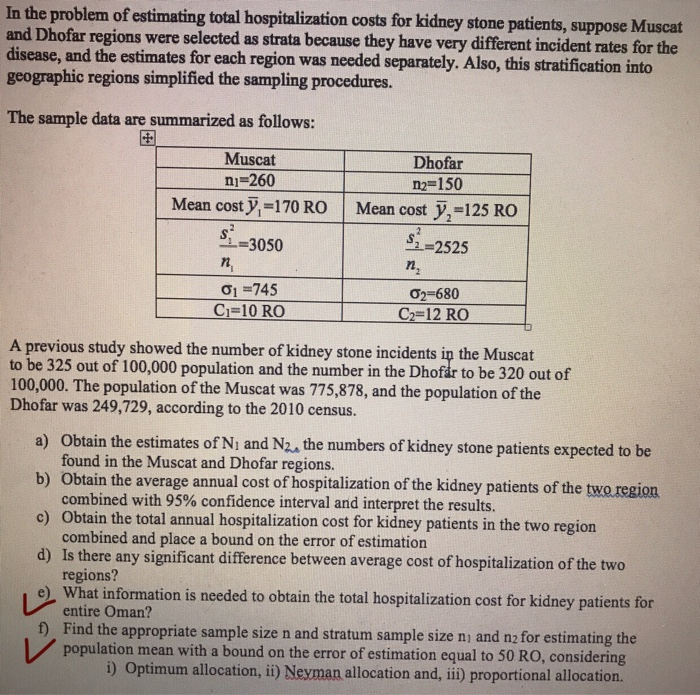
In the problem of estimating total hospitalization costs for kidney stone patients, suppose Muscat and Dhofar regions were selected as strata because they have very different incident rates for the disease, and the estimates for each region was needed separately. Also, this stratification into geographic regions simplified the sampling procedures. The sample data are summarized as follows: Dhofar n2=150 Mean cost y =125 RO Muscat ni=260 Mean cost 7,=170 RO s 1=3050 n 01 =745 Ci=10 RO S; -2525 n, 02=680 Cz=12 RO A previous study showed the number of kidney stone incidents in the Muscat to be 325 out of 100,000 population and the number in the Dhofar to be 320 out of 100,000. The population of the Muscat was 775,878, and the population of the Dhofar was 249,729, according to the 2010 census. a) Obtain the estimates of N, and N2, the numbers of kidney stone patients expected to be found in the Muscat and Dhofar regions. b) Obtain the average annual cost of hospitalization of the kidney patients of the two region combined with 95% confidence interval and interpret the results. c) Obtain the total annual hospitalization cost for kidney patients in the two region combined and place a bound on the error of estimation d) Is there any significant difference between average cost of hospitalization of the two regions? What information is needed to obtain the total hospitalization cost for kidney patients for entire Oman? f) Find the appropriate sample size n and stratum sample size ni and nz for estimating the V population mean with a bound on the error of estimation equal to 50 RO, considering i) Optimum allocation, ii) Neyman allocation and, iii) proportional allocation. In the problem of estimating total hospitalization costs for kidney stone patients, suppose Muscat and Dhofar regions were selected as strata because they have very different incident rates for the disease, and the estimates for each region was needed separately. Also, this stratification into geographic regions simplified the sampling procedures. The sample data are summarized as follows: Dhofar n2=150 Muscat ni=260 Mean cost y =170 RO $ =3050 n 01 =745 Cy=10 RO Mean cost y =125 RO $1 =2525 n, 02-680 C2=12 RO A previous study showed the number of kidney stone incidents in the Muscat to be 325 out of 100,000 population and the number in the Dhofar to be 320 out of 100,000. The population of the Muscat was 775,878, and the population of the Dhofar was 249,729, according to the 2010 census. a) Obtain the estimates of N, and N2. the numbers of kidney stone patients expected to be found in the Muscat and Dhofar regions. b) Obtain the average annual cost of hospitalization of the kidney patients of the two region combined with 95% confidence interval and interpret the results. c) Obtain the total annual hospitalization cost for kidney patients in the two region combined and place a bound on the error of estimation d) Is there any significant difference between average cost of hospitalization of the two regions? What information is needed to obtain the total hospitalization cost for kidney patients for entire Oman? f) Find the appropriate sample size n and stratum sample size ni and nz for estimating the V population mean with a bound on the error of estimation equal to 50 RO, considering i) Optimum allocation, ii) Neyman allocation and, iii) proportional allocation. In the problem of estimating total hospitalization costs for kidney stone patients, suppose Muscat and Dhofar regions were selected as strata because they have very different incident rates for the disease, and the estimates for each region was needed separately. Also, this stratification into geographic regions simplified the sampling procedures. The sample data are summarized as follows: Dhofar n2=150 Mean cost y =125 RO Muscat ni=260 Mean cost 7,=170 RO s 1=3050 n 01 =745 Ci=10 RO S; -2525 n, 02=680 Cz=12 RO A previous study showed the number of kidney stone incidents in the Muscat to be 325 out of 100,000 population and the number in the Dhofar to be 320 out of 100,000. The population of the Muscat was 775,878, and the population of the Dhofar was 249,729, according to the 2010 census. a) Obtain the estimates of N, and N2, the numbers of kidney stone patients expected to be found in the Muscat and Dhofar regions. b) Obtain the average annual cost of hospitalization of the kidney patients of the two region combined with 95% confidence interval and interpret the results. c) Obtain the total annual hospitalization cost for kidney patients in the two region combined and place a bound on the error of estimation d) Is there any significant difference between average cost of hospitalization of the two regions? What information is needed to obtain the total hospitalization cost for kidney patients for entire Oman? f) Find the appropriate sample size n and stratum sample size ni and nz for estimating the V population mean with a bound on the error of estimation equal to 50 RO, considering i) Optimum allocation, ii) Neyman allocation and, iii) proportional allocation. In the problem of estimating total hospitalization costs for kidney stone patients, suppose Muscat and Dhofar regions were selected as strata because they have very different incident rates for the disease, and the estimates for each region was needed separately. Also, this stratification into geographic regions simplified the sampling procedures. The sample data are summarized as follows: Dhofar n2=150 Muscat ni=260 Mean cost y =170 RO $ =3050 n 01 =745 Cy=10 RO Mean cost y =125 RO $1 =2525 n, 02-680 C2=12 RO A previous study showed the number of kidney stone incidents in the Muscat to be 325 out of 100,000 population and the number in the Dhofar to be 320 out of 100,000. The population of the Muscat was 775,878, and the population of the Dhofar was 249,729, according to the 2010 census. a) Obtain the estimates of N, and N2. the numbers of kidney stone patients expected to be found in the Muscat and Dhofar regions. b) Obtain the average annual cost of hospitalization of the kidney patients of the two region combined with 95% confidence interval and interpret the results. c) Obtain the total annual hospitalization cost for kidney patients in the two region combined and place a bound on the error of estimation d) Is there any significant difference between average cost of hospitalization of the two regions? What information is needed to obtain the total hospitalization cost for kidney patients for entire Oman? f) Find the appropriate sample size n and stratum sample size ni and nz for estimating the V population mean with a bound on the error of estimation equal to 50 RO, considering i) Optimum allocation, ii) Neyman allocation and, iii) proportional allocation
Step by Step Solution
There are 3 Steps involved in it
1 Expert Approved Answer
Step: 1 Unlock

Question Has Been Solved by an Expert!
Get step-by-step solutions from verified subject matter experts
Step: 2 Unlock
Step: 3 Unlock
 Study Help