



Question: subject : material balance ( question need to use aspen also) solution must have Flow sheet, stream input, results, graphs and stream summary and manual
subject : material balance ( question need to use aspen also) solution must have Flow sheet, stream input, results, graphs and stream summary and manual calculation
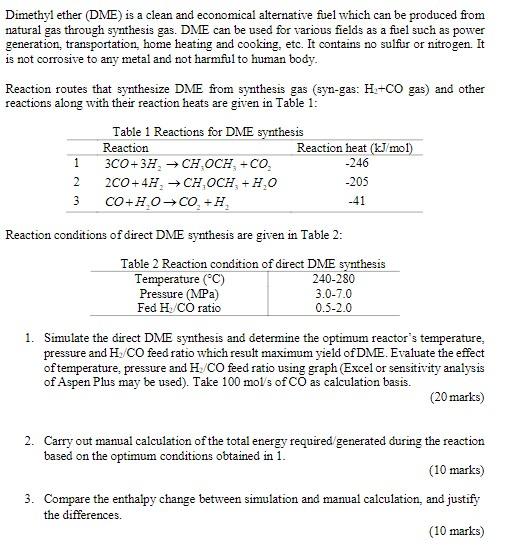
Dimethyl ether (DME) is a clean and economical alternative fuel which can be produced from natural gas through synthesis gas. DME can be used for various fields as a fuel such as power generation, transportation home heating and cooking, etc. It contains no sulfur or nitrogen. It is not corrosive to any metal and not harmful to human body. Reaction routes that synthesize DME from synthesis gas (syn-gas: H.-Co gas) and other reactions along with their reaction heats are given in Table 1: Table 1 Reactions for DME synthesis Reaction heat (kJ/mo1) 3C0+3H CHOCH + CO. -246 200+4H CHOCH, +HO -205 3 CO+HOCO+H -41 Reaction 1 2 + - Reaction conditions of direct DME synthesis are given in Table 2: Table 2 Reaction condition of direct DME synthesis Temperature (C) 240-280 Pressure (MPa) 3.0-7.0 Fed H/CO ratio 0.5-2.0 1. Simulate the direct DME synthesis and determine the optimum reactor's temperature, pressure and H. CO feed ratio which result maximum yield of DME. Evaluate the effect oftemperature, pressure and H/CO feed ratio using graph (Excel or sensitivity analysis of Aspen Plus may be used). Take 100 mois of Co as calculation basis. (20 marks) 2. Carry out manual calculation of the total energy required generated during the reaction based on the optimum conditions obtained in 1. (10 marks) 3. Compare the enthalpy change between simulation and manual calculation, and justify the differences. (10 marks) Dimethyl ether (DME) is a clean and economical alternative fuel which can be produced from natural gas through synthesis gas. DME can be used for various fields as a fuel such as power generation, transportation home heating and cooking, etc. It contains no sulfur or nitrogen. It is not corrosive to any metal and not harmful to human body. Reaction routes that synthesize DME from synthesis gas (syn-gas: H.-Co gas) and other reactions along with their reaction heats are given in Table 1: Table 1 Reactions for DME synthesis Reaction heat (kJ/mo1) 3C0+3H CHOCH + CO. -246 200+4H CHOCH, +HO -205 3 CO+HOCO+H -41 Reaction 1 2 + - Reaction conditions of direct DME synthesis are given in Table 2: Table 2 Reaction condition of direct DME synthesis Temperature (C) 240-280 Pressure (MPa) 3.0-7.0 Fed H/CO ratio 0.5-2.0 1. Simulate the direct DME synthesis and determine the optimum reactor's temperature, pressure and H. CO feed ratio which result maximum yield of DME. Evaluate the effect oftemperature, pressure and H/CO feed ratio using graph (Excel or sensitivity analysis of Aspen Plus may be used). Take 100 mois of Co as calculation basis. (20 marks) 2. Carry out manual calculation of the total energy required generated during the reaction based on the optimum conditions obtained in 1. (10 marks) 3. Compare the enthalpy change between simulation and manual calculation, and justify the differences. (10 marks)
Step by Step Solution
There are 3 Steps involved in it

Get step-by-step solutions from verified subject matter experts