







Question: Subject name is knowledge management Answer the following questions based on the Unilever Case Study. 1 What advice would you give Cathy Bautista on improving
Subject name is knowledge management
Answer the following questions based on the Unilever Case Study.
1 What advice would you give Cathy Bautista on improving the strategic focus of Unilevers knowledge management activities?
2 What changes, if any, would you make to Unilevers communities of practice?
3 How could learning histories be further developed to capture organizational memory?
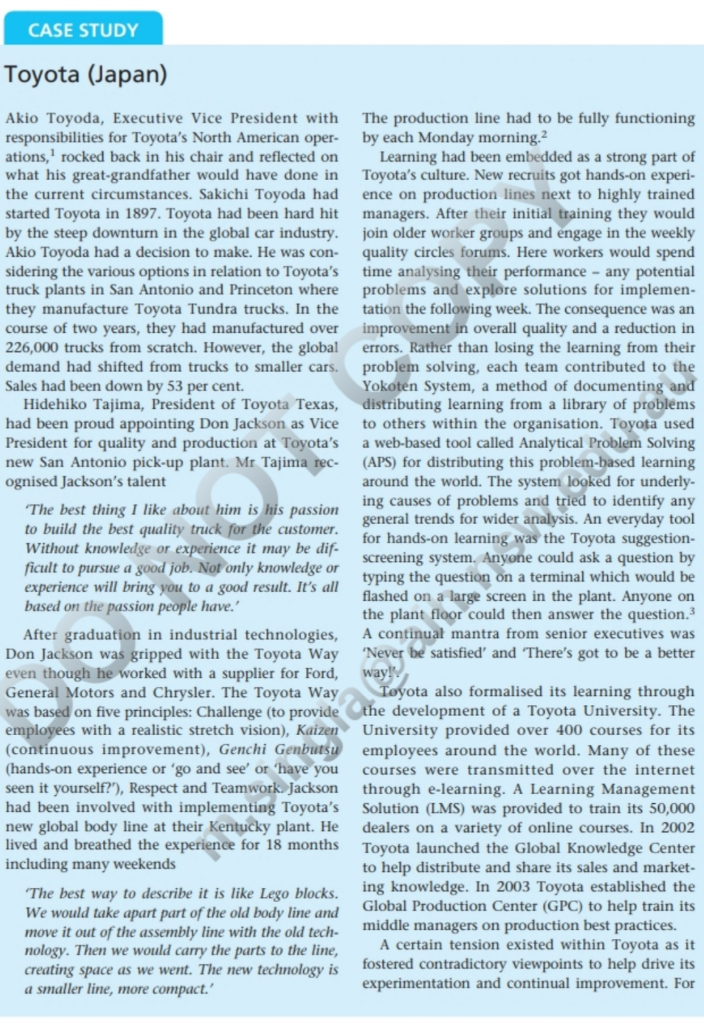
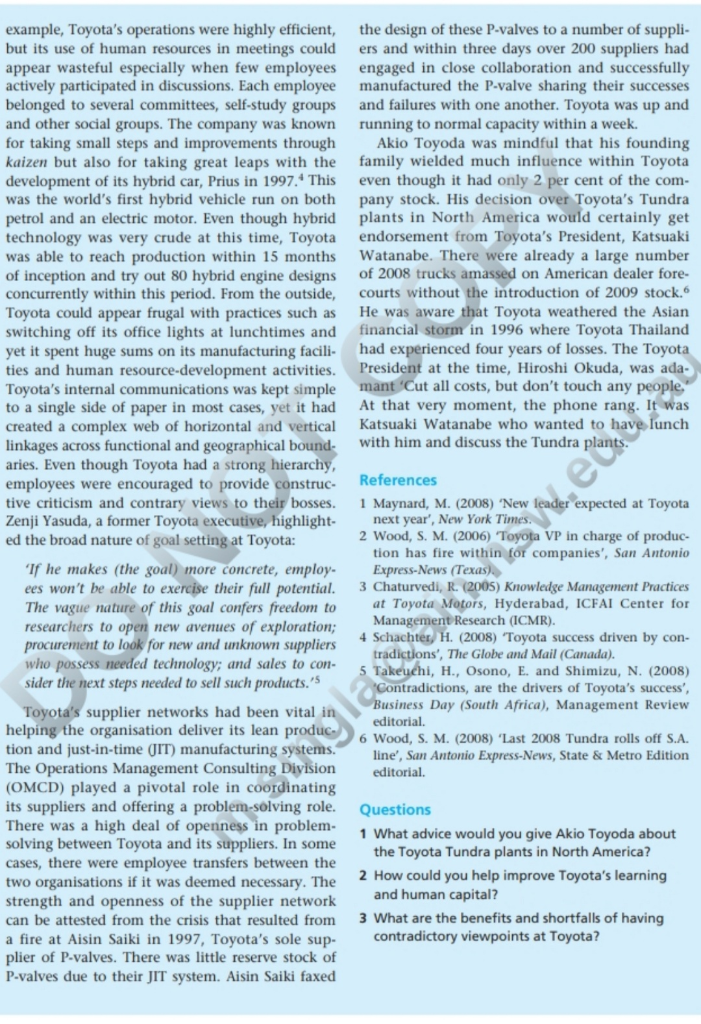
CASE STUDY Toyota (Japan) Akio Toyoda, Executive Vice President with The production line had to be fully functioning responsibilities for Toyota's North American oper by each Monday morning. ations, rocked back in his chair and reflected on Learning had been embedded as a strong part of what his great-grandfather would have done in Toyota's culture. New recruits got hands-on experi- the current circumstances. Sakichi Toyoda had ence on production lines next to highly trained started Toyota in 1897. Toyota had been hard hit managers. After their initial training they would by the steep downturn in the global car industry. join older worker groups and engage in the weekly Akio Toyoda had a decision to make. He was con quality circles forums. Here workers would spend sidering the various options in relation to Toyota's time analysing their performance - any potential truck plants in San Antonio and Princeton where problems and explore solutions for implemen- they manufacture Toyota Tundra trucks. In the tation the following week. The consequence was an course of two years, they had manufactured over improvement in overall quality and a reduction in 226,000 trucks from scratch. However, the global errors. Rather than losing the learning from their demand had shifted from trucks to smaller cars. problem solving, each team contributed to the Sales had been down by 53 per cent. Yokoten System, a method of documenting and Hidehiko Tajima, President of Toyota Texas, distributing learning from a library of problems had been proud appointing Don Jackson as Vice to others within the organisation. Toyota used President for quality and production at Toyota's a web-based tool called Analytical Problem Solving new San Antonio pick-up plant. Mr Tajima rec (APS) for distributing this problem-based learning ognised Jackson's talent around the world. The system looked for underly- The best thing I like about him is his passion ing causes of problems and tried to identify any general trends for wider analysis. An everyday tool to build the best quality truck for the customer. for hands-on learning was the Toyota suggestion- Without knowledge or experience it may be dif- ficult to pursue a good job. Not only knowledge or screening system. Anyone could ask a question by typing the question on a terminal which would be experience will bring you to a good result. It's all based on the passion people have.' flashed on a large screen in the plant. Anyone on the plant floor could then answer the question.3 After graduation in industrial technologies, A continual mantra from senior executives was Don Jackson was gripped with the Toyota Way Never be satisfied' and 'There's got to be a better even though he worked with a supplier for Ford, way! General Motors and Chrysler. The Toyota Way Toyota also formalised its learning through was based on five principles: Challenge (to provide the development of a Toyota University. The employees with a realistic stretch vision), Kaizen University provided over 400 courses for its (continuous improvement), Genchi Genbutsu employees around the world. Many of these (hands-on experience or 'go and see' or 'have you courses were transmitted over the internet seen it yourself?"), Respect and Teamwork. Jackson through e-learning. A Learning Management had been involved with implementing Toyota's Solution (LMS) was provided to train its 50,000 new global body line at their Kentucky plant. He dealers on a variety of online courses. In 2002 lived and breathed the experience for 18 months Toyota launched the Global Knowledge Center including many weekends to help distribute and share its sales and market- The best way to describe it is like Lego blocks. ing knowledge. In 2003 Toyota established the We would take apart part of the old body line and Global Production Center (GPC) to help train its move it out of the assembly line with the old tech- middle managers on production best practices. nology. Then we would carry the parts to the line, A certain tension existed within Toyota as it creating space as we went. The new technology is fostered contradictory viewpoints to help drive its a smaller line, more compact.' experimentation and continual improvement. For example, Toyota's operations were highly efficient, the design of these P-valves to a number of suppli- but its use of human resources in meetings could ers and within three days over 200 suppliers had appear wasteful especially when few employees engaged in close collaboration and successfully actively participated in discussions. Each employee manufactured the P-valve sharing their successes belonged to several committees, self-study groups and failures with one another. Toyota was up and and other social groups. The company was known running to normal capacity within a week. for taking small steps and improvements through Akio Toyoda was mindful that his founding kaizen but also for taking great leaps with the family wielded much influence within Toyota development of its hybrid car, Prius in 1997. This even though it had only 2 per cent of the com- was the world's first hybrid vehicle run on both pany stock. His decision over Toyota's Tundra petrol and an electric motor. Even though hybrid plants in North America would certainly get technology was very crude at this time, Toyota endorsement from Toyota's President, Katsuaki was able to reach production within 15 months Watanabe. There were already a large number of inception and try out 80 hybrid engine designs of 2008 trucks amassed on American dealer fore- concurrently within this period. From the outside, courts without the introduction of 2009 stock.6 Toyota could appear frugal with practices such as He was aware that Toyota weathered the Asian switching off its office lights at lunchtimes and financial storm in 1996 where Toyota Thailand yet it spent huge sums on its manufacturing facili had experienced four years of losses. The Toyota ties and human resource-development activities. President at the time, Hiroshi Okuda, was ada- Toyota's internal communications was kept simple mant 'Cut all costs, but don't touch any people." to a single side of paper in most cases, yet it had At that very moment, the phone rang. It was created a complex web of horizontal and vertical Katsuaki Watanabe who wanted to have lunch linkages across functional and geographical bound- with him and discuss the Tundra plants. aries. Even though Toyota had a strong hierarchy, employees were encouraged to provide construc References tive criticism and contrary views to their bosses. 1 Maynard, M. (2008) 'New leader expected at Toyota Zenji Yasuda, a former Toyota executive, highlight next year', New York Times. ed the broad nature of goal setting at Toyota: 2 Wood, S. M. (2006) Toyota VP in charge of produc- tion has fire within for companies', San Antonio 'If he makes (the goal) more concrete, employ Express-News (Texas). ees won't be able to exercise their full potential. 3 Chaturvedi, R. (2005) Knowledge Management Practices The vague nature of this goal confers freedom to at Toyota Motors, Hyderabad, ICFAI Center for researchers to open new avenues of exploration; Management Research (ICMR). procurement to look for new and unknown suppliers 4 Schachter, H. (2008) Toyota success driven by con- tradictions', The Globe and Mail (Canada). who possess needed technology, and sales to con 5 Takeuchi, H., Osono, E. and Shimizu, N. (2008) sider the next steps needed to sell such products.'s Contradictions, are the drivers of Toyota's success', Toyota's supplier networks had been vital in Business Day (South Africa), Management Review editorial helping the organisation deliver its lean produc. 6 Wood, S. M. (2008) 'Last 2008 Tundra rolls off S.A. tion and just-in-time (JIT) manufacturing systems. line', San Antonio Express News, State & Metro Edition The Operations Management Consulting Division editorial (OMCD) played a pivotal role in coordinating its suppliers and offering a problem-solving role. Questions There was a high deal of openness in problem- 1 What advice would you give Akio Toyoda about solving between Toyota and its suppliers. In some the Toyota Tundra plants in North America? cases, there were employee transfers between the two organisations if it was deemed necessary. The 2 How could you help improve Toyota's learning strength and openness of the supplier network and human capital? can be attested from the crisis that resulted from 3 What are the benefits and shortfalls of having a fire at Aisin Saiki in 1997, Toyota's sole sup contradictory viewpoints at Toyota? plier of P-valves. There was little reserve stock of P-valves due to their JIT system. Aisin Saiki faxedStep by Step Solution
There are 3 Steps involved in it
1 Expert Approved Answer
Step: 1 Unlock

Question Has Been Solved by an Expert!
Get step-by-step solutions from verified subject matter experts
Step: 2 Unlock
Step: 3 Unlock
 Study Help