







Question: subject name is knowledge management in this case study give three qustion in last i need that three answers CASE STUDY Ernst & Young (US)
subject name is knowledge management
in this case study give three qustion in last i need that three answers
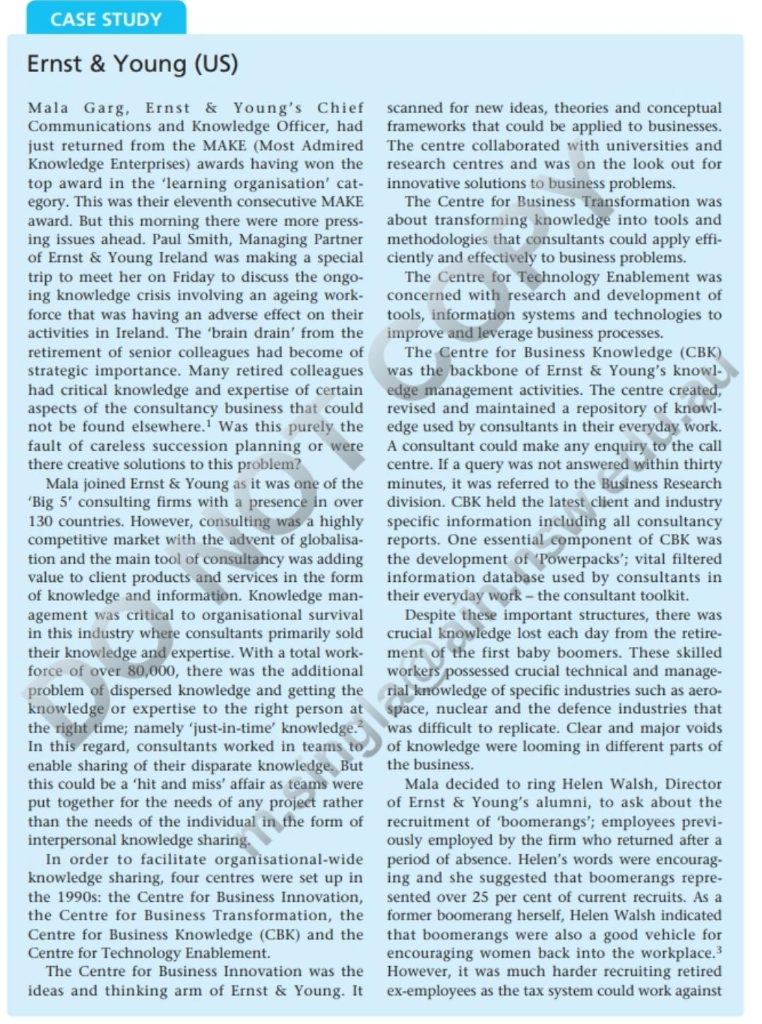
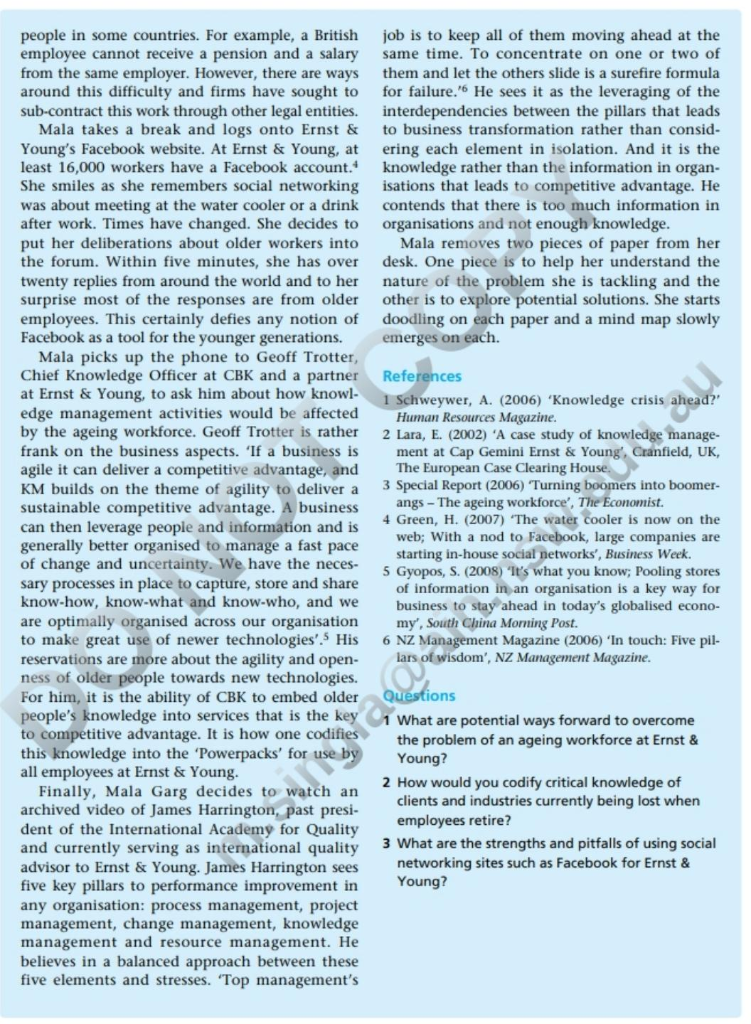
CASE STUDY Ernst & Young (US) Mala Garg, Ernst & Young's Chief scanned for new ideas, theories and conceptual Communications and knowledge Officer, had frameworks that could be applied to businesses. just returned from the MAKE (Most Admired The centre collaborated with universities and Knowledge Enterprises) awards having won the research centres and was on the look out for top award in the 'learning organisation' cat innovative solutions to business problems. egory. This was their eleventh consecutive MAKE The Centre for Business Transformation was award. But this morning there were more press about transforming knowledge into tools and ing issues ahead. Paul Smith, Managing Partner methodologies that consultants could apply effi- of Ernst & Young Ireland was making a special ciently and effectively to business problems. trip to meet her on Friday to discuss the ongo The Centre for Technology Enablement was ing knowledge crisis involving an ageing work concerned with research and development of force that was having an adverse effect on their tools, information systems and technologies to activities in Ireland. The 'brain drain' from the improve and leverage business processes. retirement of senior colleagues had become of The Centre for Business Knowledge (CBK) strategic importance. Many retired colleagues was the backbone of Ernst & Young's knowl- had critical knowledge and expertise of certain edge management activities. The centre created, aspects of the consultancy business that could revised and maintained a repository of knowl- not be found elsewhere. Was this purely the edge used by consultants in their everyday work. fault of careless succession planning or were A consultant could make any enquiry to the call there creative solutions to this problem? centre. If a query was not answered within thirty Mala joined Ernst & Young as it was one of the minutes, it was referred to the Business Research 'Big 5' consulting firms with a presence in over division. CBK held the latest client and industry 130 countries. However, consulting was a highly specific information including all consultancy competitive market with the advent of globalisa reports. One essential component of CBK was tion and the main tool of consultancy was adding the development of Powerpacks'; vital filtered value to client products and services in the form information database used by consultants in of knowledge and information. Knowledge man their everyday work - the consultant toolkit. agement was critical to organisational survival Despite these important structures, there was in this industry where consultants primarily sold crucial knowledge lost each day from the retire- their knowledge and expertise. With a total work ment of the first baby boomers. These skilled force of over 80,000, there was the additional workers possessed crucial technical and manage- problem of dispersed knowledge and getting the rial knowledge of specific industries such as aero- knowledge or expertise to the right person at space, nuclear and the defence industries that the right time; namely 'just-in-time' knowledge. was difficult to replicate. Clear and major voids In this regard, consultants worked in teams of knowledge were looming in different parts of enable sharing of their disparate knowledge. But the business. this could be a 'hit and miss' affair as teams were Mala decided to ring Helen Walsh, Director put together for the needs of any project rather of Ernst & Young's alumni, to ask about the than the needs of the individual in the form of recruitment of 'boomerangs'; employees previ. interpersonal knowledge sharing. ously employed by the firm who returned after a In order to facilitate organisational-wide period of absence. Helen's words were encourag- knowledge sharing, four centres were set up in ing and she suggested that boomerangs repre- the 1990s: the Centre for Business Innovation, sented over 25 per cent of current recruits. As a the Centre for Business Transformation, the former boomerang herself, Helen Walsh indicated Centre for Business Knowledge (CBK) and the that boomerangs were also a good vehicle for Centre for Technology Enablement. encouraging women back into the workplace.3 The Centre for Business Innovation was the However, it was much harder recruiting retired ideas and thinking arm of Ernst & Young. It ex-employees as the tax system could work against job is to keep all of them moving ahead at the same time. To concentrate on one or two of them and let the others slide is a surefire formula for failure.' He sees it as the leveraging of the interdependencies between the pillars that leads to business transformation rather than consid- ering each element in isolation. And it is the knowledge rather than the information in organ- isations that leads to competitive advantage. He contends that there is too much information in organisations and not enough knowledge. Mala removes two pieces of paper from her desk. One piece is to help her understand the nature of the problem she is tackling and the other is to explore potential solutions. She starts doodling on each paper and a mind map slowly emerges on each. people in some countries. For example, a British employee cannot receive a pension and a salary from the same employer. However, there are ways around this difficulty and firms have sought to sub-contract this work through other legal entities. Mala takes a break and logs onto Ernst & Young's Facebook website. At Ernst & Young, at least 16,000 workers have a Facebook account. She smiles as she remembers social networking was about meeting at the water cooler or a drink after work. Times have changed. She decides to put her deliberations about older workers into the forum. Within five minutes, she has over twenty replies from around the world and to her surprise most of the responses are from older employees. This certainly defies any notion of Facebook as a tool for the younger generations. Mala picks up the phone to Geoff Trotter, Chief Knowledge Officer at CBK and a partner at Ernst & Young, to ask him about how knowl- edge management activities would be affected by the ageing workforce. Geoff Trotter is rather frank on the business aspects. 'If a business is agile it can deliver a competitive advantage, and KM builds on the theme of agility to deliver a sustainable competitive advantage. A business can then leverage people and information and is generally better organised to manage a fast pace of change and uncertainty. We have the neces- sary processes in place to capture, store and share know-how, know-what and know-who, and we are optimally organised across our organisation to make great use of newer technologies'. His reservations are more about the agility and open- ness of older people towards new technologies. For him, it is the ability of CBK to embed older people's knowledge into services that is the key to competitive advantage. It is how one codifies this knowledge into the 'Powerpacks' for use by all employees at Ernst & Young. Finally, Mala Garg decides to watch an archived video of James Harrington, past presi- dent of the International Academy for Quality and currently serving as international quality advisor to Ernst & Young. James Harrington sees five key pillars to performance improvement in any organisation: process management, project management, change management, knowledge management and resource management. He believes in a balanced approach between these five elements and stresses. 'Top management's References 1 Schweywer, A. (2006) 'Knowledge crisis ahead?' Human Resources Magazine 2 Lara, E. (2002) 'A case study of knowledge manage- ment at Cap Gemini Ernst & Young'. Cranfield, UK, The European Case Clearing House, 3 Special Report (2006) Turning boomers into boomer- angs - The ageing workforce', The Economist. 4 Green, H. (2007) 'The water cooler is now on the web; With a nod to Facebook, large companies are starting in-house social networks', Business Week 5 Gyopos, S. (2008) 'It's what you know; Pooling stores of information in an organisation is a key way for business to stay ahead in today's globalised econo- my', South China Morning Post. 6 NZ Management Magazine (2006) 'In touch: Five pil- lars of wisdom', NZ Management Magazine. uestions What are potential ways forward to overcome the problem of an ageing workforce at Ernst & Young? 2 How would you codify critical knowledge of clients and industries currently being lost when employees retire? 3 What are the strengths and pitfalls of using social networking sites such as Facebook for Ernst & Young
Step by Step Solution
There are 3 Steps involved in it
1 Expert Approved Answer
Step: 1 Unlock

Question Has Been Solved by an Expert!
Get step-by-step solutions from verified subject matter experts
Step: 2 Unlock
Step: 3 Unlock
 Study Help